





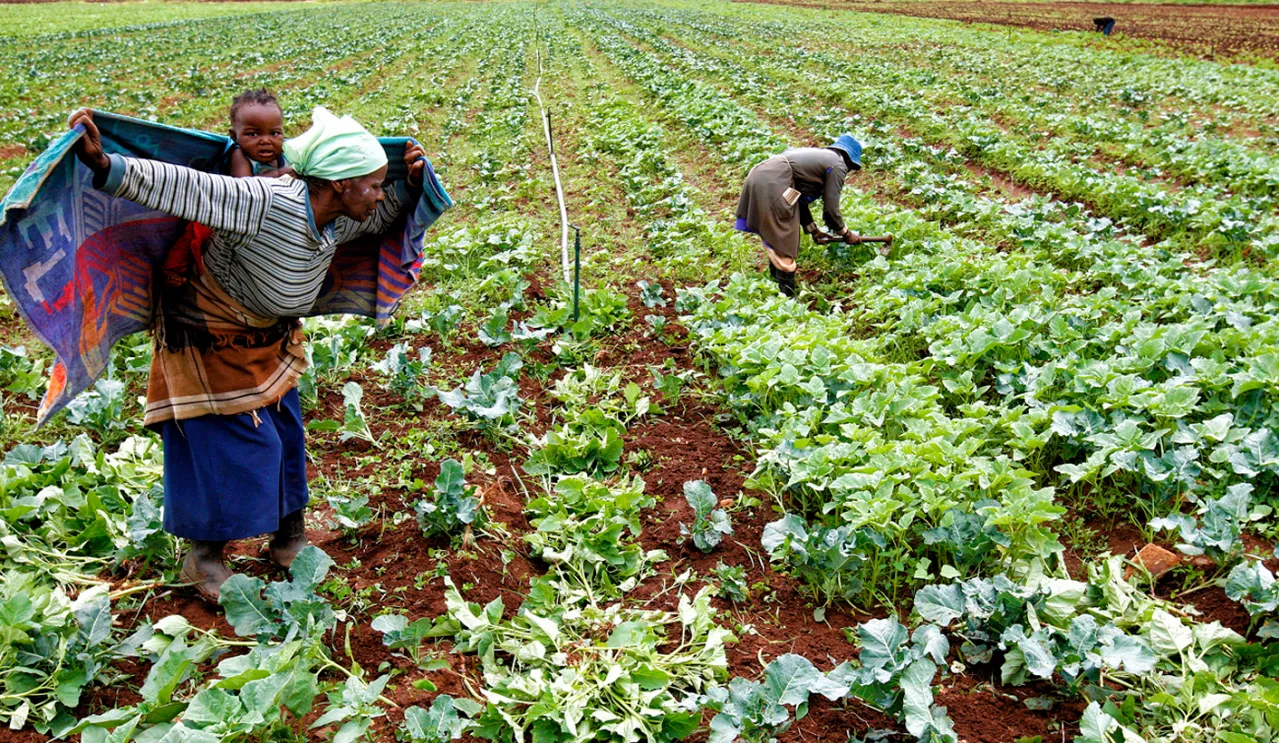
 South African agriculture does not need to choose between competitiveness and inclusion. It needs a growth path that delivers both. (Photo: Reuters / Siphiwe Sibeko)
 South Africa’s agricultural sector is often described as a quiet success story. Over the past three decades, it has more than doubled in real terms, built globally competitive export industries and established itself as a reliable supplier to markets across Europe, Asia, and the rest of Africa.
From citrus and wine to nuts and livestock, the sector has shown resilience in the face of climate shocks, rising costs and logistical challenges.
Yet beneath this success lies a more uncomfortable reality. Agriculture has grown – but it has not created jobs at the scale South Africa needs. Nor has it drawn most rural South Africans into its orbit of opportunity.
This is the central contradiction: strong growth and competitiveness on the one hand, limited inclusion and employment on the other.
A tale of two agricultures
South Africa’s agricultural structure remains deeply unequal. A small number of large, commercial farms dominate production, income and exports. These farms are highly productive, well capitalised and integrated into global value chains.
At the same time, many South Africans engage in agriculture in a very different way. These are smallholder and subsistence farmers – often in former homeland areas – who produce mainly for household consumption, with limited access to markets, finance or technology.
The gap is stark. Commercial farmers achieve far higher yields and incomes, while smaller producers remain trapped in low-productivity systems. The result is a dual agricultural economy: one globally competitive, the other largely excluded.
Why growth hasn’t meant jobs
Part of the explanation lies in the historical foundations of the sector, but part of it also lies in how agriculture has grown.
Modern farming is increasingly driven by technology, mechanisation and efficiency. Farmers can now produce more with fewer workers. This is a global trend – but in countries where manufacturing and other sectors are expanding, workers leaving agriculture can find jobs elsewhere.
South Africa’s economy has not followed that path. Manufacturing has struggled, and many new jobs are in low-productivity services. This means workers displaced from agriculture are not easily absorbed elsewhere.
Labour costs also play a role. Evidence shows that rising minimum wages have not caused widespread job losses, but they have slowed job creation. Faced with higher costs, farmers often invest in machinery rather than hiring more workers.
The result is a sector that continues to grow, but without corresponding employment gains.
Are we at a turning point?
These trends raise an important question: has South Africa’s agricultural growth model reached its limits?
In many ways, the sector has already reached a mature stage. It is productive, export-oriented and technologically advanced. But this model was not designed to solve South Africa’s employment crisis.
If the goal is to grow output and exports, it is working. But if the goal is to create jobs and reduce inequality, a new approach is needed.
Rethinking employment in agriculture
A key shift is to broaden how we define employment.
Agricultural employment is often measured by the number of workers on commercial farms. But this misses a large part of the picture. Hundreds of thousands of South African households already engage in agriculture, even if only part-time.
The real opportunity lies in helping these households move from subsistence to viable economic activity.
This means improving productivity – better inputs, better livestock systems and better farming practices. It means connecting farmers to markets. And it means reducing risk, so farmers can invest and grow.
At scale, this could transform agriculture into a significant source of self-employment and rural enterprise.
Unlocking what we already have
There are also missed opportunities that could make a meaningful difference.
Many irrigation schemes in former homeland areas are underperforming or in disrepair. Where they function well, they can significantly increase production, incomes and employment. Where they fail, they represent lost potential.
Similarly, in livestock systems, basic improvements – better animal health, nutrition and breeding – can raise productivity and incomes for rural households.
These are practical interventions that could have a substantial impact if implemented effectively.
The missing ingredient — institutions
One of the clearest lessons from South Africa’s agricultural history is that markets alone are not enough.
The success of commercial agriculture was built on decades of investment in research, extension services, finance and infrastructure. These institutions enabled farmers to become productive and competitive.
Today, many of these support systems no longer exist in the same form – and crucially, they were never fully replaced for new entrants.
If South Africa is serious about building a more inclusive agricultural sector, it will need to invest in modern versions of these institutions – ones that reduce risk, support farmers and connect them to markets.
This includes access to finance, reliable infrastructure, strong extension services and effective market linkages.
A more inclusive growth path
The challenge is not to abandon the current model, but to build on it.
South Africa does not need to choose between competitiveness and inclusion. It needs a growth path that delivers both.
This means maintaining a strong commercial sector while deliberately expanding participation. It means creating opportunities not only on farms, but also in processing, logistics and agricultural services.
And it means recognising that employment will not only come from large farms hiring more workers, but also from people building livelihoods as farmers and entrepreneurs in the rural economy.
Why this matters
South Africa faces one of the highest unemployment rates in the world, particularly among young people. Rural areas are especially affected.
Agriculture alone will not solve this crisis. But it can be part of the solution.
With the right policies, investments and institutions, agriculture could play a much larger role in creating jobs, generating income and supporting inclusive growth.
The question is whether we are willing to rethink the model – and act on it. DM
Tinashe Kapuya is research director, Africa Network of Agricultural Policy Research Institutes. Wandile Sihlobo is chief economist, Agricultural Business Chamber of South Africa.
This essay is a summary of the research paper the authors prepared for the Economic Research Southern Africa’s economic growth policy paper series.
Comments
Scroll down to load comments...