




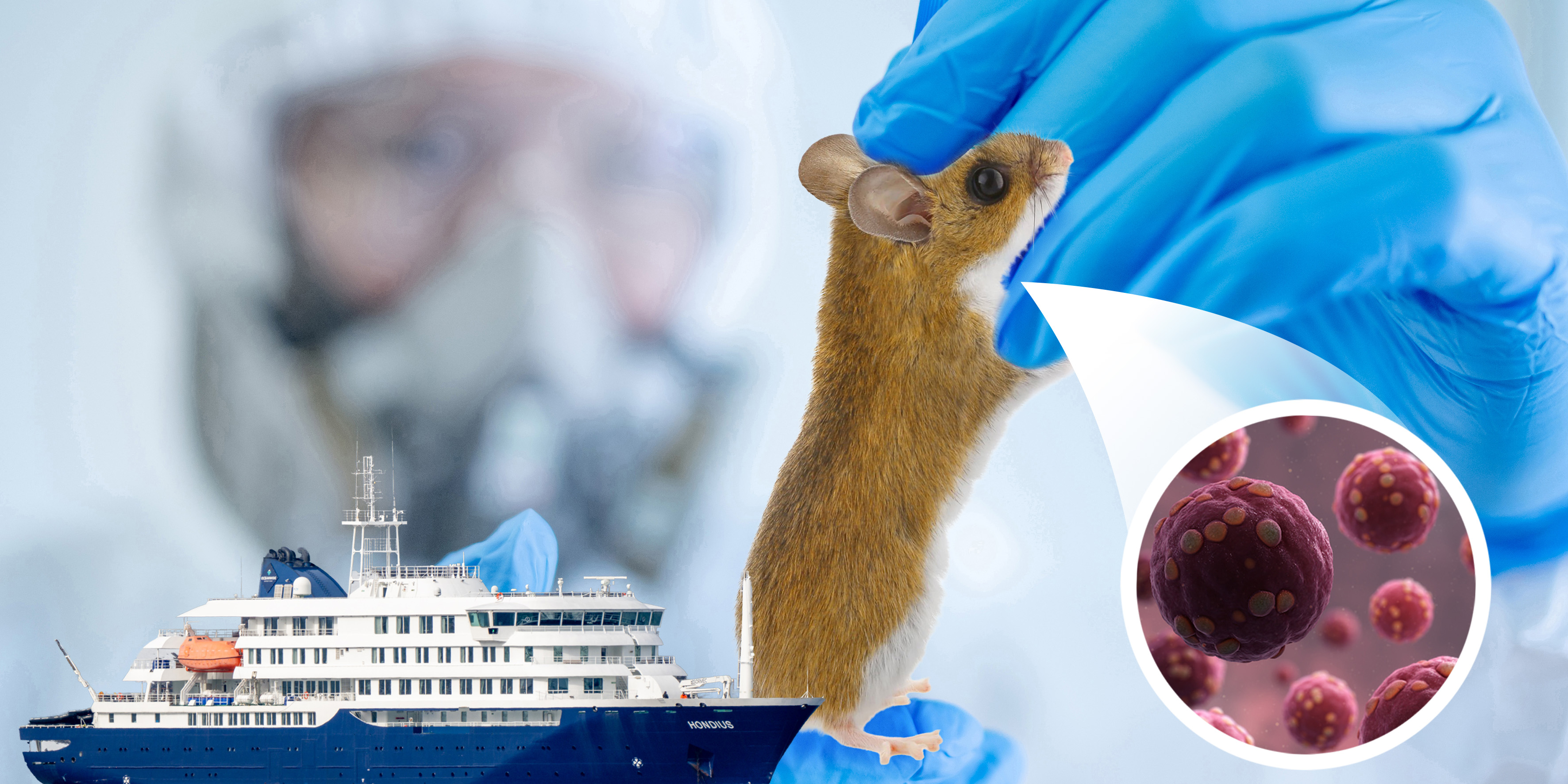
 Illustrative image | Scientist and deer mouse: iStock; Ship and virus: Wikimedia commons. (Design: Jocelyn Adamson)
It started with an email that arrived late on Friday, 1 May 2026, a public holiday, from a concerned colleague. The message was from a UK infectious disease specialist to Professor Lucille Blumberg of the South African National Institute for Communicable Diseases (NICD), and it set events in motion that led to her team finding a rare virus as the cause of an outbreak on the cruise ship MV Hondius within 24 hours.
Blumberg recounted the team’s efforts before Parliament’s Portfolio Committee on Health this week.
“It was really – if I have to say it myself – amazing. This was a team effort,” she said. “They have done extremely well.”
Within 24 hours after she received the email, the team managed to confirm a hantavirus infection in a British patient who had been evacuated to South Africa for treatment on 27 April.
By Wednesday, 6 May, it was identified as the Andes virus – the only strain of hantavirus that can be transmitted between humans. The patient is still being treated in a private hospital in Sandton.
Blumberg said the email she received from her UK colleague stated that there was concern about an outbreak on a ship.
The trouble was, Blumberg explained, that the patient was elderly with comorbidities, and because a lot of people on the ship were ill with respiratory symptoms, finding the exact pathogen was always going to be a struggle. It was not unexpected, she added, for the elderly to fall ill on such a cruise.
She pointed out that what made this even more remarkable is that hantavirus is not endemic to SA and not a usual cause of respiratory infections.
“It is not a virus we see in this country,” she said. “And it is not the usual cause of respiratory infection outbreaks on ships.”
She said that normally when there was an outbreak of this nature on a ship, legionella bacteria or a flu virus would be the suspect.
/file/attachments/2991/Dr-Lucille-Blumberg-Pic-13_564555.jpg)
“I really want to pay tribute to the NICD team and the laboratory,” she said. “As a country we have done extremely well.
“Just remember patients don’t come and say, ‘I am part of an outbreak’. It does take a little bit of time to get all the facts. But within 24 hours we knew what we were dealing with and we had a large amount of information,” she said.
Blumberg said the support from the global community was excellent, too.
The Dutch widow’s case
SA first became involved in the medical emergency on the luxury cruise liner MV Hondius when the British tourist fell ill with pneumonia-like symptoms and was evacuated by helicopter to Johannesburg. But by then a 70-year-old Dutch passenger had already died on 11 April, and medical staff on board were unable to ascertain the cause of death.
The man’s body remained on the vessel until 24 April, when the crew reached St Helena and arranged for his repatriation to the Netherlands. His 69-year-old widow accompanied the body on a flight to OR Tambo International Airport from St Helena and was meant to take a connecting flight to the Netherlands from there.
Health Minister Aaron Motsoaledi said on Wednesday that she was never meant to enter SA and only had a transit visa.
/file/attachments/orphans/Hantavirusdesignonline_660396.jpg)
However, she collapsed shortly after arriving at OR Tambo airport on 27 April. Despite receiving emergency medical treatment at a nearby hospital, she also died.
Blumberg explained the frightening progression of the disease caused by hantavirus. After a long incubation period, she said, the later stages of the illness “happen very, very quickly”.
Motsoaledi said the widow was screened at the airport, but at that stage did not have a fever. The medical team who treated her at a Kempton Park hospital did take a blood sample from her to send for testing, but after she died it was marked for destruction.
“At first we did not know about this patient,” Blumberg said. “She did not report illness [to the airline or the customs officials]. We had nothing to alert that she may have something.”
But when the team found out about her, they rushed to the hospital and managed to save a blood count specimen, taken as a routine sample, from being destroyed.
“It was a stroke of luck,” Blumberg said.
/file/attachments/2991/042025_Hondius_-_IMO_9818709_by_2eight_-_9SC4311_124392.jpg)
Tests revealed that the widow, too, had hantavirus and the sequencing team later identified that both she and the patient in ICU in Sandton were infected with the Andes strain.
A German woman also died on 2 May aboard the MV Hondius after exhibiting symptoms of fever and pneumonia.
‘NICD is the best’
There are 38 different viruses in the hantavirus family, but only the Andes strain has a history of being contagious among humans through close interpersonal contact. The others only infect people through contact with infected rat droppings, urine or saliva.
The World Health Organization also confirmed that the 70-year-old Dutch national who died first and his widow, who died in the Kempton Park hospital, had visited Argentina before embarking on the cruise. This is a country where the Andes hantavirus strain is endemic.
“The pieces came together extremely quickly – it was quite remarkable to make that diagnosis,” Blumberg said. “It was a most unusual pathogen in a most unusual setting.”
Blumberg said although medical teams on cruise liners sometimes had rapid influenza and Covid-19 tests on board, they could not test for viruses like hantavirus. It was therefore not possible to make a diagnosis on board.
/file/attachments/2991/0001211993_resized_aaronmotsoaledigovt1022_729717.jpg "Health Minister Aaron Motsoaledi. (Photo: Gallo Images)")
Members of Parliament were full of praise for the NICD team. “It was like finding a needle in a haystack,” said Dr Karl le Roux, the DA’s deputy spokesperson on health.
“The NICD is the best, whether you are talking public or private,” Motsoaledi said.
Contact tracing
The Department of Health has established that a possible 62 people were in close contact with the Dutch widow who died after collapsing at OR Tambo airport, as well as those involved in the medical evacuation of the British tourist to Johannesburg.
Six of the 62 were passengers on the widow’s flight. Four were flight crew members, and one was part of the medical crew on the evacuation flight. Four are port health officials, 32 are health workers and nine are security guards.
So far, only 42 of them have been traced. The department indicated that they will be monitored until the incubation period for the virus – six weeks – has passed. Blumberg said the team started contact tracing even before they were sure what they were dealing with, out of an abundance of caution.
Airlink, the airline on which the widow flew, said in a statement this week that there were 82 passengers and six crew onboard the flight.
/file/attachments/2991/04-052AMN4K6LFRLNBNXN5TKSWOBQOA_624818.jpg)
“At the time, Airlink was unaware that any of the passengers were unwell. On Sunday, 3 May, Airlink was notified by SA’s public health authorities that the passenger from the ship, who had been on the previous week’s flight, had passed away after she arrived in Johannesburg and that her death was thought to be attributable to the rare hantavirus,” the airline said.
In accordance with health protocols, Airlink provided the department with the names, contact details and seating allocation of all the passengers and crew who had been on the flight. This was to enable the health authorities to begin contact tracing.
“Airlink is also contacting passengers who were on that flight and advising them to contact SA’s Department of Health.”
On Thursday, 7 May, Kiki Herschfeldt, the spokesperson for Oceanwide Expeditions, which operates the MV Hondius, said the company was aware that 29 passengers and crew had disembarked from the ship at St Helena. Given the results of the NICD team’s sequencing tests, this had caused considerable alarm on the island.
The governor of St Helena, Nigel Phillips, said, in a letter addressed to island residents: “We are now responding to a crisis none of us would have wished.
“The resilience of our communities has been tested before and I am proud once again of the calm, measured and proportionate response we are seeing across the territory in difficult times. Those responding directly warrant special thanks.”
The UK Health Security Agency issued a statement saying two ship passengers who were in close contact with a patient from the MV Hondius had left the ship and were now in Britain.
The two individuals were advised to self-isolate and were not currently showing symptoms.
/file/attachments/2991/04newestmapworldmap_820493.jpg "Graphic: Jocelyn Adamson")
Cases linked to outbreak
South Africa: One deceased, one in hospital.
Zurich, Switzerland: One confirmed case – his wife is in isolation but asymptomatic.
UK: Two ship passengers are self-isolating pending testing. Both are asymptomatic.
St Helena: Monitoring for cases continues.
Amsterdam: A KLM flight attendant has been hospitalised with suspected Andes virus.
Cape Verde: Two MV Hondius crew members and a passenger have been medically evacuated. DM
This story first appeared in our weekly DM168 newspaper, available countrywide for R35.
/file/attachments/orphans/DM-08052026001CPTJHB_501259.jpg)
Comments
Scroll down to load comments...