




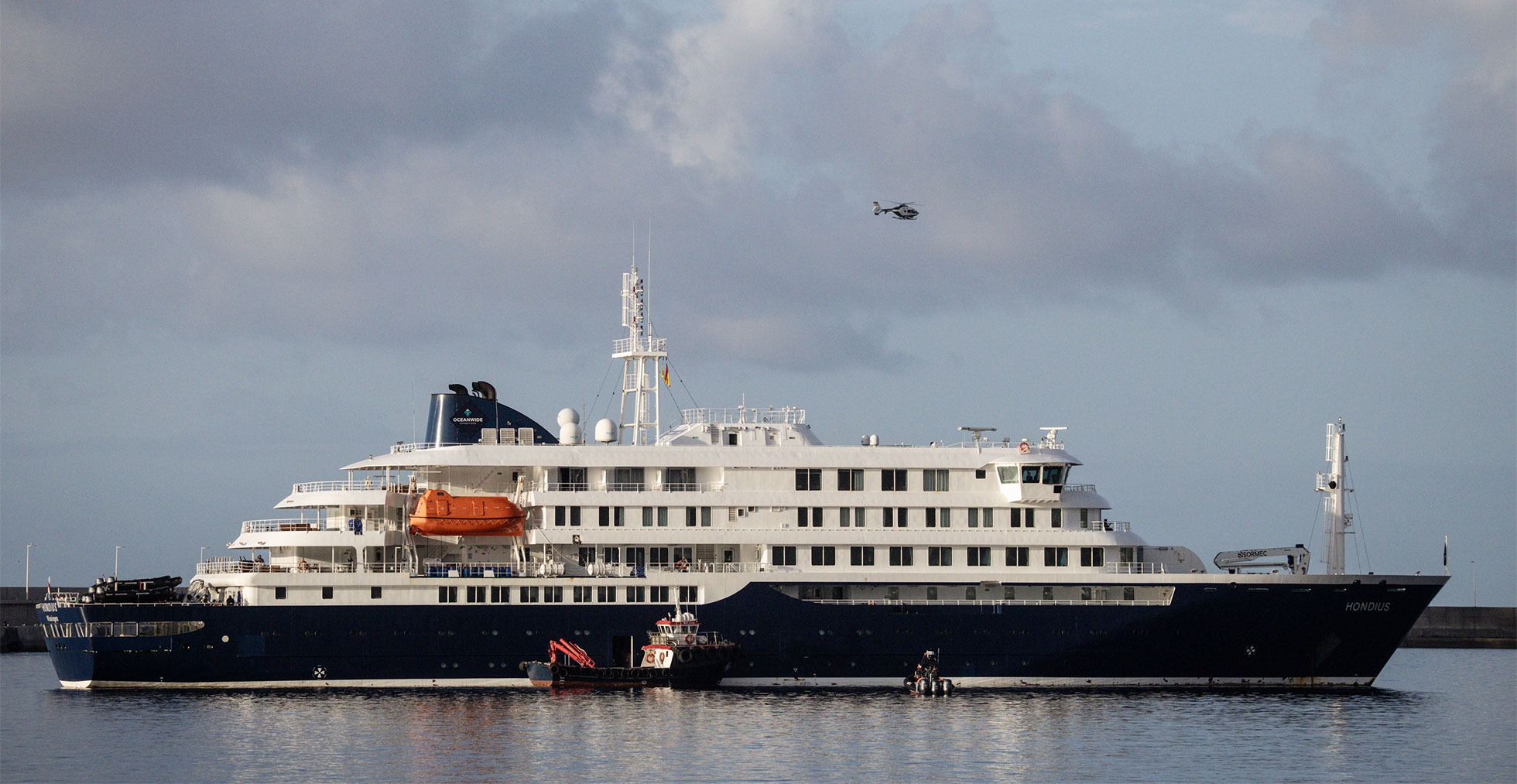
 A helicopter flies over the hantavirus-hit cruise ship MV Hondius off the Port of Granadilla de Abona, Tenerife, part of the Canary Islands, Spain, on 10 May 2026. (Photo: Chris McGrath / Getty Images)
One Western Cape resident who has shown flu-like symptoms has been tested for the Andes virus after possible exposure on a flight from St Helena island to Johannesburg.
The Andes virus
Scientists at the NICD narrowed the type of hantavirus down to the Andes virus, the only one of the existing 38 hantaviruses that is transmissible between people. The others are transmissible through the droppings, urine or saliva of infected rats.
This person was being monitored, the Health Department said last week. Spokesperson Foster Mohale said on Sunday that they were checking the results of the test.
The patient is part of a group of four who live in the Western Cape, but the only one of the group who has shown mild general symptoms – a sore throat and a fever.
But the World Health Organization (WHO) said in a late afternoon press conference that as far as it knew, there were no fresh cases.
Cases so far
According to the WHO, eight cases have so far been linked to the outbreak on the cruise ship MV Hondius.
The first was an elderly Dutch man (70) who was probably exposed to the virus during a birdwatching excursion in Argentina. He boarded the ship on 1 April, after more than three months of travel in Argentina, Chile, and Uruguay, and developed symptoms on 6 April. He died on board on 11 April. At that stage, the ship’s medical team was unable to test for the virus. As a result, he is considered a probable case.
This man’s wife (69) went ashore at Saint Helena on 24 April with gastrointestinal symptoms. She deteriorated on a flight to Johannesburg on 25 April. She died on 26 April in a Johannesburg hospital. The National Institute for Communicable Diseases (NICD) tested a blood sample, and she was subsequently confirmed positive for a hantavirus infection. Scientists at the NICD later narrowed the type of virus down to the Andes virus, the only one of the existing 38 hantaviruses that is transmissible between people. The other viruses are transmissible through the droppings, urine or saliva of infected rats.
A British man, currently in ICU in Johannesburg, developed symptoms on 24 April and was medically evacuated from Ascension Island on 27 April. He too tested positive for the Andes virus.
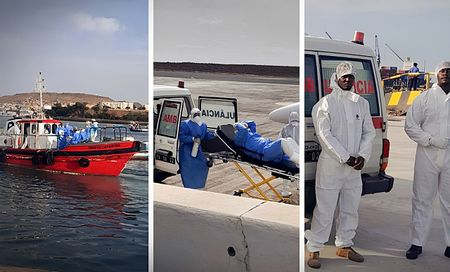
A woman who had flu-like symptoms and was later diagnosed with pneumonia died on the ship on 28 April. A post-mortem sample was collected and sent to the Netherlands with the evacuated patients, where it was confirmed that she too had been infected by the Andes virus.
The ship’s doctor then fell ill on 30 April. He tested positive for the Andes virus on 6 May. He was medically evacuated to the Netherlands and is in a stable condition.
A guide on the cruise liner reported symptoms on 27 April. His blood sample also tested positive for the Andes virus. He was medically evacuated from the ship to the Netherlands and is in a stable condition.
A passenger who left the cruise in St Helena and flew home to Switzerland through South Africa and Qatar has meanwhile tested positive for the Andes virus. He is hospitalised and in isolation in Switzerland.
A flight attendant who had contact with the Dutch tourist who died in Johannesburg was feared to have the Andes virus, but her test came back negative.
Authorities are awaiting the test results for another passenger, a UK citizen, who left the cruise liner in Tristan da Cunha on 14 April and then fell ill. He is in a stable condition, and British paratroopers were used to bring him medical supplies this week due to the remoteness of the group of volcanic South Atlantic islands.
MV Hondius update
Meanwhile, the MV Hondius, the cruise liner at the centre of the outbreak, docked off the coast at the Port of Granadilla de Abona, Canary Islands, Tenerife, Spain, early on Sunday morning, 10 May. Spokesperson for Oceanwide Expeditions, Kiki Herschfeldt, said the company was not involved in the further management of the passengers and crew. Those who remained on the cruise liner will be transported to their home countries by air.
Since the MV Hondius did not dock at the port, passengers and crew were transported to the island using the vessel’s Zodiac craft or launch boats in groups of five or 10.
/file/attachments/orphans/2275417847_646485.jpg "Passengers carry their belongings in plastic bags in the Port of Granadilla, Tenerife, Canary Islands, Spain, after their evacuation from the cruise liner MV Hondius on 10 May 2026. (Photo: Chris McGrath / Getty Images)")
“The sequence of disembarkation will be coordinated with arriving repatriation flights. Luggage of all guests will remain on board MV Hondius. Oceanwide Expeditions is in contact with all guests regarding the process for returning all luggage safely to them,” Herschfeldt said.
“After the guests and limited crew have disembarked, MV Hondius will bunker (take in fuel offshore) and take on necessary supplies at Santa Cruz, Tenerife. Following this, the vessel will transit to the port of Rotterdam, the Netherlands, with the remaining crew members (about 30) aboard,” she said.
In an early-morning press conference, it was confirmed that military aircraft were used for the repatriation flights.
/file/attachments/orphans/2275401413_257721.jpg "A Guardia Civil officer in a hazmat suit stands by as the MV Hondius arrives in the Port of Granadilla in Tenerife, Canary Islands, Spain, on 10 May 2026. (Photo: Chris McGrath / Getty Images)")
WHO update
Dr Maria van Kerkhove, acting director of the Department of Epidemic and Pandemic Threat Management for the WHO, explained that there were no passengers showing symptoms on board. She said that after the passengers were brought to land by the launch boats, they would be screened. She said physicians on board, including infectious disease specialists, had already medically assessed the passengers and had assessed their possible exposure.
“We classify everybody on board as a ‘high risk contact.’ ” We talk about the risk to them,” she said. The risk to the public is low.”
She said that the virus had a long incubation period – of up to six weeks – and the WHO recommend countries performed daily monitoring and checked for fever and symptoms, as well as enforcing a quarantine period of 42 days.
Van Kerkhove said a nurse from the Netherlands would board the MV Hondius on its homebound journey to support the remaining crew.
Passengers and crew leave the MV Hondius
Dr Diana Rojas Alvarez, the WHO’s health operations lead at Tenerife, said the first passengers and some crew members left the cruiseliner at 7.30am.
“We were all looking at the ship and seeing how happy the patients were at finally being back on land,” she said. Rojas Alvarez said that before they disembarked, port health officials performed their own health assessment of the passengers, who left the ship in order of nationality and were taken by bus straight to military aircraft from various countries that were waiting to take them home.
There are no South Africans on board the MV Hondius.
/file/attachments/orphans/2275417771_609922.jpg "Passengers after being evacuated from the MV Hondius after arriving in the Port of Granadilla. (Photo: Chris McGrath / Getty Images)")
So far, Rojas Alvarez said 46 passengers from Spain, France, Canada and the Netherlands had left the cruise liner. The operation was to conclude on Monday.
According to Van Kerkhove, the latest number of cases linked to the MV Hondius is eight.
Not the same as Covid-19 pandemic
Van Kerkhove said this outbreak was not the same as the outbreak of the Covid-19 pandemic in 2020. “It is an outbreak on a ship,” she said.
“This is a very different virus,” she said. “We know this virus.” The SARS-CoV-2 virus was exceptional because it was a new virus. Van Kerkhove said scientists who were performing sequencing (identifying the specific type of virus) of the Andes virus that caused the outbreak on the ship had not seen anything “exceptional” about it, but they were comparing it to results from previous outbreaks.
The first sequencing of the virus was done in South Africa, by scientists at the National Institute of Communicable Diseases. DM
/file/attachments/orphans/DM-08052026001CPTJHB_501259.jpg "Scientist and deer mouse: iStock
<br>Ship and virus: Wikimedia commons")
Ship and virus: Wikimedia commons
Comments
Scroll down to load comments...