




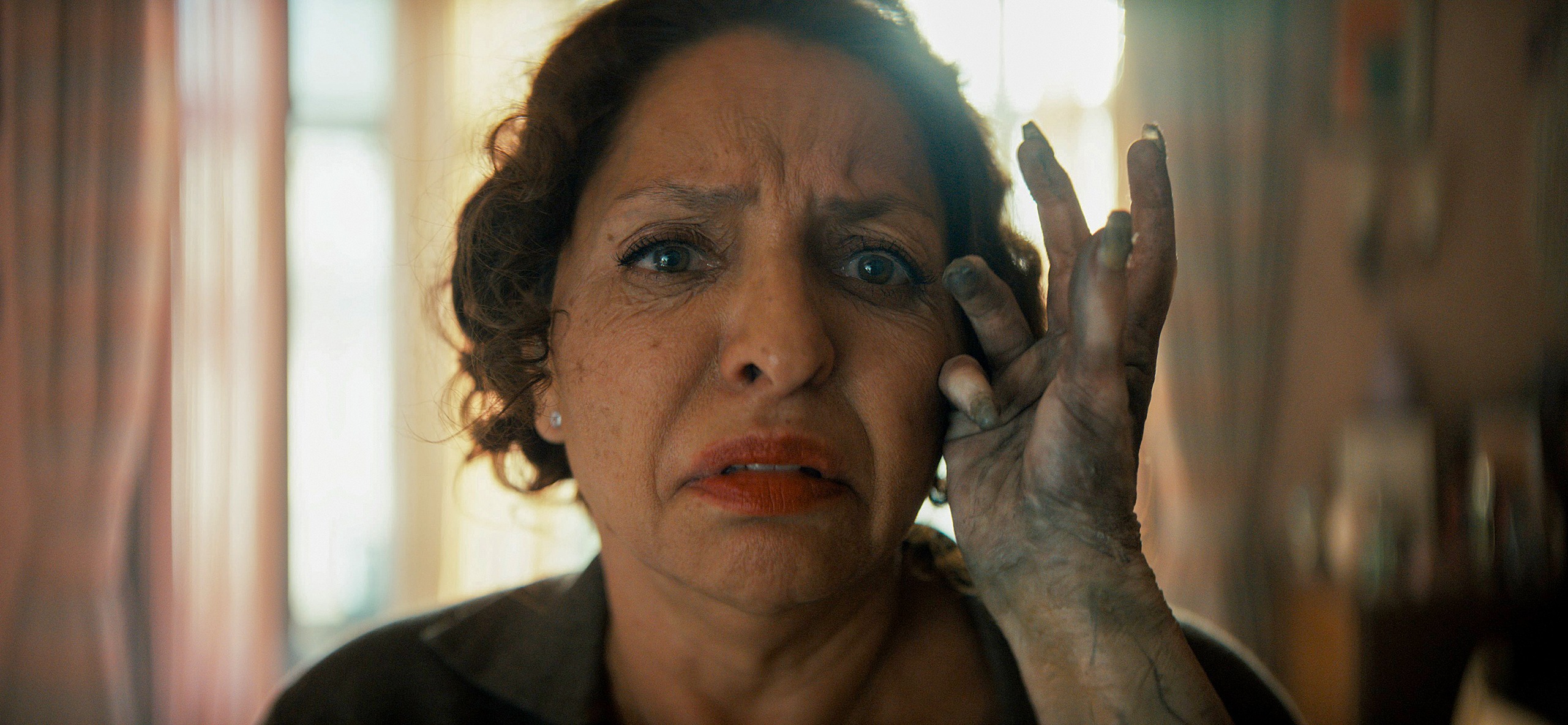
 Veronica Falcón as Carmen Santiago in Lee Cronin's The Mummy. (Photo: Lee Cronin's The Mummy)
Every year, a couple of horror movies make it big, winning over a mainstream cinema audience, raking in the bucks and achieving an unusual profitability thanks to typically smaller budgets.
With the Oscar-winning success of last year’s Weapons, and Sinners, the genre is enjoying a new level of respectability as well. Both of those movies were backed by Warner Bros. and evidently the studio is hoping for similar success with Lee Cronin’s The Mummy, which aims to honour a Golden Age Hollywood tradition, and make mummies disturbing again. No high-spirited action adventure here.
Like Weapons, with Zach Cregger driving the project, and Sinners, which Ryan Coogler helmed, Lee Cronin’s The Mummy is making quite a fuss of the filmmaker responsible for it – even attaching the writer-director’s name to the title. It’s a surprising move considering Cronin only has two other features under his belt, 2019’s A Hole in the Ground and the hit horror franchise revival Evil Dead Rise.
One can theorise that either the studio just wants something to distinguish its new release from Universal’s pulp Mummy movies, or it wants to leverage the Evil Dead association. Whether the latter is the reason or not, there are a lot of parallels between The Mummy and Evil Dead Rise. Probably too many, because if you’ve seen Cronin’s take on the Evil Dead franchise, you realise it’s a superior film to his latest big screen effort.
As in Evil Dead Rise, The Mummy zooms in on a family forced to contend with a living nightmare. TV journalist Charlie Cannon (Jack Reynor) is on the cusp of making it into the network news big leagues. But as he prepares to vacate his correspondent post in Cairo – with nurse wife Larissa (Laia Costa), and young children Katie and Sebastián in tow, Katie is abducted by a cloaked figure.
Eight years later, against all odds, Katie (played as a 17-year-old by Natalie Grace) is found in a centuries-old sarcophagus. She’s physically and psychologically warped, but the Cannons hope that time in their New Mexico home, surrounded by loved ones, will help to heal their daughter. Immediately, though, things take a dark, paranormal turn.
/file/attachments/orphans/NatalieGraceasKatieCannoninLeeCroninsTheMummy_WarnerBrosPictures_836066_507234.jpg "Natalie Grace as Katie Cannon in Lee Cronin's The Mummy. (Photo: Lee Cronin's The Mummy)")
Lee Cronin’s The Mummy is 133 minutes long, and while you don’t feel the unusually lengthy runtime for a horror movie, in hindsight, you realise the film is a thematically void experience.
Child abduction is a chilling topic by default, and comes with numerous interesting angles to explore, like feelings of remorse, guilt and blame that can fester within the family left behind. Then there’s the issue of integrating the victim back into a household that has moved on.
The film receives only one scene devoted to each discussion, with Cronin preferring to trot out a tale that is basically The Exorcist meets The Ring, with a liberal serving of body horror grossness involving adolescents, akin to the work of Danny and Michael Philippou, namely Talk To Me and Bring Her Back.
Without giving anything away, the movie even avoids a potentially complex discussion about the “greater good” motivating Katie’s disappearance.
Still, The Mummy does have some things going for it. It’s most emotionally impactful when it quietens down and treats viewers to close-up shots of the practical makeup effects representing Katie’s repulsive transformation. It’s not a frightening film, but it’s certainly disturbing.
/file/attachments/orphans/MayCalamawyasDaliaZakiisadetectivefightingtheoddsinLeeCroninsTheMummy_WarnerBrosPictures_117334.jpg "May Calamawy as Dalia Zaki is a detective fighting the odds in Lee Cronin's The Mummy. (Photo: Lee Cronin's The Mummy)")
Also in the plus column is the appearance of May Calamawy as Dalia Zaki, an Egyptian detective doggedly fighting the odds on multiple fronts. She’s arguably the most interesting figure in a film that doesn’t bother with character exploration or development.
That again makes it feel inferior to Evil Dead Rise, where time was devoted to presenting complicated sibling dynamics and personal motivations; getting the audience to care about the fate of its cast. As one example in The Mummy, Katie and Sebastián just do not interact after her return, despite obvious regret on his part.
Ultimately, Lee Cronin’s The Mummy is a movie that you need to feel more in the moment than think about at any point.
Along with missed opportunities for more depth, it’s littered with all-too-convenient narrative decisions that prompt questions from the viewer. Like why abduct the daughter of a prominent American figure when local children are easier targets? And why would people move a sarcophagus in the manner they do?
There’s a lot that’s senseless about Lee Cronin’s The Mummy, paired with it becoming increasingly overblown and schlocky, before a final scene that feels like it stemmed from a test screening rather than the memorably bittersweet moment that precedes it.
And that’s the impression that The Mummy leaves: a striking first impression unwraps – or unravels – to reveal something you’ve seen a hundred times before if you’re a horror fan. DM
Lee Cronin’s The Mummy is playing in cinemas. This review was first published on Pfangirl.
Comments
Scroll down to load comments...