
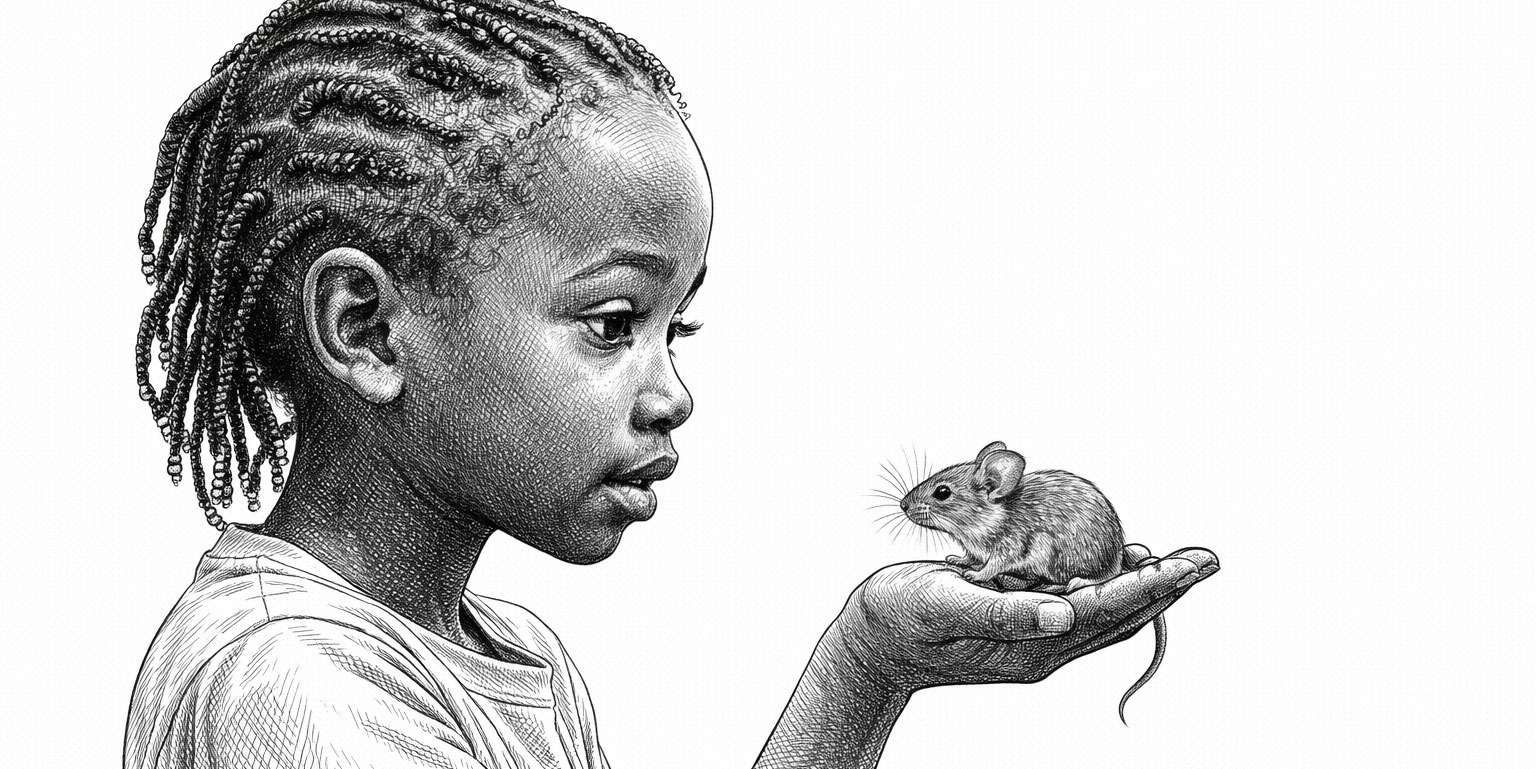
 An animal totem is a lens into nature and the non-human world. (Image: Sketchy)
 /file/attachments/2989/NOtesfromasmallfinal_693776.jpg)
At a recent book launch, a young man raised his hand and said he had a story to share. His mother – his favourite person – had died of Covid-19, and in the weeks after her passing he felt hollowed out. Nothing brought comfort. Nothing made sense. So he did the only thing that felt right: he drove into a game reserve and sat quietly in his car.
That was when the giraffes arrived.
Long legs, patterned flanks, slow, deliberate chewing. A small herd stepped out of the bush and arranged themselves around his vehicle like gentle sentinels. Through this forest of legs, he watched the horizon shift and felt something lighten inside him. The grief didn’t disappear entirely, but the weight of it changed shape. He described it as peace at last.
/file/attachments/orphans/Totem-1_796178.jpg "Healing came through a journey of giraffes. (Image: Sketchy)")
I asked him, only half-joking, if it had occurred to him that giraffes might be his totem. Something lit up behind his eyes. Venda people have lived in relationship with totems for thousands of years, and suddenly the idea seemed to unlock a door he didn’t know existed.
I would not be surprised if a small giraffe now stands beside his bed. And if giraffes were ever threatened and he was called to help, I’m fairly certain he’d be the first to jump up.
Totems often sound like the territory of “primitive tribes” or modern hippies, but this is a mistake. Choosing (or being chosen by) a totem animal might be one of the most underappreciated tools in the conservation toolbox – and one of the most transformative things an individual can do.
Totems: not mascots, but mirrors
A true totem is not simply a favourite animal. It’s a symbolic hinge between your life and the more-than-human world – a single species through which whole ecosystems become legible.
The French anthropologist Claude Lévi-Strauss once said that totemism isn’t about worshipping animals, but about thinking with them. A totem is a companion to your inner life. A pattern. A teacher. It holds emotion and memory, and it pairs your psychology with behaviours that have evolved over millions of years. We often think of symbolism as something fluffy, but here it’s deeply practical: a totem trains your attention.
Think of it this way: adopt a pangolin as your totem and you’ll soon find yourself obsessed with termite mounds, soil structure, trafficking routes and nocturnal habits. Choose the lilac-breasted roller and suddenly you notice perch points, grassland condition and the changing colours of the sky. Be claimed by an elephant and you’ll suddenly see elephant images everywhere.
Pay attention to anything long enough and you start to care about it. Care about something long enough and you start protecting it.
A totem is an anchor that pulls you a little closer to the pulse of the living world.
Ecological literacy
Totemic bonds create a surprisingly sophisticated kind of ecological knowledge.
Ghanaian researchers have shown that communities with active totem systems often have better understanding of local biodiversity than areas relying solely on formal education.
A totem makes you notice things other people miss: the shift in seasons, the arrival of insects, the drying of a water hole, subtle changes in behaviour that precede storms or droughts.
You don’t acquire this knowledge through textbooks – you accumulate it through affection. And it’s affection that makes conservation stick.
We often try to save the planet with facts and figures. But spreadsheets don’t compete well with awe, mystery and the emotional charge of recognition. A child who decides her totem is a dung beetle may spend her life defending healthy grasslands. A teenager whose totem is the Cape clawless otter might become obsessed with river health. A family with a shared totem often ends up with a shared sense of responsibility.
Totems sneak conservation in through the heart and only later let it rise to the head.
Taboos
Totems also come with rules – traditional taboos that forbid harming or eating the totem species. These practices evolved long before national parks or environmental legislation and, remarkably, they still work.
In parts of West Africa, totemic taboos have protected whole groves of forest, river catchments and keystone species for centuries. Communities avoid hunting their totem animals, avoid destroying associated habitats, and sometimes even intervene when outsiders threaten them.
Conservationists now study these taboos as sophisticated, self-regulating environmental systems that cost governments nothing and often outperform formal protection.
A totem makes conservation personal, not abstract. You’re not protecting “biodiversity” – you’re protecting your grandmother’s elephant, your family’s crocodile, your clan’s eagle.
Being claimed by a creature
This part is less discussed, but just as powerful: totems do emotional work.
Animals are astonishing mirrors. They express things we can’t easily articulate. They hold our fears, our longings, our strengths and shadows. A leopard can carry your courage. A tortoise can carry your patience. A flamingo can carry your flamboyance, even if you yourself are shy and quiet.
Modern eco-psychology suggests that totemic identification helps people regulate emotion, process grief and strengthen their sense of belonging. In Namibia, ethnographers have found that “totemic experience” often provides a stable narrative for people navigating cultural change, loss or big transitions. A totem can become a form of emotional continuity – an enduring companion in a world of sudden shifts.
This is why the young man surrounded by giraffes felt peace. The giraffes weren’t just giraffes. They were standing in for something larger – a way of organising emotion, anchoring identity and making grief survivable.
/file/attachments/orphans/totem-3_191961.jpg "To become your totem is to have it offer you its characteristics. (Image: Sketchy)")
Modern life has a way of flattening nature into scenery: distant mountains, anonymous trees, something green beyond the car window. A totem wrestles that flatness back into depth.
To know one species deeply is to enter its network: the insects it eats, the grasses that feed those insects, the predators that hunt it, and the stories humans have told about it for thousands of years. Through one creature, an entire ecological web becomes visible.
African environmental philosophers describe this as Hukama – relational living. A totem reminds you that you are part of a network of dependencies, obligations and exchanges. You’re not a spectator in nature. You are stitched into it.
Finding your totem
Here is the fun part: choosing (or discovering) your totem is not a quiz or a hashtag. It’s an encounter.
Take young people to a game reserve – not to tick off the Big Five, but to wait. To watch. To notice which creature pulls at them. It might be a charismatic lion, but it could just as easily be a warthog that glances back with suspicious dignity. Or a tiny stone-coloured lizard sunning itself on a rock. Or a bird whose call gives them goosebumps.
A totem doesn’t need to be glamorous. It only needs to be yours. Once claimed, that creature becomes a portal: into curiosity, into attention, into care. And if all goes well, into a lifelong commitment to protecting the piece of the world that creature depends on.
We live in an age of ecological anxiety – melting ice, collapsing species, headlines that feel heavier every year. Totems offer a different entry point. Not panic, not guilt, but relationship.
You don’t have to save the planet. Just fall in love with one species. It’ll take you the rest of the way. DM