
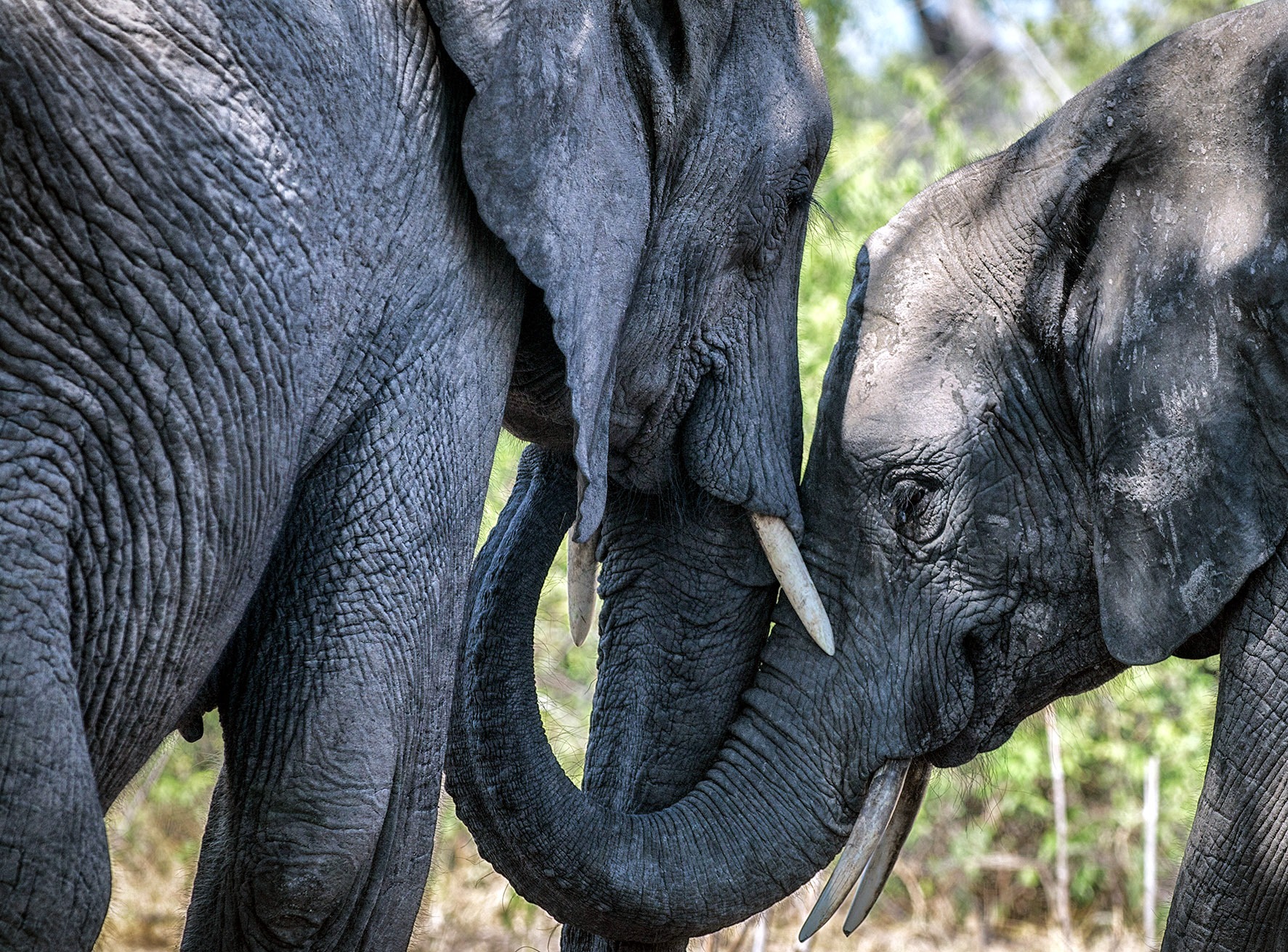
 Is the problem in Madikwe too many elephants or poor elephant management? (Photo: Don Pinnock)
 It’s been a bad few years for South Africa’s elephants. Pressure is mounting, with growing talk of “too many elephants”, plans to move or cull populations and renewed interest in hunting as a management tool.
There are also rumblings in Kruger Park about reducing poaching by feeding boundary communities elephant meat. And, after many years, there are moves to allocate a hunt quota.
To understand where this may be heading, Madikwe Nature Reserve in North West is a good place to start.
There’s a sentence buried deep in Madikwe’s own official Elephant Management Plan (EMP) that should stop everything now unfolding in the reserve. Culling, it says, is a last resort: not a tool of convenience, not an economic opportunity, and not a short cut to be used before all other options have failed. It reads:
“Culling is the last option where translocation, contraception and even range manipulation have been considered and failed.
The EMP was approved by the minister in March 2023.
Culling not authorised
The EMP is also unambiguous about authorisation: “The plan does not authorise the carrying out of any restricted activities involving the elephant. Prior to carrying out any restricted activities involving elephants, the Madikwe Game Reserve will still be required to apply for a permit in terms of section 57(1) of NEMBA [National Environmental Management: Biodiversity Act ].”
In a reserve governed by a detailed official plan, that raises an uncomfortable question about what appears to be unfolding: are the rules being bent, or simply ignored?
Meanwhile the rains have come to Madikwe, starvation is no longer an issue and natural attrition during drought is normal.
Madikwe’s approved EMP sets out a hierarchy of interventions: translocation, contraception and only then, under strict conditions, lethal control. It’s worth quoting:
- “Translocation of family groups is still the preferred option.”
- “Immunocontraception has been proved effective in controlling elephant population growth and is the preferred option.”
- “Culling is not a preferred option… an independent culling plan must be submitted for approval.”
- “Hunting is not advocated and would only be considered in exceptional circumstances.”
Minister evades accountability
Answers to questions submitted in Parliament to the Minister of Forestry, Fisheries and the Environment Willie Aucamp, confirmed the same position: “Culling is not routinely permitted and may only be considered under exceptional circumstances where all other management options have been exhausted and where such intervention is explicitly provided for within an approved EMP.
“Any such consideration must be fully compliant with the applicable norms and standards, supported by scientific evidence, and subject to the necessary regulatory approvals.”
When asked in the National Council of Provinces to provide details of all approvals given by him, his predecessor or his department for the culling or lethal removal of elephants, the minister answered: “No, no permit applications were received.”
But the difference between approvals and permits is critical. Approval of EMPs and culling plans is given by the minister, but culling permits are issued by provincial authorities. So while the national minister may not have received permit applications, it doesn’t discount the possibility that North West provincial authorities could legally have issued permits.
Confusingly, the minister then added: “No applications were rejected from 1 January 2025 to date for the culling or lethal removal of elephants.” There are blurred lines of authority here that could be intentional.
Given the controversy around culling, it’s likely that the minister would wish to distance himself from any direct permission to cull. However, unless he intervenes to ensure that Evidenced Based Decision Making and the proper legislated processes are followed, he risks being remembered as the minister who allowed unnecessary mass culling.
Management plans are not vague guidelines. They are binding principles within a formally approved framework, aligned with national norms and standards that emphasise ethical, humane and precautionary management of elephants.
/file/attachments/orphans/DSC0834_493757.jpg "Immunocontraception was offered free but not taken up. (Photo: Don Pinnock)")
Bureaucratic ineptitude creates crisis
The reality emerging from Madikwe tells a different story. Parliamentary hearings in June last year revealed a crisis years in the making: more than 1,600 elephants in a fenced reserve originally intended for far fewer.
But the crisis itself is not the most damning part. What matters is how it came about. According to testimony presented to Parliament, a long-term preventative measure – immunocontraception – was offered at no cost to Madikwe as far back as 2020. However, after bureaucratic delays, an MOU was eventually signed with the NGO Humane World for Animals only in 2024. But, it was never implemented.
The failure by North West Parks & Tourism Board (NWPTB) to implement the MOU has since resulted in the avoidable births of at least 400 elephants, with a further 50% of adult females expected to be currently pregnant, resulting in another 200-300 births which could have been avoided.
The NSPCA and MPs alike described the situation as the result of “decades of inaction” rather than sudden ecological collapse.
If contraception was not implemented and translocation was not sufficiently pursued, can culling legitimately be framed as a “last resort”? Or is it, as critics suggest, a first resort disguised as a last one? The question is, why?
Many governance failures
The NWPTB appears to be acting as if it has never read its own management plan. The EMP says the plan will conform to the philosophy of adaptive management, requiring unambiguous goals, strategies designed to achieve those goals, and monitoring of the effects of any interventions.
It also promises a transparent, accountable process for planning within a structured, consistent framework for implementation and adherence by managers. It further requires that all stakeholders be included at the appropriate development stage of the process.
Those commitments matter, because the current process appears to have done the opposite. The NWPTB has flown in the face of criticism from Parliament over failures in governance.
- It failed to issue the Provincial Task Team report by the due date of November 2025;
- Failed to invite the NSPCA into oversight processes despite instructions from Parliament to do so;
- Failed to implement contraception; and
- Failed to heed warnings from lodges in the area that hunting and culling would have disastrous effects on tourism.
None of these failures is, on its own, necessarily illegal. Taken together, however, they signal something more subtle: a policy shift.
Following the politics
Now consider the broader political context. South Africa has a new Environment Minister, Willie Aucamp, whose formal responses emphasise that elephant management in provincial reserves falls under provincial authority.
At the same time, the NWPTB is openly exploring hunting and culling as tools of “balance”, while maintaining relationships with hunting organisations and promoting the sustainable-use narrative at international hunting conventions. Officials of the NWPTB even went on a junket to the Dallas Safari Club Convention in the US “to explore possibilities”.
In 2025, the NWPTB also issued a tender to trophy hunt elephants, black rhino and buffalo. The tender was allegedly issued without prior consultation with concessionaires or other affected stakeholders, with consultation attempted only afterwards. After uproar from concessionaires, the tender was formally withdrawn.
Either way, the tender shifted the idea of killing elephants from a tightly controlled, ethically fraught decision into a procurement process: a service to be delivered.
/file/dailymaverick/wp-content/uploads/2025/07/Madikwe-elephants-Declan-Hofmeyr.jpg "There has been a lot of discussion about elephants, their management and what to do in Madikwe. (Photo: Declan Hofmeyr)")
An inside source who asked not to be named said the NWPTB has since suggested that it might not pursue full-scale hunting, but that some animals might be hunted “in the middle of” a cull. The response from concessionaires, according to the source, was emphatic: no hunting, not even if folded into culling.
The cost of all this is hard to calculate. Immunocontraception was offered free and funded by an NGO, the cost of culling or relocation (though there are claimed to be no available places for the elephants to go) is the job of the Provincial Task team which should have reported long ago but is chewing its cud. The cost of choppers, drugs, transporting hundreds of dead or live elephants? Hard to say.
The danger of convenience
The NSPCA has warned explicitly against this framing, arguing that culling “cannot be repackaged as an income stream” and that the commodification of wildlife risks eroding both ethics and South Africa’s conservation reputation.
There are rumblings elsewhere. In Ezemvelo, a recent spate of elephant-related announcements about the supposed need to relocate more than 1,000 elephants coincides with severe economic stress in the park system and raises further questions.
Is Ezemvelo’s call for translocations a cover story about seeking non-lethal solutions while planning and motivating for lethal removals? Could it be planning to blur the lines between culling and hunting to compensate for successive budget cuts and a dysfunctional operations-to-salaries ratio? Both are probable, but time will tell.
There is also a deeper legal and ethical question. A 2021 analysis by Professor Rob Slotow and colleagues argues that “the current culling method is likely to be inhumane, and potentially inconsistent with the Constitution”.
Elephants are not just large animals. They are socially complex, sentient beings with tight family structures — a fact explicitly recognised in national norms and standards. To treat their removal as a logistical exercise alone is to ignore that complexity.
A turning point
Madikwe is, in many ways, a microcosm of South Africa’s conservation dilemma: a fenced reserve, a growing elephant population, limited ecological options and pressures on land, biodiversity and tourism. Intervention is unavoidable.
But how that intervention is framed, and how quickly lethal options are reached, matters enormously.
Once culling becomes normalised, once hunting is integrated into management planning as “cull/hunting” and once tenders are issued as routine instruments of wildlife control, the meaning of “last resort” begins to erode.
And a concern lingers: who benefits? With local government elections this year, it may be irresistible for politicians to garner votes with promises of elephant meat.
The real question now is whether South Africa is institutionalising lethal wildlife control as a normalised policy choice – serving narrow economic and political aims – rather than reserving it as an exceptional measure justified by clear ecological and biodiversity imperatives. If that is the direction of travel, then Madikwe is not an exception. It is a warning. DM