




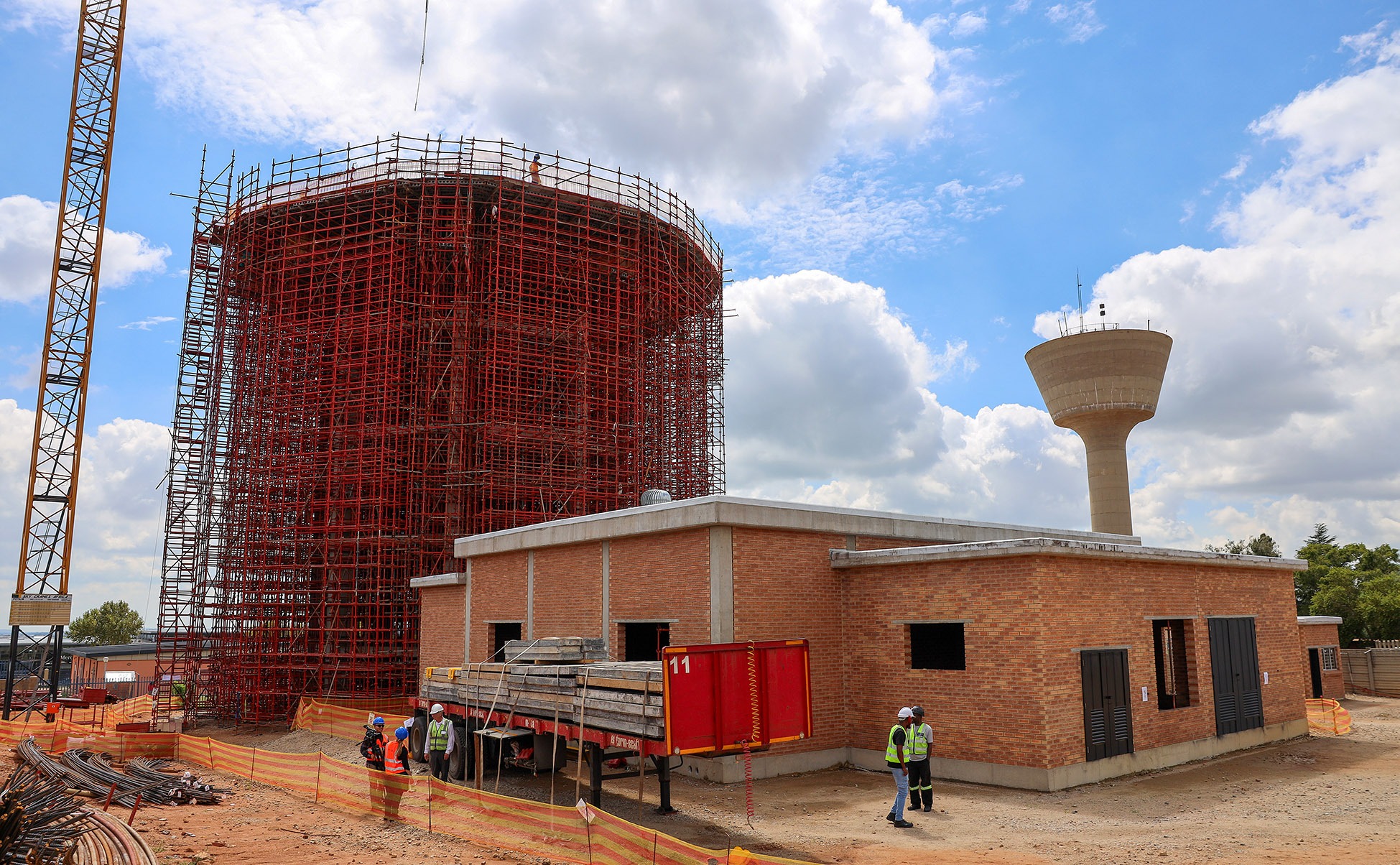
 The Erand Tower in Midrand during a site visit in March 2025. It is meant to form part of the Johannesburg Water Reservoir Storage Programme, which aims to ensure the provision of 24-hour storage capacity in all the entity’s reservoirs. (Photo: Gallo Images / Luba Lesolle)
Days after the City of Johannesburg publicly celebrated the reopening of the Brixton reservoir as a flagship infrastructure success – and amid a fresh warning from Finance Minister Enoch Godongwana about Johannesburg’s deteriorating financial position – it has emerged that in Midrand, a near-complete Johannesburg Water project has been brought to a halt after running out of money.
Johannesburg Water confirmed that the Erand Tower project has been “temporarily suspended” at an advanced stage of completion after exhausting its allocated budget.
Residents in Midrand have taken to the streets in recent months over repeated water shortages, with protests erupting after days-long outages and persistent low pressure across higher-lying areas. Communities described the situation as “unbearable”, complaining of dry taps for nearly a week at a time and inconsistent water tanker support. Local representatives say the unrest reflects growing frustration that infrastructure has not kept pace with rapid development.

The Midrand water system consists of separate but interdependent components. The Erand reservoirs – referred to as Erand 1 and Erand 2 – are storage reservoirs holding treated water, while the Erand Tower project houses the pumps needed to move that water into the reservoirs and supply higher-lying areas. This means that even if water is available in the system, supply to elevated parts of Midrand can still fail if the pumping infrastructure is not operational.
“Proceeding beyond the approved budget would have resulted in unauthorised, irregular, fruitless and wasteful expenditure (UIFW), which constitutes noncompliant and reckless financial practice that Johannesburg Water does not permit,” said spokesperson Nombuso Shabalala in response to questions from Daily Maverick.
“The depletion of funds is attributed to several unforeseen and unavoidable factors encountered during implementation,” she said.
These included “the discovery of asbestos-bearing material on site, which required specialised handling, disposal at certified facilities, and resulted in environmental approval delays”.
Shabalala added that project delays had led to cost escalations “not anticipated at the time of contract award”, while “necessary revisions to the foundation piling design due to changed founding conditions following the removal of asbestos… required additional piling work”.
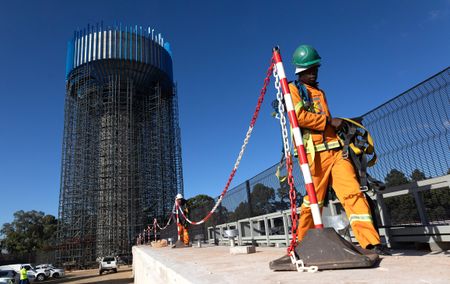
The project forms part of the broader Midrand water system, housing pump infrastructure that transfers water to storage reservoirs and enables supply to higher-lying areas.
/file/attachments/orphans/6I1A3310_669594.jpg "Minister of Water and Sanitation Pemmy Majodina, Cooperative Governance and Traditional Affairs Minister Velenkosini Hlabisa, Deputy Minister of Water and Sanitation David Mahlobo, Deputy Minister of Cooperative Governance and Traditional Affairs Namane Dickson Masemola and Joburg mayor Dada Morero conduct an oversight visit at the Erand Tower project in Midrand on 12 February 2026. (Photo: Felix Dlangamandla)")
Near complete – but stopped
While Johannesburg Water did not disclose the exact outstanding amount, Daily Maverick understands that less than 10% of the total contract value remains – estimated at about R16-million – a figure the utility did not confirm or dispute.
The relatively small balance raises questions about why the funding shortfall was not resolved before the project reached its final stages, effectively halting a near-complete asset.
Johannesburg Water said the project had exceeded the 20% variation threshold permitted under municipal procurement rules.
“In line with section 116(3) of the Municipal Finance Management Act, any contract amendment beyond this threshold must undergo a formal public participation and approval process,” Shabalala said.
This includes a 30-day public participation period, followed by submission of a report to council and consideration through municipal governance structures.
“Subject to the successful conclusion of this process, the contractor will be formally instructed to resume work. The process to reinstate the contractor on-site is estimated to take approximately three months, depending on the outcome of public participation.”
Impact on water supply and development
Johannesburg Water acknowledged that the project is “essential for improving water supply reliability in Midrand and enabling future development in the area”.
Its suspension therefore has immediate and longer-term consequences.
Without the additional pumping capacity, Midrand’s already strained water system remains vulnerable to pressure fluctuations and supply disruptions, particularly in higher-lying areas.
Midrand councillor Annette Deppe said the impact extended beyond water supply, affecting development across the area.
“We have been told the remaining amount is about R16-million, which is less than 10% of the contract value. Yet this is holding back development across Midrand. This is preventing further high-rise construction because developers are being told supply cannot be guaranteed. Infrastructure constraints are now likely to delay or limit new development approvals, effectively placing a brake on growth in one of Johannesburg’s key expansion zones,” she said.
/file/attachments/orphans/GroundUp-water-protestmain_470234_359149.jpeg "Midrand residents took to the streets in February 2026 to protest against a six-day water outage. (Photo: Ihsaan Haffejee)")
The project was recently included in a high-level visit to Midrand by mayor Dada Morero and Deputy Minister of Water and Sanitation David Mahlobo following water supply disruptions in the area.
Deppe said the visit created confusion by focusing on existing reservoir infrastructure rather than the stalled pumping system.
“This is the same project the mayor took the delegation to, but the focus was on the old reservoir rather than the new infrastructure that is not operational,” she said.
“The towers are what pump the water to the reservoirs. If they are not working, the system cannot supply the higher-lying areas properly. Many residents in these areas have already been battling for months to get water.”
Deppe said residents were increasingly frustrated after repeated assurances from senior political leaders that Midrand’s water challenges would be addressed.
“After those high-profile visits and assurances from Gauteng premier Panyaza Lesufi and even Deputy President Paul Mashatile, who committed to addressing Midrand’s water challenges, we now see budgets being pulled from critical infrastructure projects including a water tower that is reportedly 99% complete,” she said.
“Midrand has already experienced the strain of water shortages, and halting near-complete infrastructure projects is not just irresponsible, it is dangerous. Residents deserve better.”
Months before work resumes
Even under the most optimistic scenario, construction is unlikely to resume immediately.
Johannesburg Water must first complete the legally mandated public participation and council approval process before issuing instructions for the contractor to return to the site.
Only then can work recommence on a project that is already largely built.
WaterCAN: Development funds not being used in Midrand
Julia Fish of WaterCAN said the stalled project raised broader questions about how development contributions collected in high-growth areas such as Midrand are being used.
Fish said developers in Midrand are required to pay substantial development levies linked to infrastructure capacity when projects are approved, particularly in rapidly expanding areas such as Waterfall, Carlswald and along the Allandale corridor.
“These contributions are meant to support the infrastructure required for that growth. Midrand is one of the highest-development regions in Johannesburg, so there should be significant funding flowing into infrastructure,” she said.
Fish questioned whether those funds were being properly ringfenced for the region and the relevant municipal entities.
“We have not been able to trace where these development contributions are being spent. Developers cannot obtain approvals without paying these levies, yet critical infrastructure projects are stalling near completion because there is apparently no money available,” she said.
“This creates the impression that the City is borrowing from Peter to pay Paul – using money generated in high-growth regions to plug broader financial gaps elsewhere.”
Fish said WaterCAN was calling for greater transparency and an investigation into how these development contributions are allocated and spent, since they do not appear to be going either to the relevant entity or the region where they are generated.
Less than 10% of the contract value now stands between Midrand and a critical piece of water infrastructure – but residents may still wait months before work resumes. DM
Comments
Scroll down to load comments...