



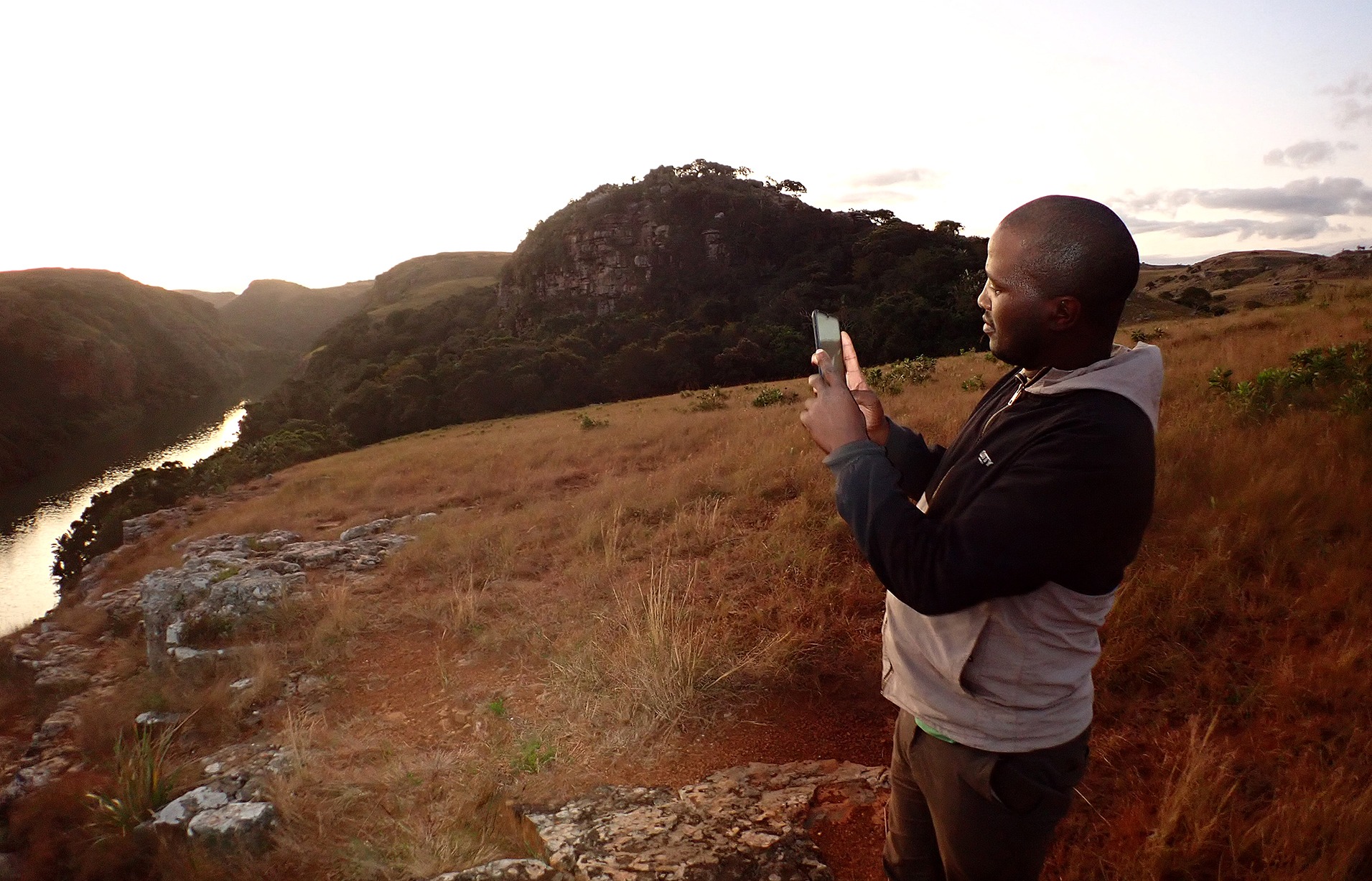
 Farmer, tour guide and community organiser Siyabonga Ndovela takes visitors to a popular lookout
point above the Mtentu River mouth. Light-touch tourism, low-impact farming and wild harvesting
certain plants and ocean species keeps this local economy ticking over.
(Photo: Leonie Joubert)
Farmer, tour guide and community organiser Siyabonga Ndovela takes visitors to a popular lookout
point above the Mtentu River mouth. Light-touch tourism, low-impact farming and wild harvesting
certain plants and ocean species keeps this local economy ticking over.
(Photo: Leonie Joubert)“It’s no accident that this place is so beautiful,” says Siyabonga Ndovela, “we keep it this way.”
The 33-year-old Pondoland farmer, tour guide and community organiser delivers this message with a winning smile as he confronts tourists who’re tearing along a rocky cul-de-sac at the Mtentu River mouth on quad bikes. It takes the visitors a moment to realise that behind Ndovela’s affable demeanour is a reprimand.
A cavalcade of 4x4s had pulled into a campsite earlier, deep in communal Pondoland. They’d offloaded their muscle-toys and were treating the secluded hillside like a demolition derby. This kind of behaviour can land someone in the traditional court – a legal process recognised by the Constitution – and fined, Ndovela says, explaining the community’s process for keeping visitor behaviour in line with environmental laws.
The amount is usually the equivalent of the offence of cutting down an umdoni, a waterberry tree: the value of a goat, roughly R2,500.
“We normally don’t charge so much, though.”
/file/attachments/orphans/3P72006041_430177.jpg "The Mtentu River mouth, bordering South Africa’s newest Unesco-recognised Ramsar wetland, draws tourists to its relatively untouched wilderness. But its food heritage holds solutions to today’s most pressing public health challenges. (Photo: Leonie Joubert)")
The conversation is brief. No one raises their voice, and there’s no need to escalate things to a court appearance. The visitors apologise and the place returns to the quiet haven that has long drawn nature lovers to these remote and rugged shores.
Much of this relatively unspoiled part of the Wild Coast relies on nature-based tourism to keep the economy ticking over: mostly multi-day hikes led by local guides, with hikers overnighting in families’ homes along the way.
Food system experts recognise something equally rare here, though.
There’s a cultural connection with soil and nature that starts with small-scale farming and comes full circle to a plate of home-grown grub. This isn’t just a key pillar to the local economy, along with tourism. It keeps alive a custom of indigenous and traditional foods. With it, these amaMpondo have retained the health benefits of a food system that in many other places has been replaced by a globalised, same-same industrial food system that’s causing the worldwide explosion of “diseases of lifestyle”.
Preserving this cultural heritage isn’t about keeping alive what many might see as a quaintly peasant lifestyle as a cultural curiosity in a fast-changing world, experts argue. They’re looking to it as a way to repair a modern profit-driven food system that leaves so many hungry, heavy and sick.
Madumbi vs the Big Mac
It looks like food. It tastes like food. The packaging says it’s food. But is it food?
Dr Florian Kroll flips a crumpled chip packet over in his hand, picked up on a village footpath that morning – a rare thing to find out here – and squints at the almost illegible ingredients list, so fine is the fine print. Many of these are unrecognisable chemical names, and not just to this group of Pondoland farmers seated along the curved interior of a rondavel.
Today’s gathering is on a hillside overlooking the Sikhombe River mouth, near the otherworldly red dunes of Xolobeni that would have been irrevocably changed but for this community’s activism that stopped a titanium mine from setting up shop in the 2000s.
Kroll, a researcher in food governance, is here to talk about another industrial process, with its own unique kind of pollution: highly processed food-like products, and what they do to gut health.
A team of food system experts with the Centre of Excellence in Food Security, headquartered at the University of the Western Cape but with a range of partners around the country and abroad, has been working with these farmers for two years as part of a study that’s looking at the state of gut health in small-scale farmers who eat plenty of home-grown greens compared with those whose diets are high in processed industrial food-like products. Today is a final wrap-up meeting.
/file/attachments/orphans/4IMG_9234_545968.jpg "The amaMpondo culture connects to soil, land and home-grown foods. Because of this, their gut health has been protected from the pollution that comes with eating food-like composites whose preservatives dramatically reduce the health and diversity of the gut microbiome that’s needed for digestion and nutrient absorption. (Photo: Leonie Joubert)")
The snack that Kroll’s talking them through, to remind everyone of why they’re doing the study, is made of maize, palm oil and corn starch, things most South Africans will know. But the rest?
The villagers may not recognise the string of unpronounceable chemicals – starting with monosodium glutamate and descending into gobbledygook – but they know about “high blood” and the other common illnesses that the researchers remind them are linked with eating these faux-foods over a long period of time. Diseases like stroke, heart attack, diabetes, complications linked with weight gain.
The original stuff – maize, oil, that kind of thing – gets fed from one machine to another where it’s crushed, broken apart, refined, liquified, or powdered. These constituent parts get handed from factory to factory where they’re glued together in all manner of edible formulations which are salted, sweetened, flavoured, dyed and preserved with chemicals. These are eatable concoctions rather than real food and have been on the public health radar for years. They’re understood to be engineered in this way: to be tasty and addictive, and to override the satiety off-switch in the human brain, ensuring that people overeat.
There’s a good three or more decades of public health literature on this, but the 2025 UN special rapporteur on the right to food, Michael Fakhri, in a report on the fallout from the concentration of corporate power in the global food system, sums it up neatly (see bullet point 18 on page six).
“There are many things in here that are called preservatives,” Kroll says, holding up the packet. These give ultra-processed foods the improbably long shelf life that they have, compared with fresh foods. But it’s these very preservatives that kill off much of the microscopic life forms in the human gut which are responsible for digestion and nutrient absorption.”
/file/attachments/orphans/5IMG_9512_467385.jpg "A diet rich in whole foods typically means someone has a healthier and more diverse gut microbiome, like a species-rich wild forest. This imagery the amaMpondo can relate to, close as they are to coastal forests with the endemic Pondoland palm. (Photo: Leonie Joubert)")
/file/attachments/orphans/3P41801381_196900.jpg "The Mtentu River mouth. (Photo: Leonie Joubert)")
/file/attachments/orphans/12024-07-211219051_101261.jpg "Even as she approaches her 100th birthday, Nozilayi Gwalagwala’s larder brims with home-grown maize drying on the cob, beans and a few bushels of cannabis, a staple in these parts. Food systems experts are looking to this kind of food garden heritage as an antidote to a disease-causing industrialised food system. (Photo: Leonie Joubert)")
If you look under a microscope at the gut microbes from a healthy belly, Kroll explains, it’ll look more like a wild forest with a rich diversity of species. This is an image the villagers know well, close as they are to the coastal forests with their endemic palms and towering Strelitzias.
“When we eat a lot of processed foods, the inside of our bellies will look more like a sugar cane field.”
Urbanisation around the Global South usually comes with a switch to what’s often called the Western diet, where people abandon whole, high-fibre foods and eat more refined foods that are loaded with salt, fat, sugar and chemicals. However, this label implies that the diet is a benign cultural export from the West, which is why some public health experts prefer to call it the neo-liberal diet. This is a nod to what they describe as the predatory profit-driven motives of globe-dominating multinationals that have amassed mind-blowing wealth and increasingly concentrated their power across the food system. They’re seen as spreading aggressively into new markets of the Global South, health consequences be damned.
This community of amaMpondo haven’t been exposed to the polluting effects of this homogenised diet yet, protected as they are by their remoteness, which has allowed them to retain a traditional farming and food custom.
Which brings them to the awkward part of the meeting. There’s some coy laughter here and there. Many of them volunteered stool samples a few months back – how else do you test if madumbis make good microbes? – which the researchers tell them are still en route to a specialist laboratory in France. Some red-tape delays and what-not. A few more giggles.
/file/attachments/orphans/5P4180121_551670.jpg "A diet rich in whole foods typically means someone has a healthier and more diverse gut microbiome, like a species-rich wild forest. This imagery the amaMpondo can relate to, close as they are to coastal forests with the endemic Pondoland palm. (Photo: Leonie Joubert)")
/file/attachments/orphans/7P4180010_806175.jpg "Nkosi Sonjica takes tourists for canoe trips up the Mtentu River which forms the northern-most boundary of the Mkhambathi Nature Reserve. Last month, this was declared a Unesco-recognised Ramsar wetland of international importance. (Photo: Leonie Joubert)")
Results should be back by year-end, along with those from a second community of farmers near Mtunzini, about six hours’ drive from here, on the KwaZulu-Natal North Coast. Researchers won’t know until the sample results come back, but they anticipate that the Pondoland farmers’ gut microbiomes will be richer and more diverse than those near Mtunzini, where people eat more refined foods.
Out here, the locals still eat way more madumbis – known as the African potato, but which isn’t African or a potato – than they do Big Macs. Researchers hope that Pondoland's local food system will stay this way. Their work is framed around looking to communities like the amaMpondo to find “alternative food systems centring on traditional African foods… to pinpoint the role of those foods in the gut microbiota and promote their production using agro-ecological practices”.
That’s just a fancy way to say they’re calling for a return to the kind of food systems that most societies had in a time before whole food farmers’ markets were replace by Whole Foods Market Inc.
Home-grown grub
Ndovela doesn’t have time to stop for a chat. It’s a rare day that his diary isn’t chock-a-block with meetings and community organising. It’s mid-April, and blissfully overcast. Perfect to get a few more beds ready for winter crops: cabbage, spinach, tomatoes, cucumbers, maize, potatoes, sweet potatoes, madumbis, beans… the list goes on.
“I’m already running late, I should have started in March,” he says, in between meniscus arcs of the hoe which he’s using to turn the leaves of a previous crop into mulch for the dark, fertile soil.
/file/attachments/orphans/11IMG_9194_170225.jpg "Indigenous staples like sorghum and millet have largely been replaced by imports such as maize and madumbis, the ‘African potato’ that is in fact from southern India and isn’t, technically, a potato. These are nevertheless regarded as traditional foods, having become so much a part of African food heritage. (Photo: Leonie Joubert)")
The Ndovela household gets more than half of their food from the home gardens. He has a few head of cattle under his stepfather’s care – his boy is too young to take on the role of cattle herder for now – and the goats are his gig, too.
“I have chickens, yeah, lots of chickens…”
But his hand waves a no-no sign, laughing.
“… which is my wife’s job. The man doesn’t do the chickens.”
They’re for meat and eggs.
Ndovela has a few irons in the fire. Other than the home-grown food that he says accounts for more than half of what they eat year-round, he needs some cash income, which he gets from selling surplus crop yield, and guiding multi-day hikes along the coast.
This is the bread-and-roses economy of the coast: subsisting off the land, wild harvesting plants and marine foods, and some cash activities. He needs this to pay the local miller to grind their maize once it’s dried on the cob, or for things like petrol for his motorbike, cellphone airtime and the few groceries that they can’t produce themselves.
“Mainly rice, cooking oil, some soup, spices. That’s it.”
The ocean is throaty in the background, a reminder that he returned from the surf the previous evening with a bunch of rock lobster for dinner.
/file/attachments/orphans/10P7170049_794020.jpg "A typical homestay near the Mtentu River mouth, where locals offer catered accommodation to hiking groups. (Photo: Leonie Joubert)")
For city folk who may be conditioned to measure affluence in pay cheques, Gucci knockoffs or KFC takeouts, the life of a traditional Wild Coast family might seem wanting. But the now erstwhile special rapporteur Michael Fakhri disagreed in his 2025 report. The kind of food system that contributes to the Ndovela’s livelihood and wholesome diet is precisely the thing that he was bemoaning the loss of, largely because of the corporate-driven food system running rough-shod over these traditional ways: the shift in diet from “traditional, healthier diets to those increasingly consisting of unhealthy food and beverage products, which are often ultra-processed”; the high rates of hunger and food insecurity because of this, particularly in poorer communities; how this nutrition transition mimics colonial power structures and relations.
“Traditional diets and food cultures (are) being supplanted by diets that are largely shaped by corporations headquartered in historically powerful and wealthy countries,” the report states. “The exponential growth of supermarkets and fast-food chains is displacing smaller, informal fresh food markets that sell locally sourced food. The spread of supermarkets often coincides with increased imports and sales of ultra-processed foods.”
Farmers like these sitting in the workshop may not appear to have much in terms of accumulated stuff, but they still have the kind of decision-making power and ability to exercise their voices that is lost to so many in the face of increased corporate concentration of power in the food system.
/file/attachments/orphans/9P7200241_940415.jpg "Traditional healer Malibongwe Ndovela (35) collects medicinal and charm-plants in the grasslands and forests at the Mtentu River mouth, a popular overnight stop for hikers. (Photo: Leonie Joubert)")
How much is too much?
Many of the politically motivated amaMpondo would like to keep it that way. Just as the community polices tourists’ behaviour, so they want a say over what kind of development is coming their way. Many fear that SANRAL’s N2 highway ugrade and development, which will cut nearly 100km of virgin asphalt through communal lands just inland of here, and will open the area up to the outside world, disrupting local customs and bringing crime and brothels. With the highway would come the filling stations, the KFCs, the small supermarkets, and the bigger supermarkets.
“Coca-colonisation” – the spread of neo-liberal products like Coca-Cola and the consumer attitudes that go with it, which is seen as a kind of cultural imperialism – hasn’t arrived in Nyavini village yet.
Rock lobster, though, is a regular on the menu, but with none of the swagger of a city restaurant.
/file/attachments/orphans/8P7200580_850765.jpg "Nozukile Ndovela (36) runs a homestay near the Mtentu River mouth, where she offers catered accommodation to hiking groups. The food heritage here is simply the kind of food system that most societies had in a time before whole food farmers’ markets were replace by Whole Foods Market Inc. (Photo: Leonie Joubert)")
/file/attachments/orphans/6IMG_9146_208615.jpg "Siyabonga Ndovela prepares raised beds before winter vegetable planting, which protect plants from flooding after a heavy rainfall. (Photo: Leonie Joubert)")
Two laaities and a teenager amble up to a lodge on the Mtentu, an amaCheckers (plastic shopping bag) twitching and clicking faintly with lobsters fresh from the surf, hoping to sell some to guests. The youngsters are selling their harvest for less than they’d pay for a two-litre bottle of Coca-Cola. A visitor haggles them up to a price that seems closer to the kids’ efforts and the value of such a rare treat.
This happens in the same week that neighbouring Mkhambathi Nature Reserve was declared a Ramsar wetland of international importance. Government officials and community leaders at the launch event in April spoke of the potential for this Unesco accreditation to draw more tourists here, and the need to build infrastructure to increase the traffic.
/file/attachments/orphans/15IMG_9081_125824.jpg "‘Coca-colonisation’ – the spread of neo-liberal products like Coca-Cola, a kind of cultural imperialism – hasn’t arrived in this part of the Wild Coast. Rock lobster, though, is a regular on the menu. (Photo: Leonie Joubert)")
This also happens in the same week that community leaders in Nyavini village receive video footage of another bunch of tourists ripping up a nearby beach on their quad bikes.
This community of amaMpondo, in such a relatively untouched part of the Wild Coast, walk a delicate balance. Many want it to retain the kind of lifestyle that lets youngsters harvest lobster and earn some cash, while not bringing so many tourists that this becomes another same-old-same-old seaside destination, where Big Macs replace madumbis. DM
Leonie Joubert is on a mobile journalism project investigating how the climate crisis is unfolding on our doorstep, in our lifetime. Story Ark — tales from southern Africa’s climate tipping points is an award-winning collaboration with the Stellenbosch University School for Climate Studies and the Henry Nxumalo Foundation.


Comments
Scroll down to load comments...