




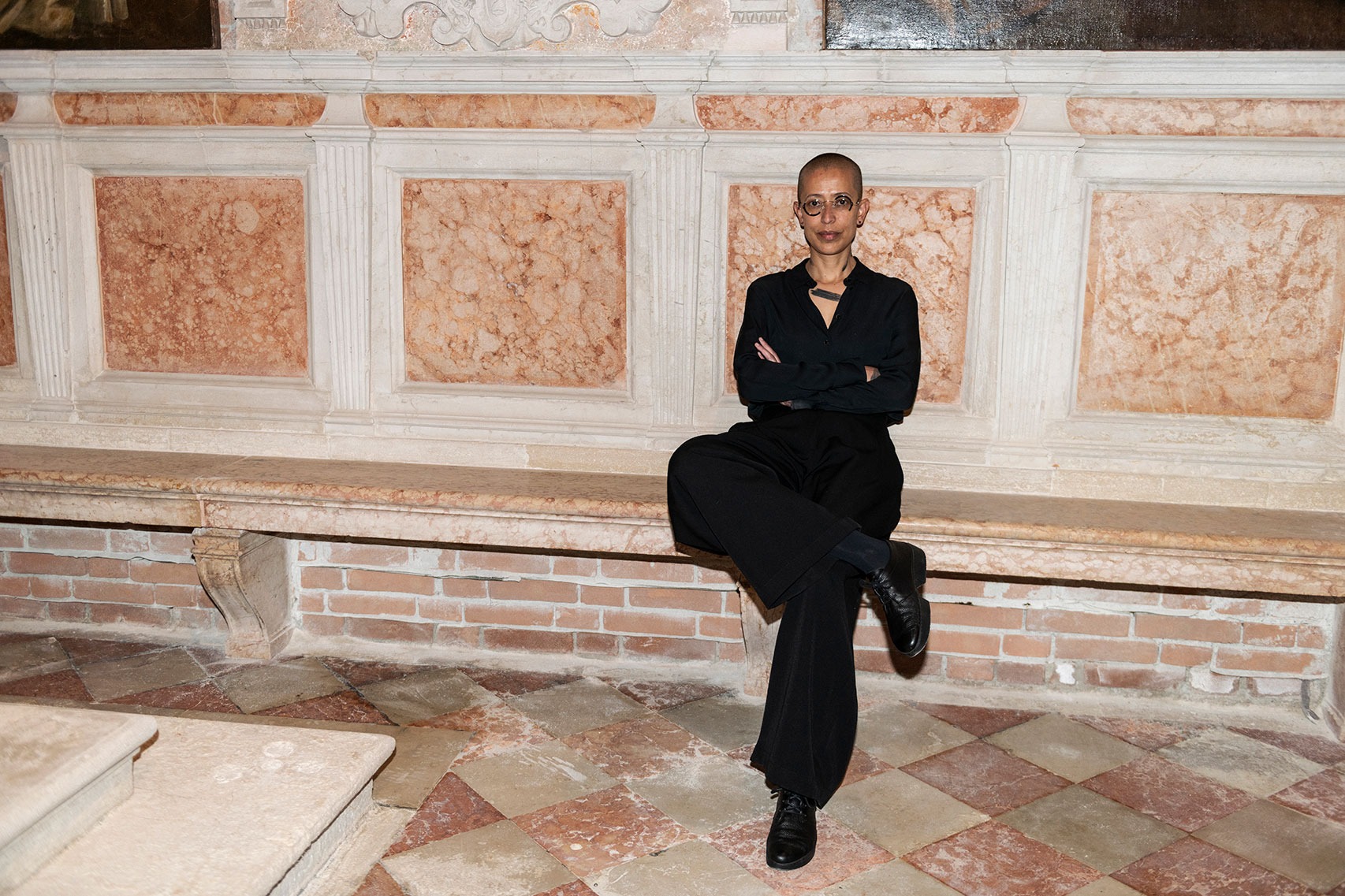
 Gabrielle Goliath stages an independent exhibition of her
acclaimed, long-term performance project Elegy — a ritual lament of shared breath and song — as a multichannel video installation at Chiesa di Sant’Antonin in Castello, Venice, from Tuesday 5 May to Friday 31 July 2026. (Photo: Supplied / Luca Meneghal)
Gabrielle Goliath stages an independent exhibition of her
acclaimed, long-term performance project Elegy — a ritual lament of shared breath and song — as a multichannel video installation at Chiesa di Sant’Antonin in Castello, Venice, from Tuesday 5 May to Friday 31 July 2026. (Photo: Supplied / Luca Meneghal) Perhaps the God that populist Arts and Culture Minister Gayton McKenzie believes in so fervently does indeed exist – and she does work in mysterious ways.
The Venice Biennale, from which McKenzie had prevented artist Gabrielle Goliath’s Elegy from representing South Africa because it allegedly affronted his pro-Israel sensibilities, can be a noisy place: a frenzy of cocktail parties and previews, crowded schmoozing and loud conversations as weighty as the air kisses the art world’s glitterati use as greeting. Pass the Prosecco, and never mind the genocide in Gaza, dahlink!
This appeared to be the case, according to reports emanating from the previews which started on Wednesday, before the Biennale opens to the general public on 8 May. The noise has been building up ever since the Biennale’s jury resigned en masse on 30 April, eight days after it had released a statement announcing that it would not consider giving awards to countries facing charges of war crimes by the International Criminal Court. Israel and Russia, in other words.
In response, the Biennale Foundation has not barred either country, but instead announced that the audiences will vote for the “Visitors’ Lion” prizes, which will replace the Gold and Silver Lions usually handed out by the jury.
This has all increased the volume in discussions about the place of politics in the art world. The Art not Genocide Alliance has already protested outside the Israeli pavilion and is planning another protest at the city’s Viale Garibaldi on 8 May.
So when Goliath’s Elegy did open in Venice’s Chiesa di Sant’Antonin on 5 May, outside of the official Biennale and its concentration of national pavilions and parties, its quiet location must have felt like a godsend?
Over the phone from Venice, Goliath’s mellifluous laugh carries a sense of vindication: “It’s so obvious that a church is the natural place for a work of remembrance and mourning. You feel the work so profoundly when you step into that space,” she says.
The installation consists of eight screens, each showing a relay of women holding the B natural note, while ascending to a spot-lit dais for a few seconds before descending and moving back into the shadows. In harmony, their voices fill the church with the mournful memory of the women and queers who have been murdered by men.
/file/attachments/orphans/Elegy_Gabrielle-Goliath-2026-courtesy-of-the-artist-photo-Luca-Meneghel_1_747141.jpg "Gabrielle Goliath’s Elegy exhibition alongside and outside of the official 2026 Venice Biennale. (Photo: Supplied / Luca Meneghal)")
“In the church, the work feels beautiful, urgent and insurgent. Its doing exactly what it was meant to do: invoke these absent presences, these lives so easily disavowed – Heba Abu Nada [the Palestinian poet killed after 7 October 2023 in Gaza by the Israeli Defense Forces], Ipeleng Christine Moholane [who was killed in South Africa in 2014 and whose death caused Goliath to begin work on Elegy], the two Nama women ancestors [who remain nameless in the German colonial archive] and so many more,” says Goliath.
It is clear that McKenzie’s attempts to censor Goliath, news of which first broke in Daily Maverick in January, and the international media coverage which followed, has reaffirmed both the artist and Elegy as a cause célèbre in Venice.
/file/attachments/orphans/Elegy_Gabrielle-Goliath-2026-courtesy-of-the-artist-photo-Luca-Meneghel_9_426884.jpg "Gabrielle Goliath’s Elegy installation — a ritual lament of shared breath and song — at Chiesa di Sant’Antonin in Castello, Venice. (Photo: Supplied / Luca Meneghal)")
The artist has been inundated with interview requests from the media, and the Chiesa di Sant’Antonin has, according to her, become an oasis of calm: a space for reflection, remembrance, resilience and mourning, removed from the buzz of the Biennale. While the South African Pavilion at the Biennale stands empty, thousands have already come to view the work and the response, says Goliath, has been “profoundly, truly humbling”.
At the time of writing on Thursday evening, people were gathering outside the Chiesa di Sant’Antonin to read from the Elegy Reader being launched by Ibraaz, a London-based space for art, culture and ideas from the “global majority”. The Elegy Reader, conceived as an extension of Goliath’s work, is a collection of poetry and texts that responds to “histories of displacement, colonialism and genocide”, according to Ibraaz.
Ibraaz and its director, Lina Lazaar have been instrumental in getting Goliath to Venice. Likewise, the Bertha Foundation and a host of other “existing relationships” that Goliath had acquired over the years as an artist – all pulling together to ensure her work appeared in Venice.
At the end of March, Goliath’s life was a flurry of activity: preparing for another exhibition, Bearing, in Milan, while also readying the transportation of Elegy to Venice. Her European network was kicking into solidarity and logistical gear – helping to bring down the cost of getting the work to Venice.
She sounded exhausted then. Now, Goliath says she is “feeling a bit fragile” from all the attention, but, simultaneously, a sense of triumph at evading McKenzie’s attempted censorship.
/file/attachments/orphans/Elegy_Gabrielle-Goliath-2026-courtesy-of-the-artist-photo-Luca-Meneghel_8_357118.jpg "Gabrielle Goliath stages an independent exhibition of her acclaimed, long-term performance project Elegy — a ritual lament of shared breath and song — as a multichannel video installation at Chiesa di Sant’Antonin in Castello, Venice, from 5 May to 31 July 2026. (Photo: Supplied / Luca Meneghal)")
Elegy was prevented from representing South Africa in the Biennale after McKenzie’s manoeuvring and a high court ruling that found Goliath did not have legal standing to bring her urgent application to have her work reinstated as the official South African entry.
While the ruling is being appealed (a date hasn’t been set), it has not stopped McKenzie from misrepresenting it to the South African public. In March, a few weeks after judgment was handed down, McKenzie told a press conference: “I want to make it clear, the court upheld my decision as legal and we are confident that the appeal courts will rule the same way, but let’s allow the process to play out.”

Gauteng high court Judge Mamokolo Kubushi had, in fact, not “upheld” McKenzie’s “decision as legal”. She had instead declined to find on the merits of a case which carried significant importance in relation to freedom of expression and executive overreach. Instead Kubushi delivered a ruling on the procedural rather than substantive aspects of the case.
McKenzie, at that March press conference, reiterated his belief that he had unfettered power to do as he pleased as arts and culture minister: “I must have the right to say which art do we as the minister want at particular events,” he said.
This is exactly the kind of authoritarian behaviour that Goliath’s lawyers hope to rein in with their appeal, as they argue that McKenzie’s behaviour in attempting to censor and then cancel Goliath “violated the principle of the rule of law” and “violated the right of freedom of expression in section 16 of the Constitution”.
In their notice of leave to appeal, Goliath’s lawyers further claim that the high court should not have shied away from considering the merits of the case and that McKenzie’s behaviour during the debacle “constituted a breach of a public undertaking or promise, and was unlawful on the ground that constituted unconscionable state conduct”.
During arguments in the Gauteng high court when Goliath’s matter was first aired, the Campaign for Free Expression had argued that McKenzie’s behaviour was akin to that of apartheid-era ministers hell-bent on propaganda to wash the regime’s reputation.
There have been similar criticisms of the Biennale Foundation allowing countries such as Israel and Russia to “art-wash” their reputations through their continuing inclusion.
Goliath believes the Biennale Jury “took a principled stance in resigning” and says she has been reminding people that “I come from a country which was barred from the Biennale because of apartheid. The Biennale Foundation was able to locate its moral compass then; it should do so again.” DM