




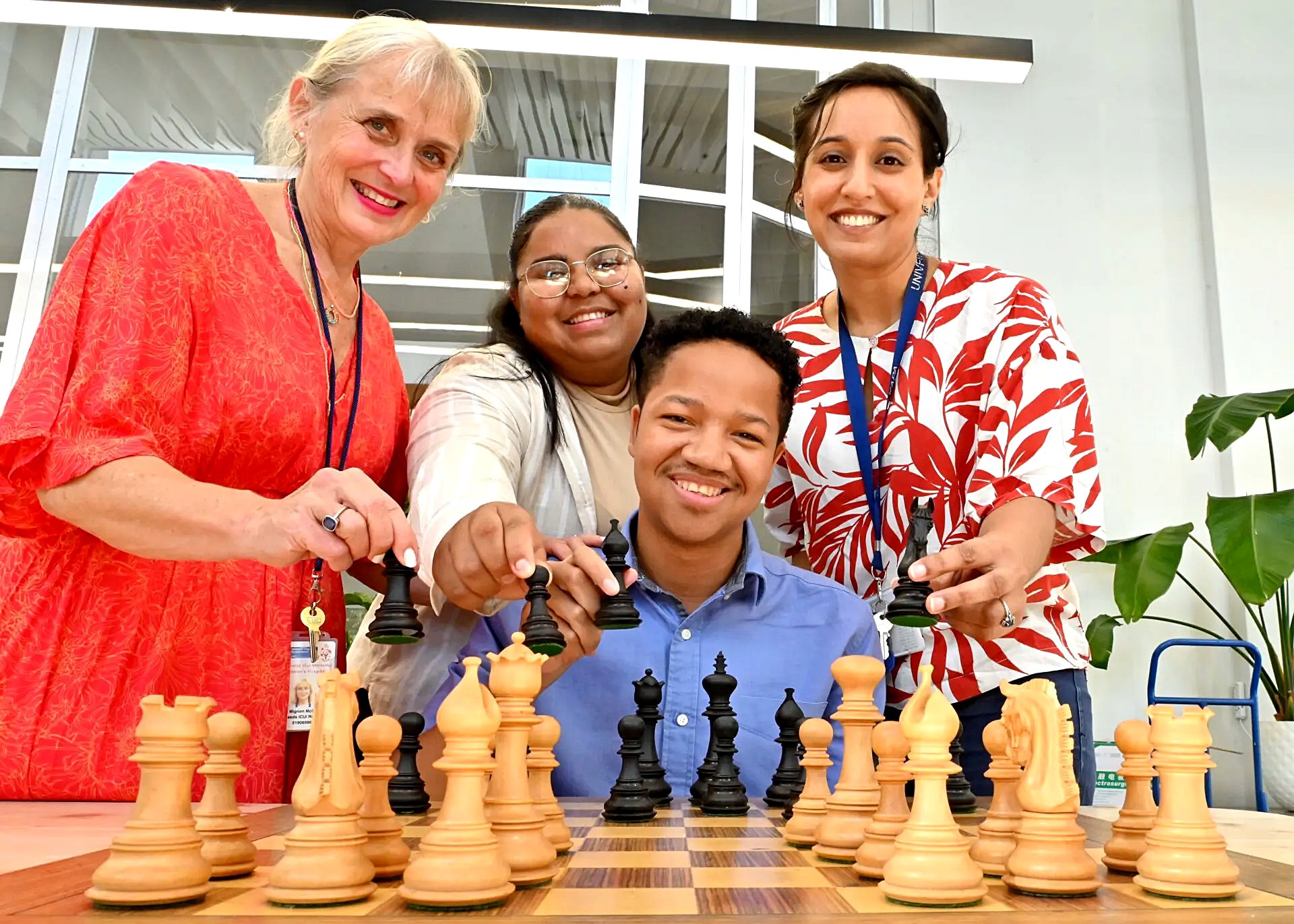
 Patient Tarique Kenny with the team at Kayac clinic at Groote Schuur Hospital. (Photo: Nasief Manie / Spotlight)
The halls of Groote Schuur Hospital in Cape Town are sometimes rather sombre, but on a Thursday afternoon the Nephrology Unit feels more like the chatty passageway of a high school.
This is when the Kidney Adolescent and Young Adult Clinic (Kayac) is in session for patients between the ages of 13 and 25. They give blood and urine samples, see their medical teams, pick up medication, and go to a social support group with other teenagers – all in one go.
A regular presence here is Tarique Kenny. The 25-year-old has a big smile and a love for playing 30 Seconds during the support group time.
“Even though Kayac is amazing, the truth is that for any youngster, a hospital is boring,” he says. “Nobody wants to be here.”
Kenny has spent his life in hospitals, missing school, and needing to take bitter-tasting medication several times a day with frequent side effects. When he was three, Kenny was diagnosed with a genetic metabolic disease called Cystinosis, which causes crystal formation affecting the kidneys and other organs. He received a kidney transplant when he was 14.
He still remembers how scary it was outgrowing paediatric services at the neighbouring Red Cross War Memorial Children’s Hospital.
“It felt like a nightmare, because of the mood, it just felt really depressing,” he admits.
But once inside Kayac with patients of his own age, Kenny says he immediately adjusted.
“I think within a couple of hours, it felt like my new home, a new safe zone.” He recently moved over into adult nephrology services, but is now a patient mentor for other young people with kidney problems at Kayac.
Kenny’s experience is unique in the public healthcare system, where children are typically moved to the adult standard-of-care nephrology services at 13 years old. Particularly in renal care, this transition can come with great risks when not well supported.
‘A silent killer’
Kidney disease is a silent killer, says Professor Mignon McCulloch, the Head of Paediatric Nephrology and Solid Organ Transplant at Red Cross War Memorial Children’s Hospital. She says that childhood kidney disease is a concern in SA where in some settings limited access to antenatal scans can mean that congenital problems are not picked up early.
“We see a lot of kids who’ve got congenital or birth defect problems with their kidneys that may not even present at birth,” she says.
/file/attachments/orphans/Image3KayacClinic_413321.jpg "Professor Mignon McCulloch’s innovative strategies are transforming kidney disease treatment. (Photo: Nasief Manie / Spotlight)")
The spectrum of kidney disease varies widely across age groups. Children often have kidney problems from birth, while teenagers are more likely to struggle with immune-related kidney disease. Adults predominantly face diabetic nephropathy and hypertensive disease. Around 10% of people are thought to be living with chronic kidney disease, but estimates vary substantially between studies and different populations.
McCulloch says that some other countries may be able to offer a kidney transplant to people who need one within a year, but it tends to take up to a decade in SA.
“That’s their whole teenage life, effectively,” she says.
For kids with serious kidney disease who cannot access care, the prognosis is often bleak. One meta-analysis found a mortality rate of about 95% in young patients with kidney failure in sub‐Saharan Africa who were not able to access blood dialysis.
However, if these patients are treated soon and consistently, there is hope.
“On the whole with kids, if you can pick it up early you can really make them hang on to their kidneys for a long, long time,” McCulloch says.
She says she was inspired in 2002 to start an adolescent clinic for transplant patients – which eventually became Kayac.
“We had a group of patients that transitioned not as well as they could have, and for some it was quite a hard and difficult journey,” McCulloch says.
Some of this cohort went on to develop advanced kidney disease, and some died.
The paediatric nephrologist wanted to give them a place where they could belong that was different to the adult service.
“Where the Kayac is brilliant, is that it’s not sitting next to 60-, 70- or 80-year-old patients, but with a group of essentially buddies,” she says.
‘Like a bridge’
“It’s kind of like the story of a bridge,” explains Dr Zibya Barday, a consultant nephrologist at Groote Schuur Hospital and head of Kayac. A facility specifically designed for adolescents is rare, but fills a crucial gap.
Firstly, Kayac sees about 15 patients at a time, while for other patient groups and adults the nephrology unit sees about 50 to 70 people. The teens get seen more regularly, for longer consultations than adult patients. They tend to see the same healthcare team every time, fostering trust.
/file/attachments/orphans/Image4KayacClinic_643365.jpg "Kayac is headed by Dr Zibya Barday in partnership with a multidisciplinary team, including an adult and paediatric nephrologist, a nurse practitioner and social worker. (Photo: Nasief Manie / Spotlight)")
Blood and urine samples are taken on site, at the day of the appointment, rather than separately at a different clinic, which puts less pressure on patients. The team also makes things easier by helping to reschedule the adolescents and reminding them of appointments. Even medication can be packed up for patients, allowing them to avoid lengthy pharmacy waits.
To help with the actual transition from paediatric care, the teams at Groote Schuur Hospital and Red Cross War Memorial Children’s Hospital work closely together and prepare children from a young age. This is different to how the transition between child and adult care was previously done, Barday says.
“In those early days, they were given a letter, because that’s how all referrals work, and they were meant to find the hospital and clinic and make the appointment.”
“I think it’s essential, because there’s no other place that focuses solely on adolescents,” says Dr Marli Matthysen, the Groote Schuur Hospital Nephrology Unit’s Medical Officer. She explains that young adults are a particularly difficult patient population because of the high risks, hormone changes, and a lack of acceptance and understanding of their circumstances.
“They feel it’s very unfair that they have been suffering from a chronic illness, and none of their peers has to go through it.”
Psychological support
This makes the social and psychological support at Kayac key to keeping teens in the system. The support group, where the adolescents can relax and talk about life beyond the hospital with others in their position, is especially important. This is where the teens find belonging, and it helps them stay engaged in their care and continue to take treatment.
Kayac also works with psychologists and other disciplines to support the teens. A unique team member is Clarissa Lawrence, a renal youth social worker focusing solely on the Groote Schuur Hospital and Red Cross War Memorial Children’s Hospital clinics and this age group. Her role is financially and professionally supported by the Oxford Young Adult Clinic in the United Kingdom. It is a sub-group of the Oxford Kidney Unit and Transplant Centre, which is a similar renal adolescent clinic that has been a partner and model for Kayac.
Lawrence says adolescents’ medical transition to adult care is often neglected or overlooked in healthcare, but that support at this critical point is important for long-term outcomes.
“We don’t realise the importance of caring for these patients right now, because if we don’t care for them right now, we are not going to have patients when they are adults,” she says.
Research has found that poor paediatric to adult care transitions in low- and middle-income countries across diseases, including HIV, can lead to increased morbidity and mortality due to an increased risk of treatment failure and patients not being followed up on. These broader insights have shown that creating programmes and policies focusing specifically on adolescents can make a significant difference.
Better outcomes
A study by Barday, McCulloch and others assessed the impact of Kayac over five years by comparing the results of their patients with adolescents who received adult standard-of-care nephrology services. It found that patients in the adolescent clinic had better outcomes, like delayed progression to kidney failure and lower rates of mortality. They also were slightly less likely to stop coming for treatment.
For instance, Kayac patients had an improved composite outcome survival rate of 97% after a year compared with 87% in the adult clinics. This means that when looking at multiple metrics like hospitalisation and death, those in the adolescent clinic had better outcomes overall than in the adult service. This difference stayed fairly steady after three and five years.
Loss to follow-up at Kayac was less than half that for the same age group at the adult clinic (15% compared with 34%) and patients who left the programme tended to have less severe disease than those who stayed. Disengaging from care is a global challenge in adolescents with complex chronic conditions.
Occasional challenges with adherence to medicine and clinic visits happen both in Kayac and the adult system. As Kayac’s capacity to take in patients from the adult service has grown, the statistics on adherence may have been affected. Regardless, it is an ongoing problem with this age population.
The doctors put the success of Kayac down to dedication and teamwork between the two hospitals. McCulloch says it is not so much about having lots of financial support, but rather commitment to the cause.
“I think you need a passionate person on the paediatric side and a passionate person on the adult side,” she says.
The success of focusing on adolescents hasn’t gone unnoticed by the wider medical field.
“We get a lot of questions from other disciplines that have tried to create transition clinics,” Barday says. “For various factors, it’s really hard to grow a new clinic or dedicated team that’s devoted to these young individuals.”
She says she hopes that their work can show the importance of not overlooking adolescent populations and their unique needs. DM
Note: This article has been updated to correctly reflect the lost to follow-up figures from the paper on Kayac. A previous version quoted figures from the text of the paper. A study author has pointed out to us that we should rather quote the figures from table 2 in the paper.
This article was first published by Spotlight – health journalism in the public interest. Sign up to the Spotlight newsletter.
/file/dailymaverick/wp-content/uploads/2024/07/Spotlight-logo-new.png)
Comments
Scroll down to load comments...