




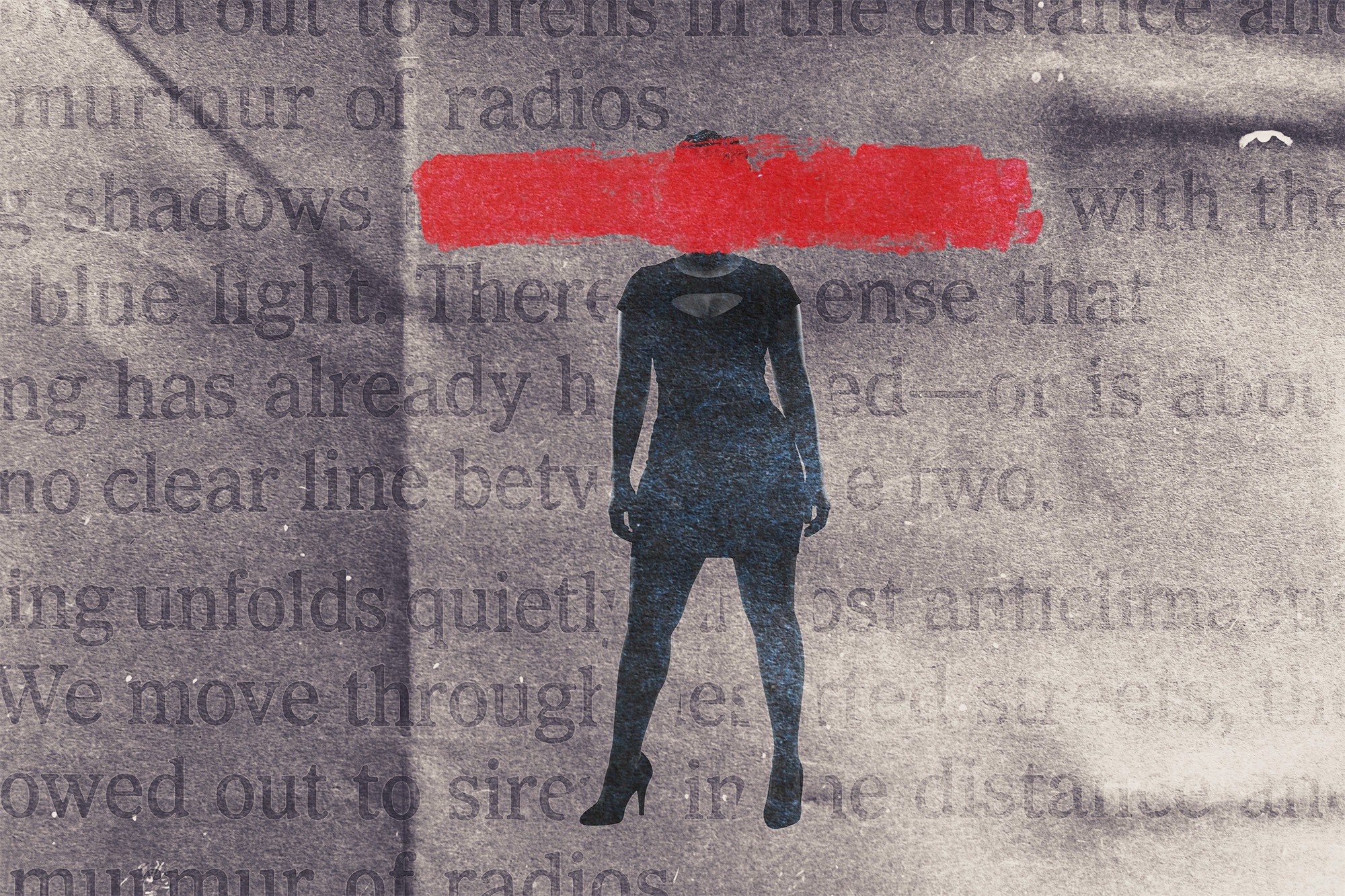
 As South Africa moves towards decriminalising sex work, journalism must recognise the crucial difference between documenting a context and reproducing a harmful gaze, ensuring people are positioned as subjects with dignity and rights, not as spectacle, the writers say. (Illustrative image: Sources generated with Google Gemini Flash Image 2.5)
 The recent “Raid to nowhere – my unlikely night with police on Queen Street, Kensington” (15 March 2026) is, on the surface, a compelling piece of writing. It is atmospheric and immersive, drawing the reader into a rain-soaked street, flashing lights and the uneasy theatre of a late-night police operation.
As a crime narrative, it works.
But presented as journalism – under “Reporter’s Notebook” rather than a clearly marked opinion piece – it raises more difficult questions.
Because good writing does not absolve ethical responsibility. If anything, it heightens it – particularly when it relates to sex workers, who face some of the highest levels of violence, discrimination and social stigma in South Africa.
The more compelling the narrative, the more power it has to shape public perception.
And this is precisely where this piece becomes troubling.
Police raids in South Africa are not a neutral event. They carry a long history – from apartheid-era enforcement of racial and moral codes to contemporary patterns of selective policing. For sex workers, research consistently documents harassment, gender-based and sexual violence, and abuse at the hands of law enforcement.
This is not abstract. It is a reality. One of the co-authors of this piece was arrested herself after police used condoms as evidence of criminality. Subjected to a degrading strip search, she later discovered money missing from her home after the police entry.
These experiences are not exceptional – they are part of a broader pattern.
/file/attachments/orphans/mabasa-sexworkvsPolice_775817.jpg "Sex workers are visible as shadowy figures, observed through the furtive gaze of the reader, painted as part of the lewd and transgressive scenery, representing an atmosphere of disorder, risk and intrigue. (Photo: Flickr / Thomas Hawk)")
Against this backdrop, what is described in the article as an uneventful “damp neighborhood gathering” looks very different for those on the receiving end of questioning, searches, arrests and detention.
The article itself is not explicitly about sex workers. It follows a journalist accompanying a community policing forum patrol addressing local disturbances such as unlicensed bars.
And yet, sex workers, who are identified as about at the same time as the patrol, are everywhere in this piece. Not as subjects, but as part of the scenery.
They are visible as shadowy figures, observed through the furtive gaze of the reader and repeatedly returned to. Painted as part of the lewd and transgressive scenery – they represent the atmosphere of disorder, risk and intrigue – rendered present but voiceless. As art critic John Berger reminds us, “every image embodies a way of seeing”. Here, that way of seeing matters.
Because this is not a neutral observation. It is a particular kind of gaze.
/file/dailymaverick/wp-content/uploads/2025/09/ED_395784.jpg "Protesters marched from Hanover Street to the Slave Lodge in Cape Town on 11 August 2022 as the Sex Workers Education and Advocacy Task Force said the Commission for Gender Equality was selling out sex workers. (Photo: Gallo Images / Brenton Geach)")
/file/dailymaverick/wp-content/uploads/MC-SexWork.jpg "Criminalisation has undermined sex workers’ access to justice for crimes committed against them and exposed them to unchecked abuse and exploitation by law enforcement officials. (Photo: thecut.com / Wikipedia)")
The journalist notes, almost with pride, that she deftly and covertly “took a few sneak photos”, congratulating herself on her “unexpected undercover skills”. This tone is strikingly familiar – echoing the cloak-and-dagger reality TV series Cops, screened on Fox TV, in which surveillance and arrest are packaged as entertainment. This includes disturbing “prostitution sting operations”, in which US police employ entrapment techniques with cameras and microphones to arrest sex workers as entertainment for millions of eager viewers. The show was eventually cancelled over racist and violent police practices.
The women in this piece, meanwhile, are described as largely indifferent and extend a form of everyday respect, allowing the journalist to occupy the space without intrusion: “They continued standing right next to me, completely ignoring me, not even offering curious stares.”
This respect is not returned.
Instead, the women are photographed, without consent, transformed into visual material and folded into the narrative as texture.
A moment that is not incidental but reveals a deeper problem.
/file/attachments/orphans/ED_232340_669874.jpeg "Members of the Sex Workers Education and Advocacy Taskforce were arrested during a march against gender-based violence from the Durban beachfront to City Hall on 27 June 2020. (Photo: Gallo Images / Darren Stewart)")
When people are reduced to composition – to what sits “in the frame” – they cease to be subjects with agency. None of this is necessarily unlawful. Photographing people in public space is often legally permissible.
But ethical journalism requires more than legal compliance. It requires attention to dignity, context and potential harms – particularly where individuals are already exposed to stigma, criminalisation and violence.
In a context where sex workers routinely navigate harassment and surveillance, being photographed without consent is not neutral.
Nor is being represented as a part of a scene of urban disorder. These forms of representation do not simply reflect vulnerability – they deepen it.
This matters all the more at a moment when South Africa is actively rethinking its approach to criminal law and consensual adult sex work. The Department of Justice and Constitutional Development has reaffirmed its commitment to decriminalisation of sex work. reflecting a growing body of evidence that criminalisation increases vulnerability – undermining rights to access healthcare, legal protection and safety.
But law reform alone is not enough. The persistence of stigma – rooted in misogyny, moralism and long-standing prejudice – continues to shape how sex workers are seen, treated and policed. Despite a moratorium on sex work prosecutions agreed by the National Prosecuting Authority in late 2025, it is unclear whether the South African Police Service will cease arresting and detaining sex workers.
Representation is at the centre of this.
The article may not have intended to centre sex workers. But it is, in effect, about them – and, crucially, about them without them. Without voice, without context and without consent. This is where the risk lies.
/file/dailymaverick/wp-content/uploads/sally-sexwork.jpg "Sex workers march in the Johannesburg CBD on 7 March 2013. (Photo by Gallo Images / Daily Sun / Noko Mashilo)")
Because when people are reduced to backdrops, it becomes easier to ignore and deny their rights. When they are rendered as atmosphere, their experiences become secondary to the story being told.
This is neither an argument against writing about sex work, nor a call to sanitise uncomfortable realities. It is a call to recognise the difference between documenting a context and reproducing a gaze.
That difference lies in how people are positioned: as subjects, or as spectacle.
At a time when South Africa is being asked to confront the realities of sex work – not as abstraction, but as lived experience – journalism matters. Not just in what it shows, but how it shows it.
Because when representation overlooks dignity and rights, even if unintentionally, it does more than misrepresent. It reinforces the very conditions that make harm possible. DM
Dr Rebecca Walker is a senior research consultant with the African Centre for Migration & Society (ACMS) at the University of the Witwatersrand. Dr Marlise Richter is a Senior Research Officer at the School of Public Health, University of Cape Town, and a Research Associate at the ACMS. Constance Mathe is National Coordinator of the Asijiki Coalition for the Decriminalisation of Sex Work.