



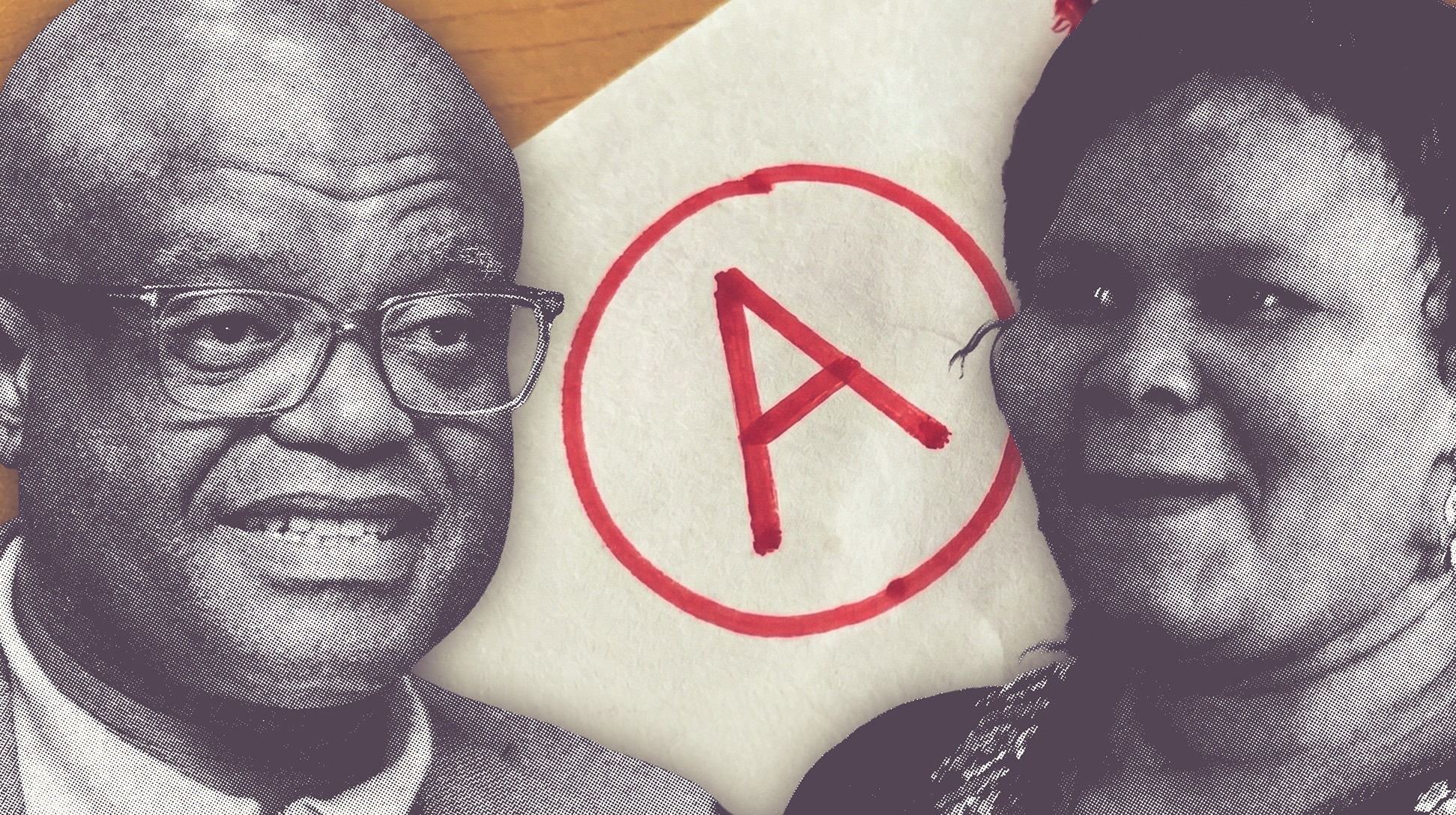
 Illustrative image, from left: Dada Morero (Photo: Gallo Images / Sharon Seretlo) | Babalwa Lobishe (Photo: Gallo Images / Die Burger / Lulama Zenzile) | Report Card (Photo: iStock)
Earlier this week, Joburg Mayor Dada Morero told News 24 he would give himself “eight out of 10” for his performance. Nelson Mandela Bay Mayor Babalwa Lobishe claimed she would get a “distinction” because she would give herself “80%”.
Morero and Lobishe must be alone in their view. It is impossible to believe people who live in those metros would share it.
Any retail politician, someone used to seeing voters and how they live, would know not to fall into the trap of answering the question. And if they had to, they would give themselves endless caveats about how so many forces are beyond their control.
It could only be politicians who are more concerned with the internal dynamics of their parties, more focused on defending the party and thus winning the support of people within it, who could have said that.
If they had had any sense of the frustration of voters in Joburg and Nelson Mandela Bay, they would never have said such a thing, knowing it would only anger people more.
News 24 has also reported that after Lobishe made that comment, Ramaphosa rebuked her privately for her performance in governance, amid allegations that she has been making decisions unilaterally.
Media hounds
This incident neatly underscores the divide between parties and politicians who focus on outside the party, attracting voters, and parties where leaders still focus more on inward dynamics.
Obviously, the size of the party and the level of power are key factors.
If the party is small and still thrusting for power, such as the PA or ActionSA, or many of the other sometimes tiny parties, they live and breathe in the media space.
This explains the DA. At the dawn of democracy, it was tiny and invested huge resources and thought in ensuring its voice was heard through the English-language media.
As our society has changed, become more urban and, strangely, more English-speaking, so the English-language media, in particular the broadcast media, have become more important.
The days of a party branch type of politics, where big decisions are taken during in-person meetings, are long gone.
This has suited the DA, and new entrants, the people who have joined those parties, have grown up focusing on the external, trying to win more support.
For them, TV and radio interviews are like living and breathing; answering tough questions from online journalists requires more thought, but is not difficult.
Branch politics
There is another group of people, who often learnt their politics in the previous era, who may not be able to change, and this will have implications for their future.
To a large extent, it is people who grew up in the culture of the ANC, when it was dominant, who fall into this category.
Former president Jacob Zuma, now leader of MK, hardly makes any attempt to engage the English-language media. He confines his public appearances (if any) to brief remarks, often in KwaZulu-Natal.
Crucially, he also speaks generally where there will be a large number of MK supporters. He appears focused only on that particular constituency.
Deputy President Paul Mashatile may be another.
It is one of the curiosities of our current period that the person with the most to gain, were something to befall President Cyril Ramaphosa, has done so little to craft any kind of public persona.
While it is true that not everyone is comfortable speaking in public, let alone in English, there are ways around that.
There are several people in our society who will gladly take your money to help train you to sound natural and confident in English – and they will help you craft your own voice when speaking in public.
Mashatile appears simply to be determined to avoid saying something new or interesting, or even substantive, while speaking in English – or indeed in any other language – in public.
The result is that he has formed no public ideology, focusing instead, it seems, on the internal politics of the ANC.
While this kind of “machine politics” has worked well for him and others in the past (and arguably got him elected deputy president of the ANC in 2022 and as National Treasurer in 2017; David Mabuza won the deputy leadership using the same system), things might be different now.
Public profile power
The broadening of our democracy, the fact that people feel they have more agency, and the weakening of the ANC and perhaps of its provincial barons, might well empower ANC delegates to make up their own minds in December next year.
And for many, the most important question might well be, who is the leader most able to attract votes in a national election?
Strangely, Ramaphosa, despite being older than Mashatile, has always been able to focus on the situation outside the ANC.
This is probably due to his long experience in public life (he became a public figure for the first time when he led the national miners’ strike in 1987, nearly 40 years ago) and his apparent comfort in dealing with both questions and television cameras (this experience might also have been won by the need to speak to an international audience during apartheid).
But more important than that, he has been able to craft a narrative in the public mind about what he stands for. This might protect him in interesting ways.
For example, should Friday’s Constitutional Court Phala Phala judgment result in the worst-case scenario for Ramaphosa, very few people outside parts of the ANC will agitate for Mashatile to take over.
This is because most people have no idea what Mashatile will stand for and what his agenda will be.
This is an example where a politician who has been able to create an acceptable public face might have more power than those who cannot.
In the DA, it is likely that Helen Zille’s very strong public profile is a hugely useful weapon. It might well have made it difficult for anyone to oppose her in the party.
As our politics becomes more contested and more accountable, this dividing line between people who focus inside their parties and those who focus outside their parties will become more important.
And those on the wrong side might find it to be a huge disadvantage. DM
Comments
Scroll down to load comments...