




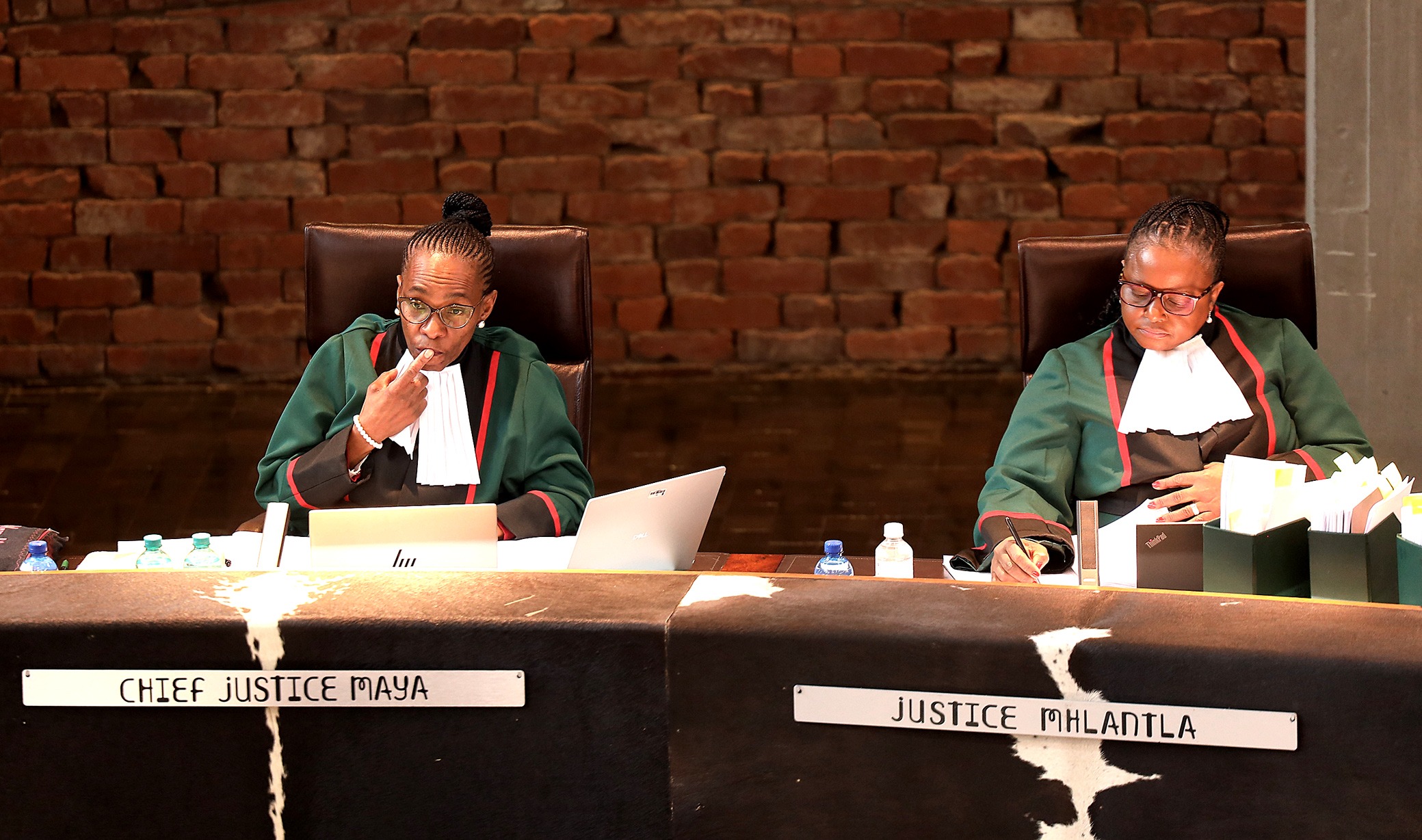
 Chief Justice Maya and Justice Mhlantla during the hearing of the National Health Insurance Act challenges at the Constitutional Court in Johannesburg on 5 May 2026. (Photo: Gallo Images / Sharon Seretlo)
 An allegedly flawed public input process is in the spotlight for a second day in the Constitutional Court, as arguments were heard in a challenge to the National Health Insurance Act on Wednesday.
In the second case brought before the ConCourt by Western Cape Premier Alan Winde, the scrutiny was on how Parliament engaged with the public in Gauteng and the Western Cape when it was considering whether to pass the NHI Act.
On Tuesday, the court heard arguments in a similar case brought by the Board of Healthcare Funders, a nonprofit organisation that represents 65 medical aid schemes, administrators and managed care organisations. The schemes represent 4.5 million beneficiaries.
The BHF also challenged the public participation process for the NHI Bill, saying that Parliament didn’t adequately engage with questions about the cost and funding model needed for the NHI. President Cyril Ramaphosa signed the legislation into law in May 2024, and it was almost immediately challenged. The Act proposed major changes to the country’s health system by pooling the resources of private and public healthcare providers.
Focus on Western Cape and Gauteng
Advocate Geoff Budlender SC addressed the court on behalf of Winde and explained that the Premier took issue with how public hearings by the National Council of Provinces were conducted in his province and Gauteng. In papers before the court, Budlender said there was a “rushed process in which meaningful engagement with public input was impossible.”
“The NCOP failed to consider input from the provincial public participation. Public participation reports from Gauteng were never submitted at all, with the result that the views of that province did not reach the NCOP. The Western Cape’s detailed public participation report was only placed before the Select Committee after the decisive stages of the process had been completed, when it could no longer influence the outcome. And even where provincial reports were available, they were not substantively engaged with,” he said in court papers.
During arguments in court, Budlender emphasised that the select committee that conducted the hearings was acting on behalf of Parliament and its work needed to pass Constitutional muster.
“There is no other public participation process. If the select committee fails to conduct public participation in the manner required by the Constitution, then the NCOP has failed to conduct the public participation in the manner required by the Constitution,” he argued.
‘Inflexible timetable’
Budlender told the court that Parliament employed an inflexible timetable and pointed out that in previous cases, the court had questioned such an approach.
“The timetable must be subordinated to the rights of the people and not the other way round. The rights don’t give way to the timetable,” he said.
Budlender also argues that the NCOP’s processes are an important part of the democratic process.
“It is made up of delegates from the provinces, and is a forum for expressing the interests of the provinces in the national legislative process, allowing for debate and discussion between provincial legislatures, particularly on issues that affect provinces. It thereby ensures that concerns raised in one province can be considered by the other provinces in a national forum. The NCOP’s role is thus that of a ‘linking mechanism’, which acts simultaneously to involve the provinces in national purposes, and to ensure the responsiveness of national government to provincial interests,” he says in court papers.
Justice Rammaka Mathopo questioned Budlender about evidence supplied by Parliament that suggested there had been hearings in Gauteng.
“In your submission, that would mean that in terms of Gauteng, nothing much transpired, and if it did, no evidence has been put forward to substantiate what happened there?” Mathopo asked.
“If it did happen, there is] no evidence to show that it did happen and no report to the select committee. No written report and no oral report, so even if it did happen, it doesn’t assist because there was no report to the select committee on what happened at the Gauteng public hearings,” replied Budlender.
Justice Mathopo followed up, asking what would happen if the court accepted Winde’s complaint.
“How are we going to unscramble this egg?” he said.
“I submit that at the very least, the public participation process would have to be repeated… You could conceptually say the public participation process must be repeated in Gauteng and in the Western Cape, and thereafter the select committee must meet and consider the reports and the amendments that are proposed,” Budlender responded.
He added that his second proposal was the “minimalist approach” to the problem.
Parliament asks for dismissal of complaint
Meanwhile, Parliament called on the court to dismiss Winde’s complaint, saying the province didn’t raise concerns at the time and that the province acted unreasonably.
“The challenge is manifestly without merit because there can be no doubt that Parliament took extraordinary steps to involve the public in the law-making process before it adopted the Bill,” Parliament’s counsel Ngwako Maenetje SC says in papers before the court.
“The Western Cape Provincial Legislature sought an extension because of three additional public participation hearings that it decided to hold in regions where it had already conducted public participation hearings during the agreed period. It contended that it needed more time so that it could collate responses from the public participation hearings, deliberate on them and agree on its negotiating mandate,” he adds.
“Parliament says it spent R14-million to ensure that it heard from people across the country and argues that there was “overwhelming support” for the Bill.
“The importance of the NHI Act is not disputed in this application. Both Parliament and the WCG recognised that the NHI Act fundamentally alters the way the State fulfils its obligations under section 27 of the Constitution. It is precisely for this reason that Parliament engaged in an extensive public participation process across the country, and over a lengthy period,” Parliament argues.
The court reserved judgment in both cases.
Five things to know about the NHI
The National Health Insurance Fund is the main tool created by the Act to manage healthcare services for citizens in South Africa.
The fund is an autonomous public entity, similar to the National Student Financial Aid Scheme, which will be used to ensure that all members of society have access to healthcare.
The fund will have the power to “determine payment rates annually for healthcare service providers, health establishments and suppliers in the prescribed manner and in accordance with the provisions of this Act.” This is a significant departure from the current system where private healthcare providers determine their own rates.
Section 4 of the act indicates that the fund will cover the healthcare of “South African citizens, permanent residents, refugees and inmates. It will cover the care of certain categories or individual foreigners determined by the Minister of Home Affairs, after consultation”. It will only cover the emergency care of asylum seekers and illegal immigrants.
The issue of how the NHI will be funded has been a hotly debated topic with many questioning where the government will get the money. The Act says it will be funded through general taxes, the reallocation of funding for medical scheme tax credits paid to various medical schemes, payroll tax and a surcharge on personal income tax.
DM