




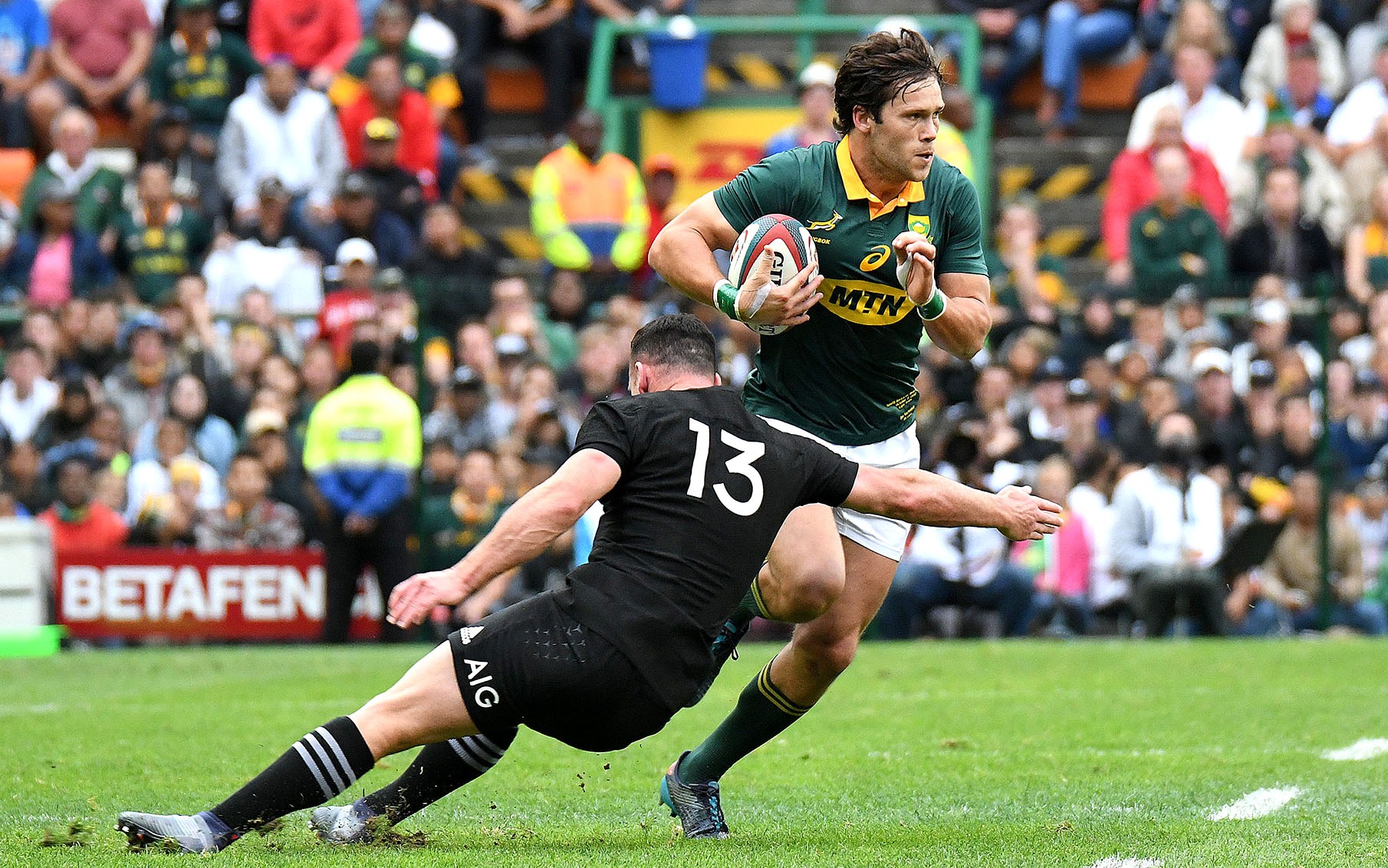
 Former Bok centre Jan Serfontein on the attack during the 2017 Rugby Championship against New Zealand at Newlands. It was the last of his 35 Test matches. He was only 24. (Photo: Wessel Oosthuizen / Gallo Images)
 It might come across as uncharitable to suggest that Jan Serfontein’s rugby career was one of unfulfilled promise. But it never quite touched the heights it could have.
A short media release from the Bulls this week, where Serfontein had been employed since returning from an eight-year stretch with Montpellier in France, noted the end of the brilliant centre’s career.
But it didn’t begin to paint the full picture of one of this country’s greatest talents in the professional era.
From Grant Khomo and Craven Week Player of the Year, to Junior World Player of the Year and a rising Test star, Serfontein was a great-in-waiting.
It didn’t turn out that way, at least not in the rugby sense. But as a person, he prioritised his family’s future and is now happily married and well positioned for the next phase of his working life.
Serfontein’s decision to leave SA after the 2017 season was taken with the full knowledge that he might not play for his country again.
/file/attachments/orphans/1479042211_897583.jpg "Jan Serfontein, playing for Montpellier, is tackled by Jack Nowell of Exeter Chiefs at Sandy Park on 2 April 2023. (Photo: Harry Trump / Getty Images)")
Montpellier were tough on well-paid foreign imports heading off to play Test rugby while under contract.
Technically, Regulation Nine of World Rugby’s laws decrees players must be released for Test duty. In reality the situation is always more complex as players such as Jannie and Bismarck du Plessis and Frans Steyn learned during their stints in France.
As a result, due to the move to France and other factors, Serfontein’s Test career, while very good, was unfulfilled for such a supremely gifted athlete.
But he prioritised family and gained a level of financial security that was difficult to match in SA. Still, he played almost 300 professional matches, 35 of which were Tests – won titles and was a respected professional. It was not a career to be sneezed at.
Serfontein was forced to call time on his career at the age of 33 this week. He was struggling to recover from a medial cruciate ligament injury sustained in April while playing for the Bulls.
“Every player knows that there’s a time to call it a day,” Serfontein said in a statement.
When it came to his Test career though, Serfontein called time on it nine years ago, even if that wasn’t his intention.
/file/attachments/orphans/858720934_555473.jpg "Serfontein fends off All Black lock Scott Barrett. (Photo: Peter Heeger / Gallo Images / Getty Images)")
Teen prodigy
There is a generation of young Springbok rugby fans who have probably not heard of Jan Serfontein, which is sad.
Serfontein made his Test debut against Italy, one week before fellow Gqeberha-raised Siya Kolisi made his international debut.
The great Bok captain continues to play at the highest level, and since that week in June 2013 when they both made their Test debuts seven days apart, Kolisi has gone on to win two World Cups and numerous other accolades.
Serfontein, by contrast, has quietly produced a high-quality, but relatively low-key career, largely away from the Test arena. Such is life and so are the nature of choices.
At 1.87m tall and 97kg for much of his career, he was a formidable physical specimen. Serfontein also had pace and deft hands and was a sublime playmaker. He had it all.
Serfontein played the last of his 35 Tests for the Springboks in 2017. He was only 24.
Ian Schwartz, who has 26 years of experience in high performance management and elite player recruitment at the Bulls and currently at the South African Rugby Union (Saru), was the first person to professionally contract Serfontein in 2009.
“In 2008, Jan was at Grey High in PE and played for Eastern Province at Grant Khomo (U16) Week in Ermelo. At that tournament, he was fantastic, despite being a year younger than everybody else,” Schwartz told Daily Maverick.
“He even kicked for goal. That doesn’t happen often. Jan had exceptional skills from early on, an unbelievable rugby IQ that was visible, even at that time.
“Nico Serfontein (no relation) was the guy that actually recruited him. We decided then that he needed to come to the Bulls, and it helped that Jan was a huge Bulls fan.
“His brother (Willem) already played for the Bulls, so we had a connection, and we told Jan we wanted to invest in his development.
“We flew him and his parents up to Pretoria and Jan attended a training session at Loftus. During that session one of the players tore his shorts and discarded them on the side of the field.
“After training, Jan asked if he could have those shorts.”
/file/attachments/orphans/TL_2462086_389654.jpg "Jan Serfontein plays in the URC for the Bulls against the Ospreys at Loftus Versfeld on 27 September 2025. (Photo: Sydney Seshibedi / Gallo Images)")
The Bulls signed him on a development agreement in 2009, which bound him to the Bulls even though he had more than two years of school to finish.
The following year Serfontein moved to Grey College in Bloemfontein, having been offered a bursary at the great rugby nursery. It took him a little closer to Pretoria, and while he was at Grey the Bulls would bring Serfontein to Loftus at regular intervals for conditioning assessments and training programmes.
Serfontein made the Free State Grant Khomo Week team in 2009 and was the player of the tournament.
For the next two years he played for Grey’s first team and made the Free State Craven Week (U18) team in grades 11 and 12. In his first year of Craven Week, Serfontein played on the wing because the two Grey centres, William Small-Smith (who captain the 2012 Junior Boks to the world title) and Dries Swanepoel (who later played senior rugby for the Bulls), were a year older and were settled in the midfield.
But by 2011, in his matric year, Serfontein was established at centre and made SA Schools after being named Craven Week Player of the Year.
Rise
The rise was meteoric from there.
In 2012 he was the star of the SA team that won the Junior World Championships on home soil, winning the World Junior Player of the Year award.
That team contained players such as Handré Pollard, Pieter-Steph du Toit and Steven Kitshoff, who have all subsequently won two World Cups.
/file/attachments/orphans/GettyImages-145969118_996261.jpg "Jan Serfontein in action for the Junior Boks against Italy at University of the Western Cape on 8 June 2012. (Photo: Luke Walker / Gallo Images / Getty Images)")
In 2013, Serfontein made his Test debut, but it came at the cost of another year at the U20 World Championships.
In retrospect, Schwartz, who in 2013 was the Springbok manager, admitted that it might have been better for Serfontein to play one more year of U20 rugby.
But the genie was out the bottle and over the next four years Serfontein became a Test player and amassed 35 caps. He won a World Cup bronze medal at the 2015 tournament.
After a brilliant 2017 season, where Serfontein starred in the 3-0 home series win over France as well as in many other Tests that year, he took up Montpellier’s offer.
No one knew it then, but he would never feature in Test rugby again as Saru and the Springboks went through significant changes in 2018, with the appointment of Rassie Erasmus as director of rugby.
Serfontein’s departure coincided with these events, as well as the rise of Damian de Allende.
/file/attachments/2991/Copilot_20260506_145817_358004.png "Serfontein's career at a glance. (Graphic: Daily Maverick)")
“Jan was born to play 100 Test matches, but for that to happen, a lot must go right,” Schwartz said. “Jan came through every pathway available in South African rugby at the time, and excelled. He was the first player out of Elite Player Development Programme (EPDP) to become a Springbok.
“It shows that everybody involved in the EPDP associated with Jan’s talent and selected him at every level on the way through the system.”
Serfontein’s story, though, is really about how quickly we forget. Or maybe it’s a story of how we have so much talent in this country that we move on very quickly because there’s another guy coming through.
Whichever it is, we only glimpsed the best of one of the greatest talents of the modern era. DM