




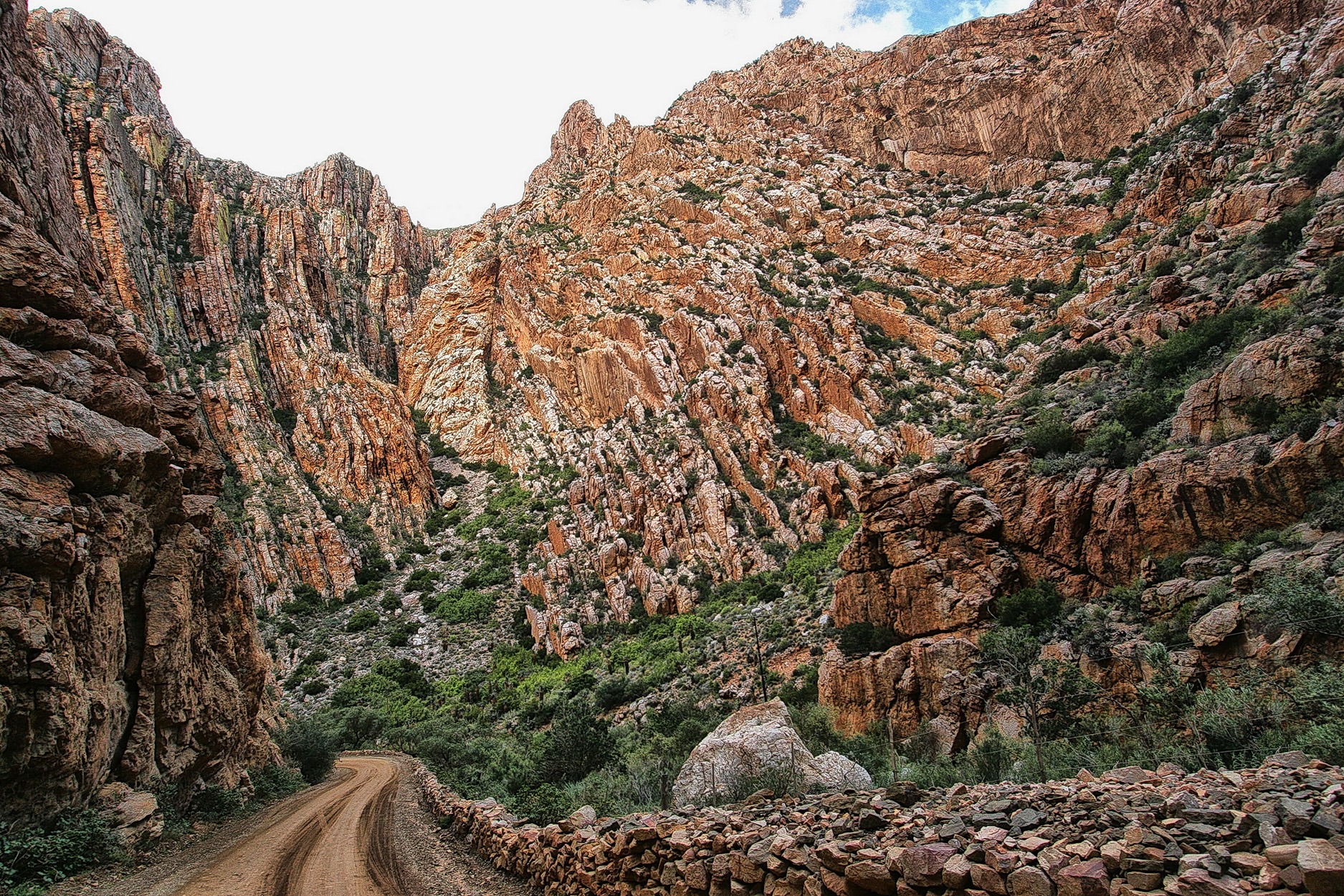
 The entrance to the Swartberg Pass, with the original stonework and spectacular rock formations. (Photo: Chris Marais)
 The entire Swartberg mountain range, the very physical border between the Great Karoo and the Klein Karoo, is 230km long and spectacularly beautiful.
From the enigmatic twin peak of Towerkop near Ladismith to Toorwaterpoort north of Uniondale, it offers some of the most interesting geological lessons this country has to offer.
High and jagged though they are, with some of the tallest peaks in the country, the Swartberg we see today is just the basement and first storey of what was once a giant mountain range.
/file/attachments/orphans/ViewoftheSwartbergRangesandtheGreatKaroobeyondfromBosluisKloof_ChrisMarais_390940.jpg "View of the Swartberg Ranges and the Great Karoo beyond from Bosluis Kloof. (Photo: Chris Marais)")
The Cape Fold Belt
Its story starts 300 million years ago, when Africa, Antarctica, South America and Australia were all still part of one giant mega-continent called Gondwana.
The tectonic plates beneath them were adrift – and still are, a unique feature of our planet. One of those plates began to push hard against the southern edge of Africa.
In slow motion, Earth’s crust was crunched, compressed and buckled by this massive and implacable pressure from further south. A mountain range began to rise from the Agulhas Sea. Over millions of years huge masses of land were pushed skywards, forming a range 6km or 7km high.
The weight of this mountain range was eventually so immense that Earth’s crust to the north of the Swartberg sagged, hollowing out a place for what would become the Karoo’s shallow inland sea.
The Swartberg Mountains are part of the Cape Fold Belt, walls of mountains running roughly parallel, east to west, rucked up like a kicked mat. The Cape Folds also include the Langeberg and Outeniquas, the Kouga-Baviaans and the Kammanassies.
Before Gondwana started tearing apart, the Cape Fold Belt stretched even wider, to the Ventana mountains of present Argentina, the Pensacola and Ellsworth mountains of Antarctica, and the Hunter Bowen range in Australia.
Once as high as the Andes, the Cape Fold Belt mountains have been worn down to a nub of their former selves. Two-thirds of their mass has eroded away. But the extraordinary weight of what once stood here has thrust, compressed, pressured, buckled and contorted the hard rock layers into spectacular curves and shapes.
/file/attachments/orphans/ThefoldedandlayeredorangerockformationsinMeiringsPoortaremesmerising_ChrisMarais_453369.jpg "The folded and layered orange rock formations in Meiringspoort are mesmerising. (Photo: Chris Marais)")
/file/attachments/orphans/ApartfromoccasionalweatherrepairstheSwartbergPassiseasilynavigatedasitsnakesthroughthemountainranges_ChrisMarais_666373.jpg "Apart from occasional weather repairs, the Swartberg Pass is easily navigated as it snakes through the mountain ranges. (Photo: Chris Marais)")
Finding a way through
For aeons, the Swartberg Mountains walled off the Groot Karoo from the southern Cape. In the 1800s, locals began petitioning for a road.
The Central Roads Board appointed engineer Adam de Smidt to cut a rough “farmer’s route” through the poort, a gorge that had been carved over time by the flood-prone Groot River.
The road was passable by 1858, linking Klaarstroom in the north to De Rust in the south. It was named Meiringspoort after farmer Petrus Johannes Meiring, who made the first path through and who was a prime motivator for the road. It criss-crosses the Groot River no fewer than 25 times and each drift has a different and evocative name. De Smidt’s road was rough and ready, but it worked.
Once he was finished with Meiringspoort, De Smidt turned to the Seweweeks, where the headwaters of the Huis River had similarly carved a canyon through the heart of the mountains. There was a bridle path through, but it took up to six days to traverse. Once De Smidt and his men were done clearing the road in 1862, the 17km journey – with 30 river crossings – took only three hours on horseback.
Both poorts cut a cross-section through the Swartberg’s belly, displaying the orange-tinted rocky innards, two beautiful geography lessons on the planet’s inner workings.
But both roads are vulnerable to flood damage and rockfalls.
/file/attachments/orphans/InheavyrainsthedryGrootRiverbedinMeiringsPoortturnstoflooding_ChrisMarais_429443.jpg "In heavy rains the dry Groot River bed in Meiringspoort turns to flooding. (Photo: Chris Marais)")
/file/attachments/orphans/ThemysticalMermaidsPoolinMeiringsPoort_ChrisMarais_208721.jpg "The mystical Mermaid’s Pool in Meiringspoort. (Photo: Chris Marais)")
/file/attachments/orphans/TheSwartbergmountainsandneighbouringLangebergrangeretainthewatersupplyoftheKleinKaroo_ChrisMarais_165108.jpg "The Swartberg Mountains and neighbouring Langeberg range retain the water supply of the Klein Karoo. (Photo: Chris Marais)")
Over the top
De Smidt’s brother-in-law was the esteemed road engineer Thomas Bain, and after the massive floods of 1875, he predicted that the only truly viable path would be over the mountains. By 1883 he was appointed to the task. Bain arrived in Prince Albert with 240 convicts, pickaxes, sledgehammers, spades, wheelbarrows, gunpowder and some dynamite.
He was the seventh child of the much-lauded Andrew Geddes Bain, who pioneered pass-building in South Africa, along with fossil-finding and geology. Thomas became the best road engineer this country had ever seen, referred to as “the man with theodolite eyes” because he could read levels in a landscape like few others.
Thomas and his wife Johanna (sister of Adam de Smidt) raised 13 children together, one child for every two passes.
/file/attachments/orphans/ProteasthriveintheSwartbergsheights_ChrisMarais_975870.jpg "Proteas thrive in the Swartberg’s heights. (Photo: Chris Marais)")
/file/attachments/orphans/EarlymorningviewoftheSwartbergmountainsfromthePrinceAlbertside_ChrisMarais_507082.jpg "Early morning view of the Swartberg Mountains from the Prince Albert side. (Photo: Chris Marais)")
Bain’s legacy
The Swartberg Mountains, protected by CapeNature, are part of a Unesco World Heritage Site. Along the ridgelines grow the proteas, ericas and restios typical of montane fynbos. Down their flanks, the highly diverse succulent Karoo ecosystem reigns, interspersed with rare renosterveld and pockets of Afro-temperate forests.
It seems fitting that the Swartberg Pass, opened in 1888, now stands as Bain’s crowning masterpiece, an engineering work of art that perfectly complements the mountains themselves. He died five years later, at the age of 63.
Bain’s road, still perfectly cambered, has never been realigned, rebuilt or tarred. The stonework is still mostly intact. This road, built for carts and wagons, supports modern vehicles with ease.
Just take it slowly. DM
Klein Karoo Magic (390 pages, full colour) by Chris Marais and Julienne du Toit was released in May, 2026. To order your author-signed first edition copy (R400 including SA courier service), email Julie at julie@karoospace.co.za
/file/attachments/2988/HeaderKLEINKAROO_510874.jpg)