



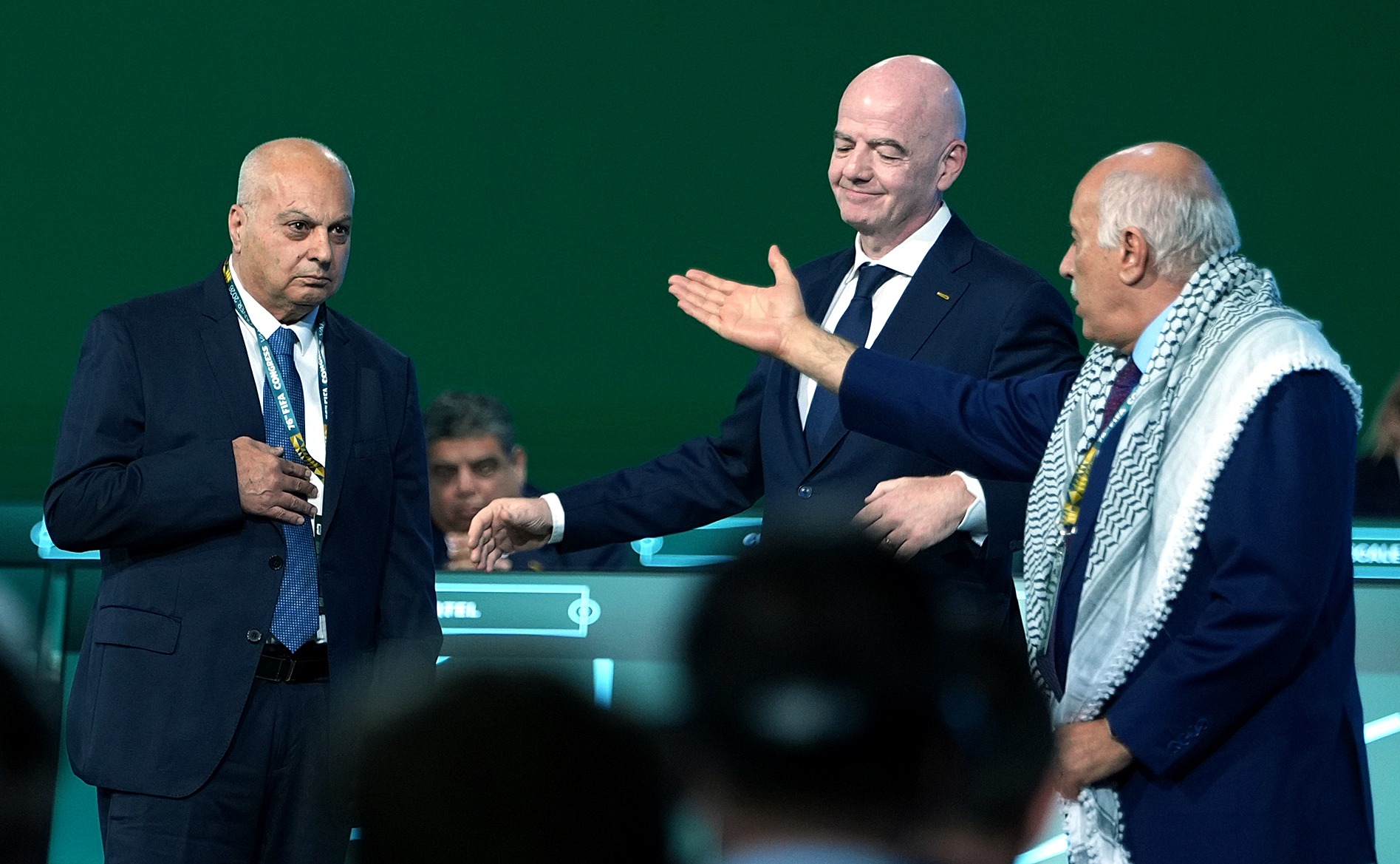
 The failed attempt by Fifa president Gianni Infantino (centre) to unite Palestinian Football Association president Jibril Rajoub (right) and Israel Football Association vice-president Basim Sheikh Suliman on stage during the 76th Fifa Congress in Vancouver, Canada, on 30 April 2026. (Photo: EPA / Bob Frid)
 There is no denying that sport has the ability to be a vehicle for change when its unifying power is used positively. Post-apartheid South Africa is a great example of this. The foundation of the country as a “Rainbow Nation” was laid after the racially divisive system was dismantled, with sport playing a major part.
Sport successes such as the Springboks winning their first Rugby World Cup on home soil (a year after SA’s first democratic elections in 1994) and Bafana Bafana lifting the Africa Cup of Nations in 1996, also at home, were key towards breaking down apartheid-enforced social barriers.
South Africans of all backgrounds and races could converge to celebrate something and forget that just a few years prior such unity had been seen as deplorable. Importantly, SA being banned from a number major global sporting events due to its racial laws spilling into sport played a pivotal part towards the eventual abolishment of apartheid.
/file/dailymaverick/wp-content/uploads/2022/12/Oped-Salters-StateTW1.jpg "The 1995 Rugby World Cup in South Africa brought the country together after decades of division. (Photo: Wessel Oosthuizen / Gallo Images)")
Global sports federations took a stance, including soccer’s global governing body, Fifa. It expelled SA from the organisation on the back of the Soweto uprising on 16 June 1976. It was a major blow for the regime as the politicians had used sport as conduit to strengthen its Afrikaner nationalist dream in a multifaceted African country.
Fifa stance
Under the leadership of Swiss soccer administrator Gianni Infantino, Fifa has taken a much more diplomatic and politically correct approach to such matters. The foundation for how Fifa approaches geopolitical matters was adopted under the leadership of Infantino’s predecessor, Sepp Blatter.
It was under Blatter’s leadership that Russia and Qatar were awarded hosting rights for the 2018 and 2022 World Cups, respectively.
At the time, Blatter expressed his joy with the outcome of that vote, saying in 2010: “I have to say thanks to the Fifa executive committee because for 2018 and 2022 we go to new lands. The World Cup has never been to eastern Europe or the Middle East. So, I’m a happy president when we speak of the development of football.”
Five years after that announcement Fifa was thrown into disarray when Blatter was forced to resign amid massive corruption scandals and indictments of the federation’s officials by US authorities for alleged malfeasance.
This forever tainted the legacies of both the Russian and Qatari-hosted World Cup editions, especially as their respective governments had long been accused of gross human rights violations.
/file/attachments/orphans/13943653_964662.jpg "By refusing to take a direct stand on current geopolitical matters, Gianni Infantino and Fifa have indirectly revealed who they back in such cases. (Photo: EPA / Bob Frid)")
However, after taking the Fifa reins, Blatter’s compatriot Infantino took the baton and justified the decisions taken by Fifa’s members to award the showpiece to these two controversial countries. Before the Qatar World Cup he gave his own version of Thabo Mbeki’s “I am an African” speech, citing the fact that he was bullied after growing up in Switzerland as the son of Italian immigrants.
“Today I feel Qatari. Today I feel Arabic. Today I feel African. Today I feel gay. Today I feel disabled. Today I feel [like] a migrant worker,” Infantino said before the 2022 World Cup.
“Of course I am not Qatari, I am not an Arab, I am not African, I am not gay, I am not disabled. But I feel like it, because I know what it means to be discriminated [against], to be bullied, as a foreigner in a foreign country. As a child I was bullied – because I had red hair and freckles. Plus I was Italian. So imagine,” the Fifa boss stated.
“Do we want to continue to spit on others because they look different, or they feel different? We defend human rights. We do it our way. We obtain results. We got women fans in Iran. The Women’s League was created in Sudan. Let’s celebrate. Don’t divide,” Infantino said.
Take a stand
While he talks the talk with such moving monologues, when it is time for action Infantino is not decisive. He and Fifa have instead chosen the path of diplomacy and neutrality, when they have the power to change people’s lives by stepping out of the grey area. Instead, by playing the diplomatic role of the United Nations, they choose sides.
It is Infantino’s Fifa that has continually refused to exclude Israel from its competitions despite the country’s onslaught in Gaza. Thousands of lives have been lost, but Fifa has refused to take a decisive stance against Israel. However, it did take a stand against Russia when it invaded Ukraine in 2022, by suspending it.
“Fifa can’t solve geopolitical conflicts, but we are committed to using the power of football and the World Cup to build bridges and promote peace as our thoughts are with those who are suffering as a consequence of the ongoing wars,” said Infantino on the refusal to act against Israel.
/file/attachments/orphans/13279719_427553.jpg "Fifa president Gianni Infantino has a close relationship with controversial US President Donald Trump. (Photo: EPA / Annabelle Gordon / Pool)")
In addition to turning a blind eye to the happenings in Gaza, Fifa has refused to directly address the ongoing conflict between the US, Israel and Iran. Contradicting his claims of neutrality, Infantino (and by extension Fifa) has formed a close relationship with US President Donald Trump.
Fifa went as far as handing the 79-year-old politician its inaugural peace prize in late 2025. In February 2026, Trump and Israel attacked Iran. Their justification? That an attack from the Middle Eastern country was imminent.
Since then, Fifa has ducked and dived when it comes to addressing the elephant in the room. Iran qualified for the World Cup and has asked that its matches be moved from the US to either Mexico or Canada. Fifa has turned down this request despite Iranian visa applications for entry into the US hanging in the air.
Infantino’s failed publicity stunt to have the Palestinian Football Association’s president, Jibril Rajoub, and Israeli soccer vice-president Basim Sheikh Suliman, embrace at a recent Fifa congress is proof that there is no such thing as neutrality. Fifa has taken a stance. DM