




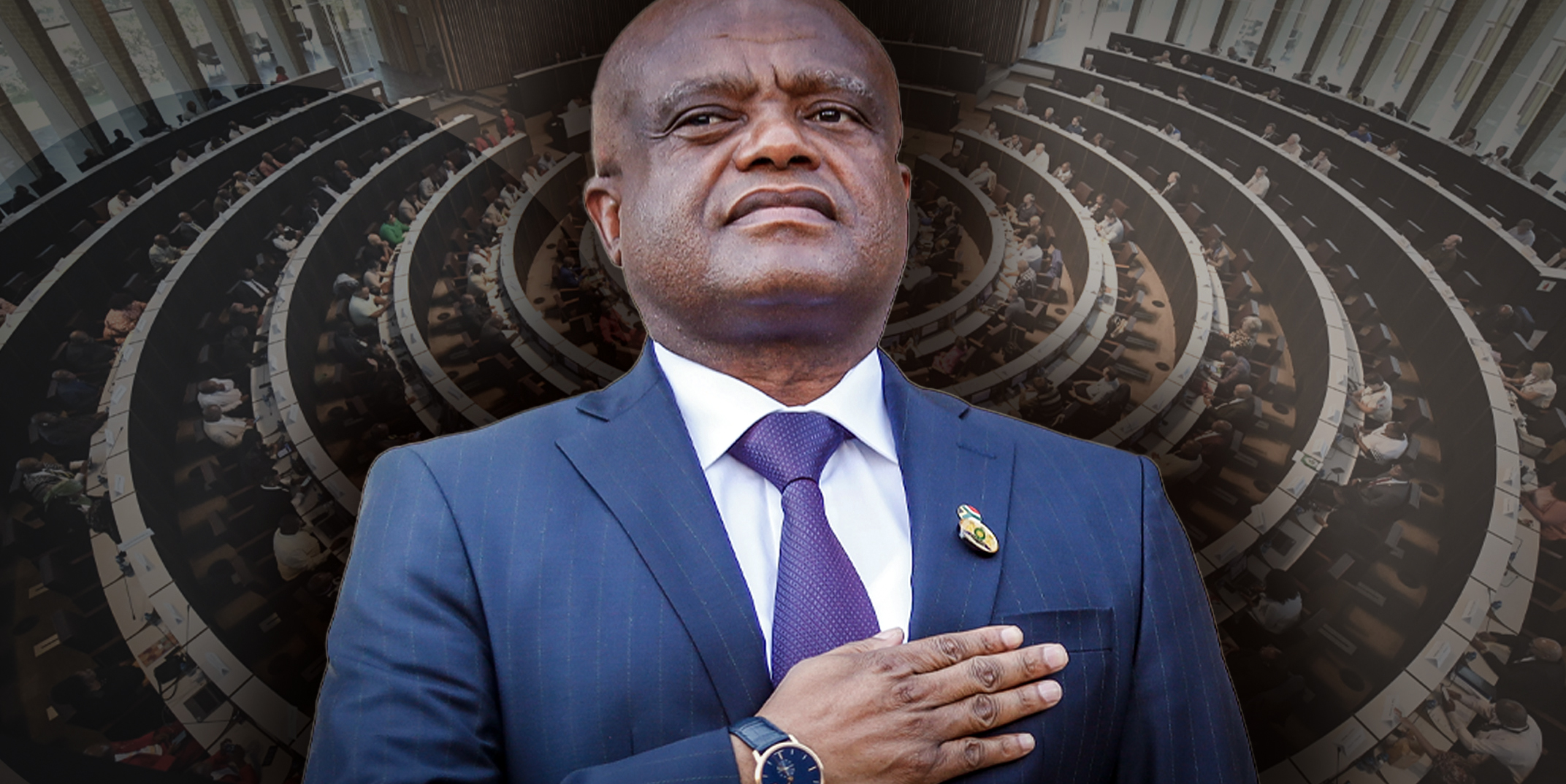
 Illustrative image: Johannesburg council chambers. (Photo: Sydney Seshibedi / Gallo Images) | Johannesburg Executive Mayor Dada Morero. (Photo: Sharon Seretlo / Gallo Images)
 On 23 April, Finance Minister Enoch Godongwana wrote to the Johannesburg mayor, Dada Morero, stating that the City could not afford its recent salary increases.
At issue is a R10.3-billion, two-year salary deal the City signed with the SA Municipal Workers’ Union (Samwu) in November 2025 to ward off protests ahead of the G20 meeting in Johannesburg. Workers say it addresses the outstanding salaries and benefits that they’ve been awaiting for years.
But it has come at the cost of services, as well as current and sorely needed capital investment in infrastructure, and has brought the City close to bankruptcy, according to the finance minister.

Godongwana’s letter laid bare that the City is, in any case, effectively bankrupt: creditors are owed R25.2-billion, while the City has R3.9-billion in cash and equivalents. It lost R12.9-billion to unauthorised expenditure in 2023/24 (the latest official reports), while the debt-to-revenue ratio increased by 29% in 2024/25, signalling a growing reliance on debt to sustain its operations.
Godongwana instructed Morero to halt the “illegally signed agreement” and warned that it threatens both the City and the national economy. Johannesburg remains South Africa’s financial centre, contributing 16% to 17% of GDP.
/file/attachments/orphans/The-great-Joburg-crash_743767.jpg)
Then Godongwana issued the clanger: he would withhold an R8-billion National Treasury grant (an equitable share grant) from Johannesburg if the mayor did not scrap the wage deal.
The ANC in Johannesburg immediately wrote to Godongwana to request an urgent meeting. It wants to protect the wage deal because workers who belong to Samwu are a vital constituency.
“We assure workers of the City of Johannesburg that we will engage the minister to ensure that the rights and interests of workers are protected and advanced. The struggle for salary parity within the municipality, as championed by Samwu, remains a priority of the ANC,” said the party’s regional secretary, Sasabona Manganye.
There is no money for the deal, and to fund it, the city has taken out loans that it’s having a hard time repaying.
This has prompted Moody’s Investor Services to warn of a ratings downgrade, while the French Development Bank, the AFD, has refused to pony up a second loan after the City failed to meet the terms of a R2.5-billion loan it obtained in 2024. The JSE suspended the listing of the City’s debt securities in March.
Budgeting on hope
“Johannesburg is budgeting on hope, not cash,” said Julia Fish, managing director of JoburgCAN, the community action network. “The City’s budgets and adjustment budgets have repeatedly been built on revenue targets it is not able to meet.”
Instead of using realistic collection data, the City keeps presenting residents with numbers it says it is working towards achieving. That is not sound budgeting, and it has left Johannesburg with a major cash-flow crisis.
/file/attachments/2984/Water-shutdown-16_722107_cdde5576acc7b45af4dd788b7b0fc3e8.jpg "Julia Fish. (Photo: Meseret Argaw)")
“When suppliers are not paid, services fail. We have seen repeated real examples, such as in the provision of water, where communities are left days, weeks and even months without a reliable source of water because of contractor non-payment,” said Fish.
Following the publication of the finance minister’s letter, Morero said he and Godongwana had met, and a formal set of engagements would be held. He did not say anything about the wage deal.
“The executive mayor assures residents, stakeholders, investors and the broader public that there is no cause for concern,” he said. “The City acknowledges the critical oversight and governance role of the Ministry of Finance in engaging municipalities on financial stability, governance and accountability.”
Zille’s warning
The DA’s mayoral candidate, Helen Zille, currently leading in the polls for the city, said at a press briefing on Wednesday, “In all my years in politics, I have never seen a letter quite this forthright or this blunt — particularly in warning of such devastating consequences if the stipulated actions are not taken.”
Zille has been campaigning in Johannesburg for six months and has exposed the City’s collapse.
“It [the letter] explains, for example, why circuit breakers cannot be replaced at substations, why there are no spare parts to fix water leaks, and why there are no ladder trucks available to repair broken street lights.”
Johannesburg Water, City Power and the Johannesburg Roads Agency are in utility death spirals, and infrastructure collapse is palpable in the city.
/file/attachments/orphans/IMG_6950_483809.jpeg "Helen Zille attends Alexandra Magistrates’ Court for a site visit on 5 March. (Photo: Reitumetse Pilane)")
Zille said Godongwana’s letter stopped short of calling for a Section 139 intervention under the Constitution, which places failed municipalities under administration.
She said it appeared that National Treasury would push for a form of financial administration of the City, with national eyes trained on the City’s treasury to help it out of the crisis, meaning the council would not be dissolved. A Section 139 intervention includes a formal dissolution of the Council.
The DA has written to councillors who supported the wage deal to warn that they could be held personally liable for the recovery of money.
The party used Section 21 of the Municipal Finance Management Act, which states: “Political office-bearers or officials who deliberately or negligently permit such expenditures are personally liable.”
Zille also wrote to the manager, Floyd Brink, warning that he could face criminal sanction for overseeing transgressions of the Municipal Finance Management Act (MFMA). Section 173 of the MFMA can be used to determine criminal liability if an accounting officer (in this case, Brink) deliberately or in a grossly negligent way fails to take reasonable steps to prevent unauthorised, irregular, fruitless and wasteful expenditure — of which there is much in the city, as our graphic shows. DM