




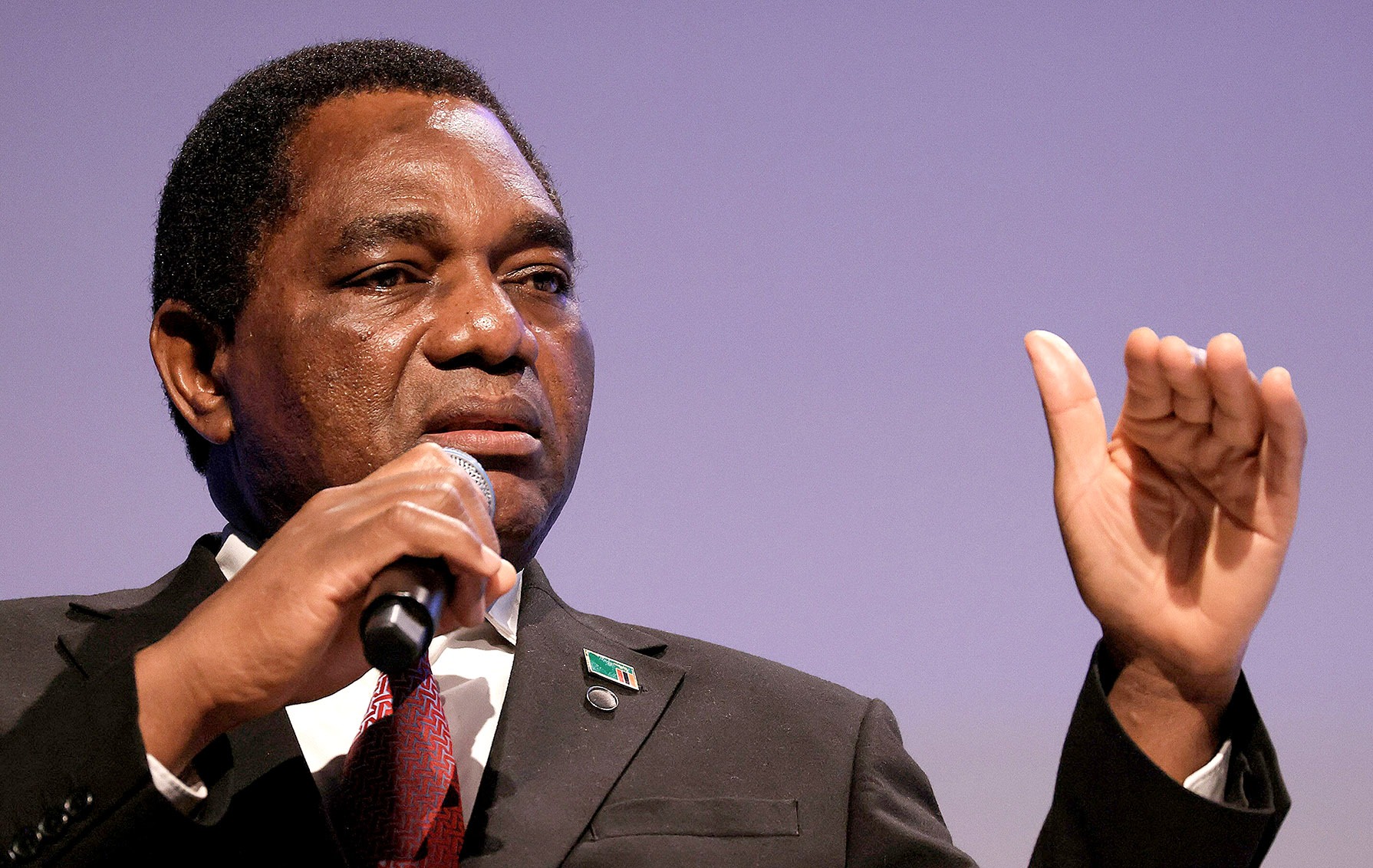
 Zambian President Hakainde Hichilema. (Photo: Krisztian Bocsi / Bloomberg
The fight for a free and open digital world was supposed to take centre stage in Lusaka, Zambia, this week. Every year, RightsCon convenes thousands of people from around the world, from business leaders and government representatives to technologists and human rights advocates, to tackle pressing issues at the intersection of human rights and technology.
Instead, a conference dedicated to strengthening rights and participation in digital spaces was shut down just days before it was due to start, with the Zambian government saying the event failed to align with “national values”.
In a statement on 28 April, the country’s minister of technology and science Felix Mutati said that certain “speakers and participants remain subject to pending administrative and security clearances”. The following day, Thabo Kawana, Zambia’s minister for information and media, said the “postponement was necessitated by the need for comprehensive disclosure of critical information relating to key thematic issues proposed for discussion during the Summit”.
Access Now, the RightsCon host organisation, said the cancellation was the result of foreign interference from China, which demanded the exclusion of Taiwanese participants.
On Friday, Access Now released a statement detailing the eleventh-hour collapse of the conference.
‘Foreign interference’
“We believe foreign interference is the reason RightsCon 2026 won’t proceed in Zambia or online,” the statement read.
According to Access Now, on 27 April, just one day after the Zambian government had publicly endorsed the event, the Ministry of Technology and Science urgently contacted organisers to report that diplomats from the People’s Republic of China were pressuring the state over the planned attendance of Taiwanese civil society delegates.
Access Now said they “immediately pushed back” and opened emergency lines of communication with their Taiwanese participants to assess potential risks. Shortly after the initial warning, organisers began receiving panicked reports that international delegates were already being intercepted by immigration officers upon arrival at the airport and told the conference had been cancelled.
These developments unfolded on the eve of a Zambian public holiday, and despite persistent attempts to contact government officials throughout the evening and into the following day, Access Now was met with silence.
On 28 April, after hours of unreturned messages, Access Now received an “informal, cryptic call” from a trusted senior ministry of technology and science official. He informed them he had been instructed to relay that the event would be postponed or cancelled, but reportedly “faltered on where the decision was coming from or why”.
When Access Now pressed for clarification, the official requested its programme and participant list. The organisers promptly resubmitted the publicly available information, but received no further response.
‘Postponed’
At 9:33 p.m. that evening, local state-owned media announced that the government had “postponed” RightsCon. Organisers convened a crisis response team, delivered a letter by hand to the ministry, and demanded an urgent meeting to reverse the decision. Instead, they were met with delayed appointments and a subsequent public statement from the ministry of information and media, reinforcing the postponement.
On 29 April, Access Now received its first piece of official, written correspondence from the government, which was sent via WhatsApp.
According to the letter, the postponement was “necessitated by the need for comprehensive disclosure of critical information relating to key thematic issues proposed for discussion”, which would be “essential to ensure full alignment with Zambia’s national values and broader public interest considerations”.
Access Now said that the message appeared to be an invitation to negotiate, yet it failed to provide any concrete explanation as to why the government had unilaterally halted the event in the first place.
“What the government wanted from us in order to lift the postponement was conveyed to us informally from multiple sources: in order for RightsCon to continue, we would have to moderate specific topics and exclude communities at risk, including our Taiwanese participants, from in-person and online participation”.
Access Now condemned the Zambian government for violating the fundamental freedoms of assembly and expression. The organisation described the incident as “unprecedented and existential”, noting that the cancellation served as chilling “evidence of the far reach of transnational repression”.
‘Symptom of democratic backsliding’
The postponement has triggered sharp criticism from digital rights organisations, human rights advocates and international observers.
Linda Kasonde, a prominent Zambian lawyer and civil society activist who founded the LCK Freedom Foundation, said she viewed the postponement as “symptomatic of the global shift away from the protection of human rights and towards a more transactional economic order”.
/file/attachments/orphans/Book-cover-selection-scaled_866875.jpg "Zambian lawyer and civil society activist Linda Kasonde. (Photo: Commonwealth Lawyers Association / Wikipedia)")
She said it appeared that the Zambian government also took issue with some other speakers advocating for the rights of sexual minorities.
“Subsequently, it is unsurprising that vague language was used to justify the suspension of the conference as most governments would want to appear to be sovereign and to respect human rights,” she said.
Kasonde highlighted that the country’s “democratic backsliding has been in motion for a few years now”, as opposition political parties were not allowed to gather in public and cybersecurity and cybercrime laws were used to silence dissent.
“But most worrying are the recent unconstitutional … amendments to the Zambian Constitution, which will not only make it much easier for the incumbent government to win an overwhelming majority in parliament, but also would entrench the winning political party in government for the foreseeable future,” she said.
Shrinking civic space
In a joint statement, the Net Rights Coalition and more than 130 digital rights groups said the cancellation was a blow to the global human rights community. The coalition warned that the cancellation of RightsCon was a severe setback that went far beyond a single conference, as it raised profound “concerns about closing civic space and fostering a culture of self-censorship ahead of the August 2026 elections”.
Kavisha Pillay, a social justice activist and founding director of the Campaign on Digital Ethics, said the organisation was registered to attend, participate in and speak at RightsCon 2026.
“A global gathering of thousands of human rights defenders, researchers, regulators and journalists was cancelled because one government told another government it didn’t like who was on the guest list. Shocking!” she said.
Expressing full solidarity with the RightsCon organisers, Pillay condemned the Zambian government’s decision to suppress a peaceful global assembly at the behest of a foreign power. She said the ongoing fight for tech accountability fundamentally relied on a vibrant civic space, defined by the freedom to organise, convene and express dissent.
/file/dailymaverick/wp-content/uploads/2022/03/MC-zuki-youthAct_4-Kavisha.jpg "Social justice activist and founding director of the Campaign on Digital Ethics, Kavisha Pillay. (Photo: Supplied)")
‘A direct attack on freedom of expression’
Angela Quintal, the Africa Director for the Committee to Protect Journalists (CPJ), said the Zambian authorities’ refusal to permit RightsCon to proceed is “a direct attack on freedom of expression and reflects a broader and troubling closure of civic space by the government”.
Quintal referred to the Zambian government’s enactment of two controversial cyber laws last year. These laws, which feature vague regulations on speech and grant authorities over-broad surveillance powers, severely risk undermining domestic press freedom.
This legislative crackdown has been accompanied by the active targeting of the media, with Quintal noting that journalists had faced escalating harassment and arrests in recent years, specifically citing two ongoing cases against Zambian journalist Thomas Allan Zgambo.
Just last month, the CPJ formally raised these issues in a direct letter to President Hakainde Hichilema. With the country’s national elections looming in August, Quintal reiterated the CPJ’s urgent call for the government to take immediate action to create a “safe and enabling environment for the press”.
Gina Romero, the Special Rapporteur on the rights to freedom of peaceful assembly and of association, said Zambia’s de facto cancellation of RightsCon is an attack on rights and freedoms. She cautioned that suppressing civic space so close to the August national elections gravely undermined the integrity of the country’s democratic process.
Romero said the cancellation set a deeply worrisome precedent for hosting international civil society gatherings worldwide.
“The Zambian action signals to the international community that the right to peaceful assembly and association is now subject to political vetting and administrative whims. [The] international community must resist this erosion; the protection of international assemblies is not a matter of diplomatic protocol, but a non-negotiable requirement for a free global society,” she said. DM
Comments
Scroll down to load comments...