




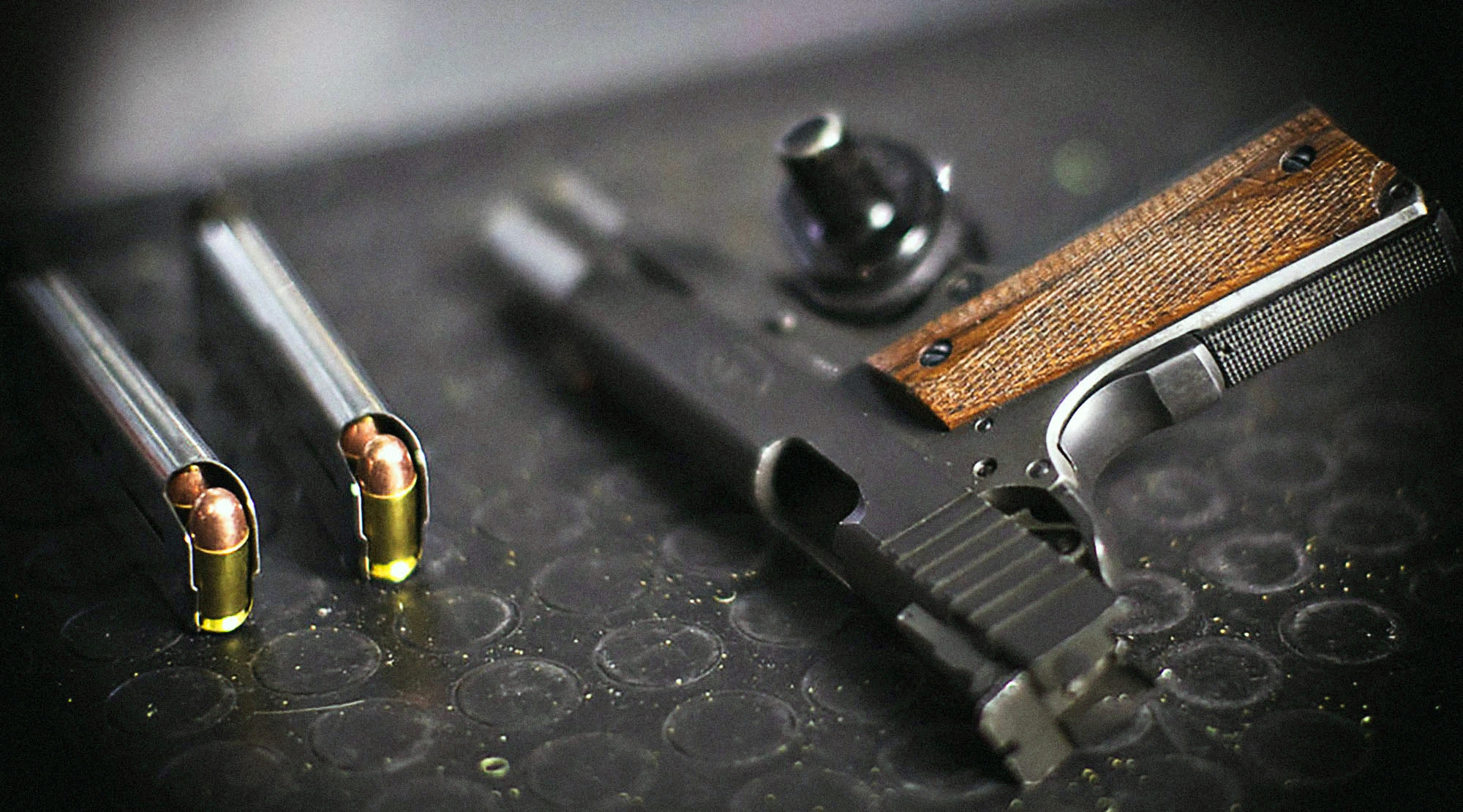
 There’s evidence that most of the guns that end up in the underworld are lost or stolen from licensed civilians (people who aren’t police or military officers) and private security firms. (Photo: UnSplash)
 /file/dailymaverick/wp-content/uploads/2025/10/label-Op-Ed.jpg)
South Africa has recently concluded proceedings of the Ad Hoc Committee established by Parliament to inquire into serious allegations relating to political interference, criminal networks, and failures within law enforcement institutions.
The committee was convened following public statements and submissions by KZN Police Commissioner Lieutenant-General Nhlanhla Mkhwanazi, who raised concerns about the existence of organised criminal networks, the handling of politically sensitive cases, and the integrity of policing processes. These allegations, and subsequent testimonies from other stakeholders, brought into focus questions of accountability, institutional credibility, and the capacity of the state to respond effectively to organised and targeted violence.
However, when one examines the content of the proceedings rather than the headlines, a clear pattern emerges. Firearms were central to these proceedings.
Parliamentary Monitoring Group
This is supported by the parliamentary record. A review of the Parliamentary Monitoring Group reports indicates that the term “firearm(s)” appears approximately 317 times in the meeting records, compared with approximately 105 times for the words “gun(s)” and “ammunition”, which appear 16 times. Across 35 meetings reviewed, references to firearms were more frequent and more consistently linked to the substance of the discussions.
Within the meetings, the pattern is even more pronounced. References to firearms appear repeatedly in relation to illegal possession, licensing failures for legal firearms, diversion and enforcement challenges.
Examples include:
- A senior SAPS official noted during a committee meeting: “The late general who was in this province dealing with gangsters had raised the involvement of illegal issuing of firearms by our very own Firearm Control Office in Pretoria, illegal issuing of firearms to the criminals in Gauteng.”
- A senior SAPS official acknowledged the ongoing impact of gun violence: “ every day I get videos of a shootout, mothers crying… we’re not focusing our energy there”.
- A civil society representative emphasised that: “All firearm offences should be treated seriously.”
These references are not limited to one category of speaker. They appear across state officials, Members of Parliament, and civil society inputs.
This matters because there is a narrative that is seeking to narrow the problem. The argument being advanced in some quarters is that only the firearms already in illicit circulation, or those lost from state stockpiles, are the real issue. In this framing, firearms are treated as if they originate either from state failure alone or from pre-existing illegal sources such as craft production or cross-border trafficking. This is an incomplete reading of the problem.
Evidence presented to the committee, and broader research in SA, shows that firearms move across the system. They do not remain confined to a single source. Firearms held legally by the state and by civilians, including individual owners and private security, can and do enter illegal circulation through theft, loss, corruption and diversion. Once diverted, they are indistinguishable in use from any other illegal firearm.
Focusing only on state losses or the so-called already illicit firearms overlooks this movement. It creates a false separation between “legal” and “illegal” guns that does not hold in practice. In reality, firearms in SA exist within a single, interconnected system in which leakage from multiple points sustains criminal use. Firearms move across the system through theft, loss, corruption and deliberate diversion.
As a result, the distinction between legal and illegal firearms is not stable.
Research and South African case evidence show that firearms used in crime frequently originate from legal sources before entering illegal circulation. This includes firearms stolen from private owners, firearms used by private security personnel, and firearms diverted from police custody.
SA currently has approximately five million licensed firearms. About 2.8 million are held by civilians, including private individuals and private security companies, and approximately 2.2 million are held by the state. The discrepancy between state-held and civilian-held firearms shows a significant risk that needs attention.
Private security
Private security is not outside the civilian category. Those firearms form part of the same national pool. Once firearms are in circulation, they are not contained within their original point of ownership. They can and do move into criminal use.
This is a systems issue, not an ownership category issue. The Ad Hoc Committee itself from the onset focused on political killings. These incidents were carried out using firearms. This is a relevant observation. It confirms that firearms are the instrument through which targeted violence is executed.
The relevant policy question is therefore not limited to identifying perpetrators. It includes understanding how firearms are accessed, transferred, and used. Evidence points consistently to leakage.
SA’s firearms control system has experienced sustained weaknesses. These include corruption in licensing processes, poor record-keeping, and failures in tracking firearms across their lifecycles. The diversion of firearms from police custody to criminal networks has been documented and prosecuted.
The Central Firearms Registry, which is responsible for tracking firearms, has been described as dysfunctional. Inconsistent data, fragmented systems and weak accountability mechanisms create conditions in which firearms cannot be effectively monitored.
This has direct implications for public safety. At the same time, there is a recurring claim that increased access to firearms improves personal safety. This argument is often presented as a response to crime and perceived state failure. The available evidence does not support this claim.
Firearms increase the lethality of violence. When a firearm is present, the probability that an incident will result in death increases significantly. Firearms are estimated to be between four and seven times more lethal than other weapons.
SA’s own data provides further evidence. Following the introduction and implementation of the Firearms Control Act, more than 4,500 lives were saved in five cities between 2001 and 2005.
In contrast, weaker enforcement has been associated with increased firearm-related violence. Firearms were used in 29% of murders in 2015/16, rising to 44% in 2023/24. This indicates that firearms are not only present in violent crime. They are a primary driver of its severity.
The implication is straightforward. Reducing firearm availability reduces lethal violence. Increasing or poorly controlling firearm availability increases lethal violence.
Role of firearms in political killings
The Ad Hoc Committee has already provided sufficient evidence to support this conclusion. It has highlighted the role of firearms in political killings and broader patterns of violence. The responsibility now lies with Parliament.
Parliament has both legislative authority and oversight responsibility. It is required to respond to evidence, not only to debate it. If no meaningful action follows, the process will be viewed as insufficient by the communities most affected by violence, particularly in the Western Cape and Gauteng.
Those communities are not concerned with terminology. They are concerned with outcomes. The relevant outcome is whether the number of firearms in circulation is reduced, whether diversion is addressed, and whether enforcement systems are strengthened.
This requires:
- Strengthened oversight of firearm control systems.
- Accountability for lost and diverted firearms.
- Improved transparency in firearm tracing and recovery.
- Consistent implementation of existing legislation.
The Ad Hoc Committee has clarified the problem. The remaining issue is whether there will be a policy and enforcement response.
If there is no such response, the conclusion will be clear.
The issue was identified. The evidence was presented. No action followed. DM
Dr Stanley Maphosa is Executive Director of Gun Free South Africa and Senior Research Fellow at the University of Johannesburg Institute for Pan-African Thought and Conversation. Minenhle Mdiniso is a Criminology and Psychology student at Emeris University in Pretoria and a Gun Free South Africa volunteer with a strong interest in crime, public policy and violence prevention.