




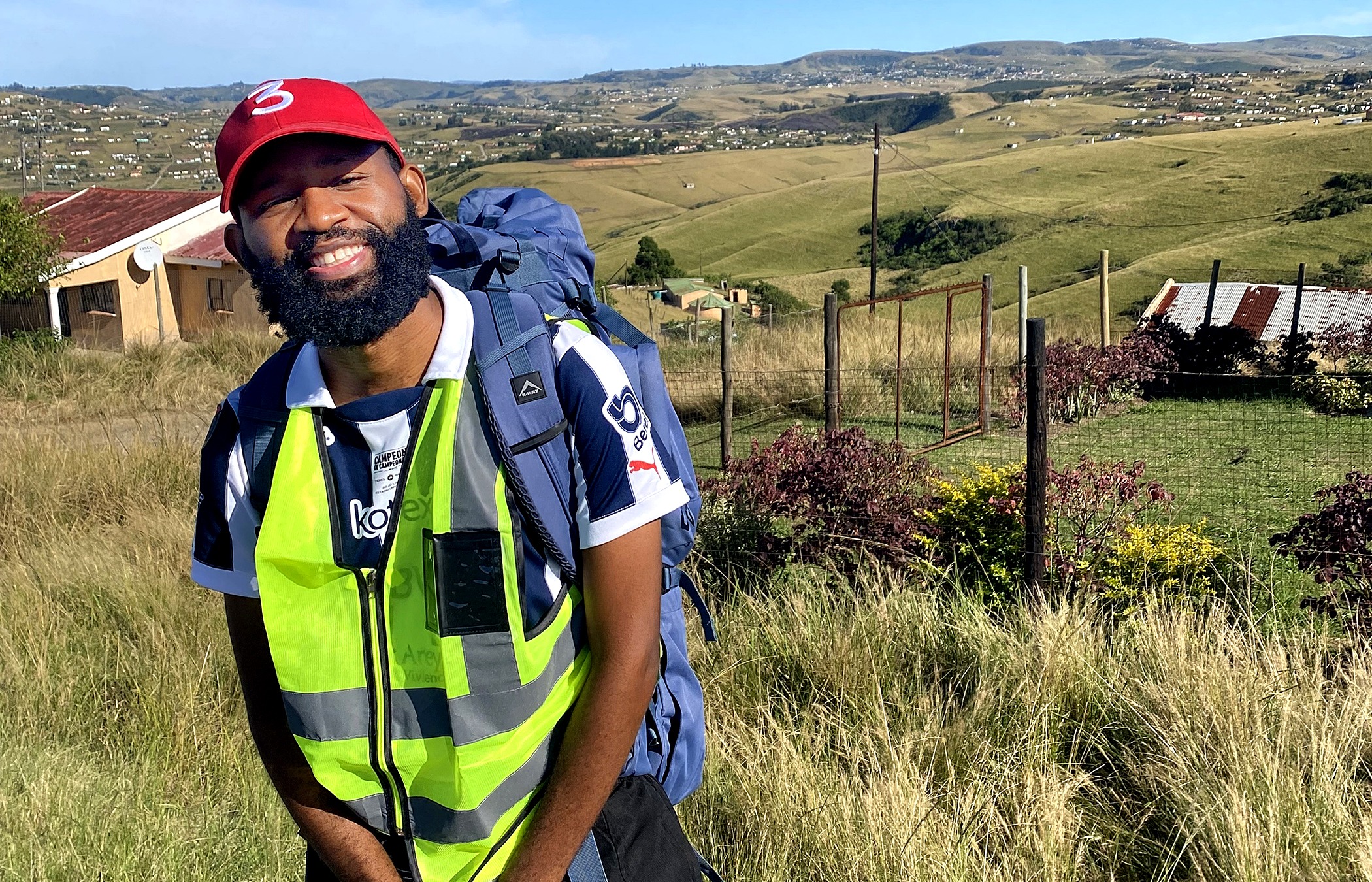
 Wandile Mthiyane is walking from Durban to Cape Town, advocating for equipping communities with proper housing resources and knowledge. (Photo: Wandile Mthiyane)
 Last week, two letters arrived from Harvard University inviting me to join its Master in Design Engineering and Master in Real Estate programmes. But when I opened them, I was not thinking first about Cambridge, Massachusetts. I was thinking about a mud-brick house in KwaZulu-Natal and the woman who taught me what home means.
Four weeks ago, my aunt died. When I was six, I lived with her in that house for three years. It was there that I learnt that home is not simply a roof, it was where I felt safe. It is where a person belongs. Years earlier, government officials had painted a number on her door to mark her place on the waiting list for an RDP house. It was meant to signal hope. It said: your turn is coming. Her turn never came. She died still waiting.
This story is personal, but it is not unique. It reflects a broader South African truth. Our housing crisis is not only about the number of homes still needed. It is also about the systems that block people before building can even begin. Families are trapped between a state that cannot deliver fast enough and a private market that excludes them by design.
That is why I am walking.
/file/attachments/orphans/ItwasathisauntshousethatWandilelearnedthathomewasnotsimplyaroofitwasaplaceofsafety_WandileMthiyane_135596.jpeg "As a child, Wandile learnt that home was not simply a roof, it was a place of safety. (Photo: Wandile Mthiyane)")
/file/attachments/orphans/Thewalkendson16Juneforareason_WandileMthiyane_876015.jpeg "The walk ends on 16 June for a reason. (Photo: Wandile Mthiyane)")
In rural South Africa, especially on tribal land, millions of people cannot use the land they live on as collateral. Banks will not lend. Families are forced to build in stages, out of pocket, often without engineering guidance and without the protections that wealthier South Africans take for granted.
In KwaZulu-Natal, that can be fatal. A house without a proper foundation in a flood-prone area is not just incomplete. It is dangerous. When the 2022 floods killed more than 400 people, they exposed a hard truth: some South Africans are not only vulnerable to climate change, they are vulnerable because the way they are forced to build is itself unsafe.
What makes this harder to accept is that the system already knows how to be flexible.
In places like Waterfall City in Midrand, leasehold arrangements can still be treated as bankable. On tribal land, similar logic is dismissed. The issue, then, is not whether adaptation is possible. It is who gets the benefit of it.
For three decades, South Africa has leaned heavily on a centralised housing model built around large tenders and standardised delivery. The results are familiar – usually delays, stalled projects, waste, and communities left to improvise. People are already building, the question is why we are not helping them to build safely and properly. That is the problem Ubuntu Home is trying to address.
I am building Ubuntu Home to reduce one of the earliest barriers on the housing journey: the cost of getting proper plans, technical guidance and safer pathways into construction. This is not about romanticising self-build or suggesting that the state can walk away. It is about making it possible for more families to build on better terms.
/file/attachments/orphans/WandileisbuildingUbuntuHometoreducethebarriersinthehousingjourney_WandileMthiyane_377550.jpeg "Wandile is building Ubuntu Home to reduce the barriers on the housing journey. (Photo: Wandile Mthiyane)")
I am often asked why I am going to Harvard instead of staying at a local institution like the University of Cape Town. UCT is an excellent university and South Africa has world-class institutions.
For me, Harvard is not about prestige. It is about proximity to research, capital, networks and to people working at a scale that can help take Ubuntu Home further. Because the problem we are trying to solve is not only South African. Housing exclusion is global.
Admission does not remove the financial barrier. Harvard has made it clear that I must cover the full cost of this education myself. It says something about who gets to access the institutions and networks that shape the future, and who still has to fight for entry even after the door has opened.
I am going because I want to come back stronger: with deeper technical training, better design tools and a greater ability to build something that can work at scale here at home.
On 15 April, I began walking from Durban to Cape Town. This is not just an endurance challenge but a listening exercise.
Along the way, I am asking people a simple question: What does home mean to you?
I am also trying to make the walk useful. I am providing free home designs to some families on tribal land so they can think more seriously about safer, flood-resilient foundations. I am visiting schools to speak about technology, design and the need to rebuild a vocational pipeline, from bricklaying to engineering. And I am documenting what the road reveals about housing in coastal South Africa, so that this journey can inform more resilient and practical solutions.
/file/attachments/orphans/WandileMthiyaneisvisitingschoolstospeakabouttheneedtorebuildavocationalpipeline_WandileMthiyane_642996.jpeg "Wandile Mthiyane is visiting schools to speak about the need to rebuild a vocational pipeline. (Photo: Wandile Mthiyane)")
I am also making a policy case. South Africa needs to move from a model of housing delivery to one of housing enablement. The Enhanced People’s Housing Process, adopted in 2008 and implemented from 2009, was meant to shift policy in that direction. It built on the earlier People’s Housing Process by putting greater emphasis on community agency, technical support and the wider human settlement. Yet more than 15 years later it remains underused while the state continues to fall back on centralised procurement.
That matters because people are not waiting for life to begin. They are already building.
The walk ends on 16 June for a reason. On 16 June 1976, thousands of Black school students in Soweto took to the streets to protest against being taught in Afrikaans, the language of apartheid power. But it was never only about language. It was about a generation refusing to accept the terms handed down to it.
Police opened fire on unarmed students. The image of Hector Pieterson, only 13 years old, being carried after he was shot travelled around the world. It exposed the brutality of apartheid and marked a turning point in South Africa’s struggle.
What that generation understood is that broken systems do not change simply because they are unjust. They change when people refuse to accept their logic as normal. My mother’s generation waited. My aunt’s generation died waiting. I am choosing to walk. DM
Wandile Mthiyane is an architectural designer, social entrepreneur and the founder and chief executive of Ubuntu Design Group. He is an Obama Foundation Leader.