



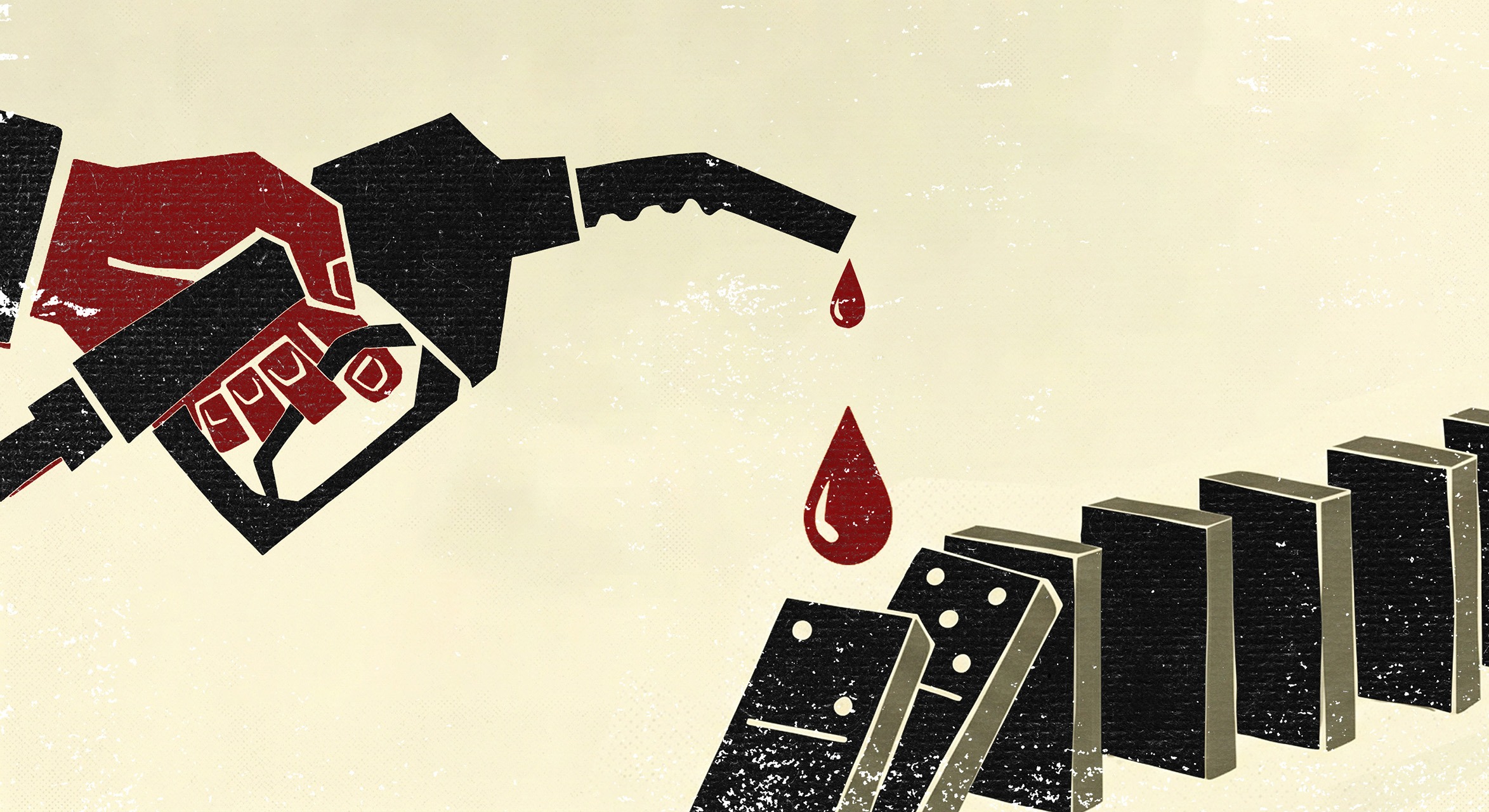
 Illustrative image: (Sources generated with Google Gemini Flash Image 2.5)
 I’ve found that in life sometimes waiting is the worst part.
It’s the anticipation of the annual medical that really kills me. Not what the doctor will be telling me to give up (although I might be dying inside).
I had kind of hoped that might be the case for fuel prices and inflation, that actually it wouldn’t be so bad.
Now I fear my musings a few weeks ago about how the worst-case scenario for fuel prices would involve me taking my daughter to school on an electric scooter with very little car traffic around us might well be my emotional high point in this awful saga.
On The Money Show last night Stanlib chief economist Kevin Lings finally removed the wine drip I’d obviously been imbibing and sobered me up completely with one simple figure.
Inflation, he said, would now go from 3.1% to 5% simply because of the fuel price increases that were announced yesterday.
Just think about that for a moment. After all of this work and time and energy, and the tireless campaigning of Lesetja Kganyago, for us to finally do the near-impossible and put that evil genie, Inflation, back in the bottle, out it pops.
I don’t need to remind you what the worst part of this is. That inflation will hit 5%, with the government still suspending the full fuel levy.
And that if oil prices stay where they are (Brent crude at about $110 a barrel) we can expect petrol and diesel to go up by about R3.93 a litre in July (half of the levy is due to be reinstated in June).
I would think by that point we’d be looking at inflation of about 6% or 7%.
Now, Kganyago has basically staked his entire career, literally his life’s work, on driving inflation down. He and the other members of the South African Reserve Bank’s Monetary Policy Committee will have no option but to hike rates if that happens.
If they don’t they’ll look soft.
But they will be cracking down on an economy to fix something that is outside the control of anyone in South Africa.
Kganyago obviously knows this is coming. Yesterday he told an audience at the University still amazingly known as Rhodes (where I learnt an awful lot about journalism, a little about life and one or two things my doctor now likes to ask about) that “we are experiencing the biggest jump in fuel price inflation in the history of inflation targeting”.
And, of course, as he also noted, the great worry is that food prices are about to jump, what with higher fuel costs, the foot-and-mouth outbreak and, joy of joys, the strong chance that we will have a lot less rain this season.
The first impact really will be on minibus taxi fares. Yesterday they went up by an average of about R5 in Gauteng. The taxi industry tries to move prices very seldom, so you can imagine the chaos in a cash-based industry when you do make a change.
This time you can’t blame them – they will not last long if they don’t implement the increase for their passengers as fuel prices go up.
At the other end of the market, Discovery Insure claims that drivers cut their fuel use by about 35% immediately after the hike at the start of April.
I was amazed at that number. I had noticed traffic was relatively light but had put that down to the change in season (there is less traffic in winter) and the school holidays (many private schools only go back tomorrow, and it’s likely that’s a disproportionate chunk of Discovery’s clients).
But it does tie in with what the fuel industry itself has always said, that despite the perception we can’t really live without fuel, we do use less when prices go up.
I suspect though that those who can save fuel are already doing that. There are probably not many more people who can save much more.
All of this puts the government in a pretty awkward position.
Like virtually all other governments of none-oil-producing countries, the only lever they have is to cut back on the taxes they charge for fuel.
I know that, at some point someone is likely to demand some kind of subsidy, but countries that have done that have found that down that path lies disaster.
It ends with people trying to smuggle huge amounts of something you really don’t want to catch alight across borders.
As it is, ESG Analytics MD Sifiso Skenjana’s already warning that high diesel prices will lead to a lot more stations illegally trying to adulterate the diesel they sell with something else – with all sorts of awful consequences for your Lexus SUV.
For the government, even just suspending the fuel levy for longer will be expensive. But not as expensive in the long run as allowing inflation to hit 6%, for the Bank to hike rates and the economy to really suffer as a result.
And if they decided to do nothing they would end up losing a large amount of tax revenue anyway because of a slower economy.
The waiting is over. The nightmare really is approaching.
And who do we have to thank for that? DM