




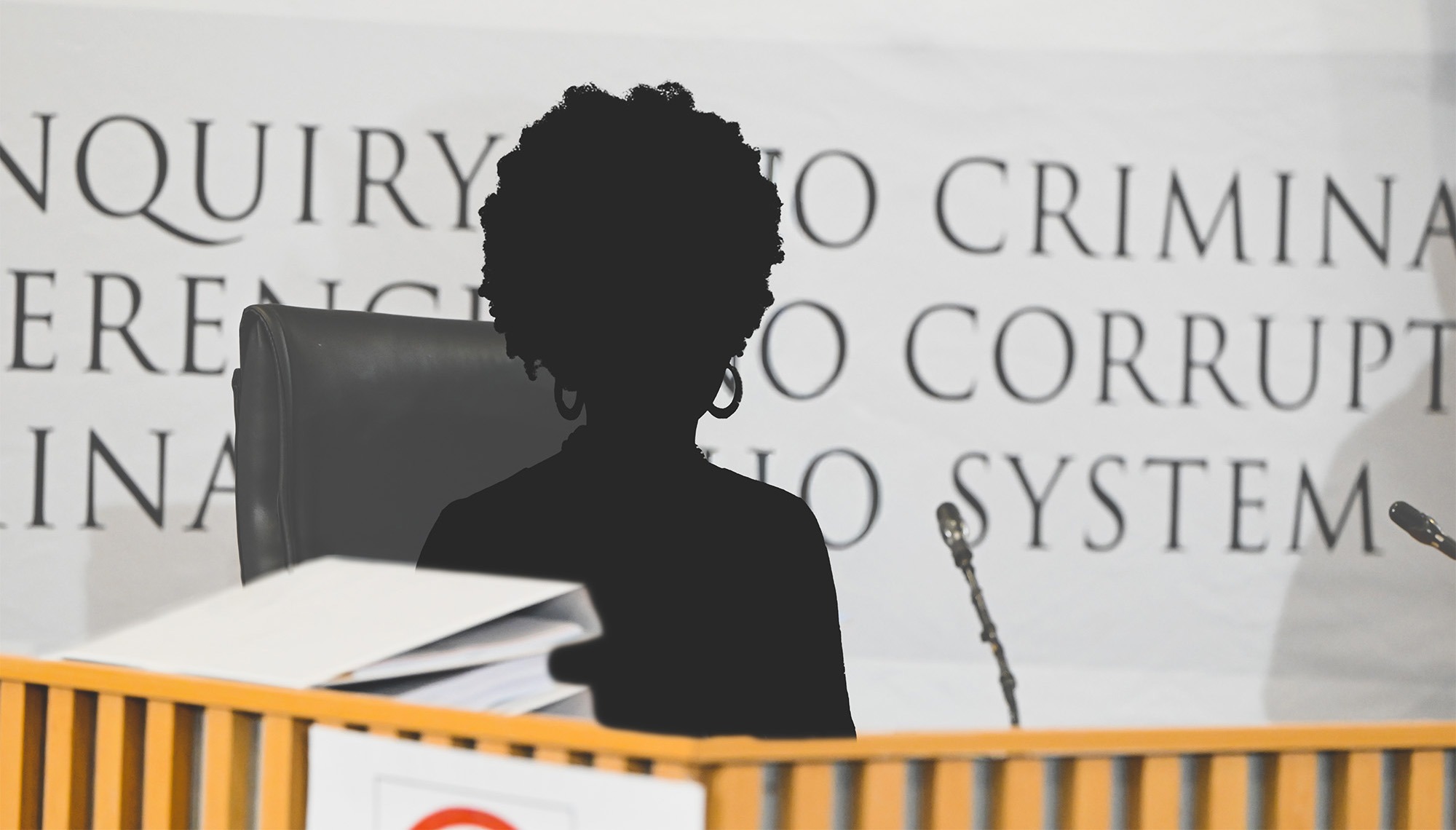
 Illustrative image: The Madlanga Commission booth. (Photo: Gallo Images / Frennie Shivambu) | Silhouette: (Graphic: iStock)
A Crime Intelligence officer, using a pseudonym to conceal their identity for safety reasons, was set to testify partially in public before the Madlanga Commission of Inquiry about issues including suspicious deaths and apparent assassination attempts.
But the officer’s decision not to detail various names and incidents, in case these exposed their identity, led to the highly anticipated proceedings being switched to in-camera, in other words, private, on Monday, 4 May 2026.
Commission chairperson Justice Mbuyiseli Madlanga explained that the hearing would no longer be accessible to the public or journalists “purely because it’s become impossible to proceed along these lines”.
Partially public to fully private
Up until that point, proceedings had inched along during the morning, interspersed with lengthy pauses, intervals, and very few details being read into the commission record.
Last month, the Madlanga Commission ordered that the Crime Intelligence officer, who went under the pseudonym Witness G on Monday, would testify “virtually and off screen, but with an audio broadcast”.
It was agreed that any sensitive testimony that could expose their identity would be in-camera.
Justice Madlanga on Monday recalled that order when announcing the hearing would be private going forward. Before that, some scant information emerged, including that Witness G is a Crime Intelligence officer with a Struggle history linked to the Umkhonto weSizwe military.
The Madlanga Commission is investigating accusations that a cartel has infiltrated SA’s criminal justice system, politics and private security.
Crime Intelligence, the police unit where Witness G works, has featured prominently in the hearings so far.
Meeting Mogotsi’s legal team
Evidence leader advocate Matthew Chaskalson guided Witness G through a statement they had prepared for the commission. Instead of reading sections of it out onto the record, Witness G merely confirmed that various sections of it were correct.
Chaskalson put it to them that they had met with ANC-aligned North West businessman Brown Mogotsi’s legal counsel in November last year, which Witness G confirmed.
/file/attachments/orphans/ED_586731_251253.jpg "Brown Mogotsi testifies at the Madlanga Commission of Inquiry on 20 November 2025 in Pretoria. President Cyril Ramaphosa established the commission to investigate the alleged infiltration of the criminal justice system. (Photo: Gallo Images / Frennie Shivambu)")
Mogotsi has been accused of acting as a middleman between sidelined police minister Senzo Mchunu and organised crime accused Vusimuzi “Cat” Matlala.
Mogotsi’s version is that he was a Crime Intelligence informant. It was widely anticipated that Witness G would provide further insight into this claim – but the public is no longer privy to this.
Chaskalson on Monday said “the role of Mogotsi in Crime Intelligence”, which was part of Witness G’s statement, was “central to our investigation”.
‘Suspicious deaths’
During Monday’s brief public proceedings, Chaskalson also suggested that Witness G read into the record several paragraphs of their statement, especially pertinent to the Madlanga Commission’s work.
“We’re now getting to material that is more directly relevant to... the inquiry of the commission,” Chaskalson said. “You deal with suspicious deaths, apparent assassination attempts and the like.
“I think this is material that should be read into the record so that people following can actually hear it.”
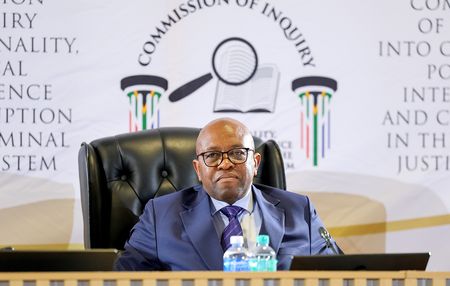
Witness G decided against that.
“I’m not going to read it into the record. It will identify who [I am],” they explained.
This to-ing and fro-ing eventually led Chaskalson to ask Justice Madlanga to rule on whether the proceedings should become an in-camera session. That was when it was decided they would be.
Last year, Daily Maverick and News24 launched an urgent challenge to an application by the commission’s evidence leaders for a ruling that a group of witnesses being called at the time be heard in-camera.
That was due to the nature of their testimony and potential safety issues.
A compromise was reached. DM