




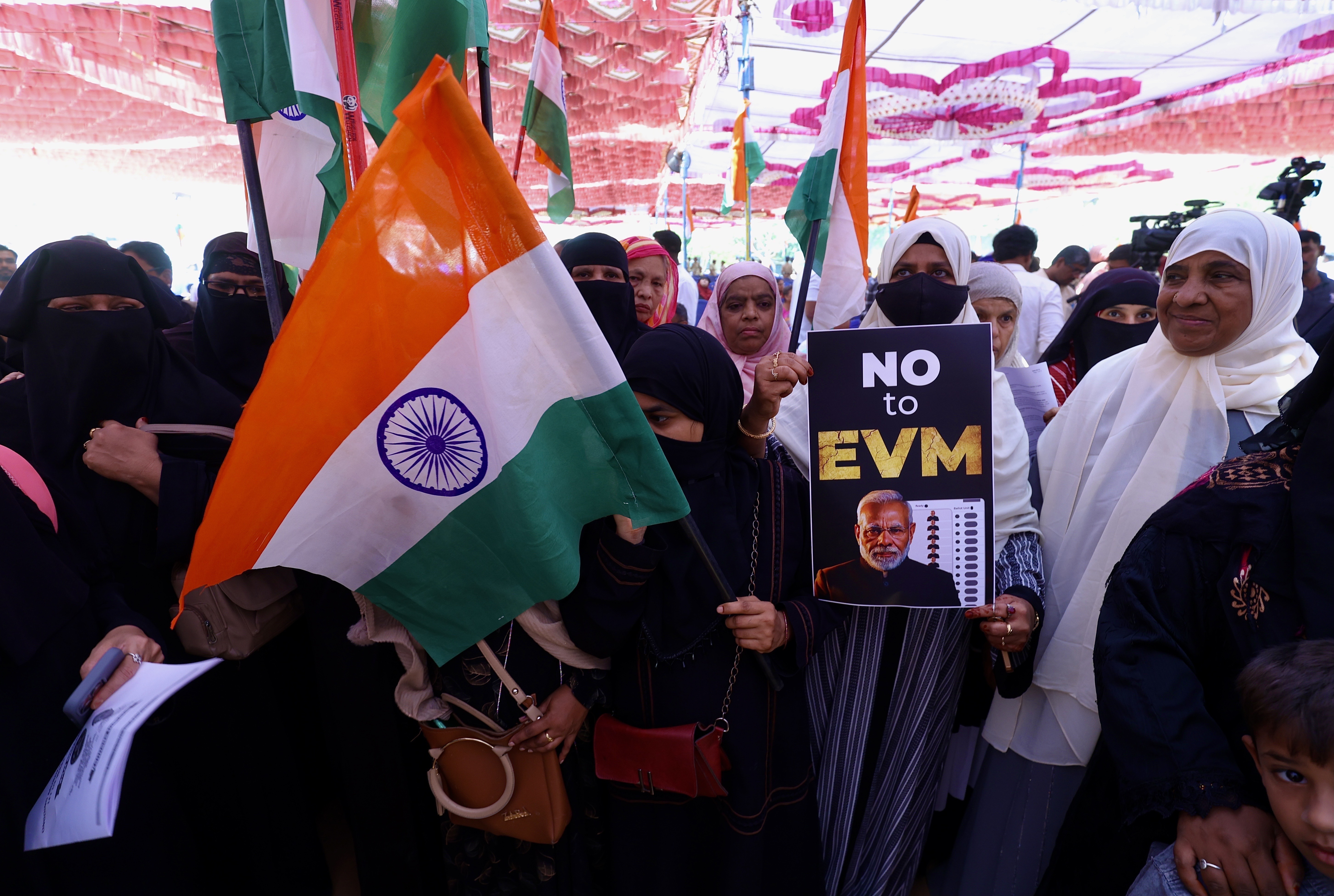
 Members of various non-governmental organizations and social activists hold placards against the BJP-led Narendra Modi government over voter-list revisions during a protest in Bangalore, India, 23 April 2026. The Election Commission of India recently announced the Special Intensive Revision (SIR) process to thoroughly update and clean electoral rolls across parts of the country. SIR is meant to improve election accuracy, but its impact depends heavily on how carefully and transparently it is implemented, and opposition parties claim the process has caused millions of people to lose their names on the voter lists and could disenfranchise minorities and the poor. EPA/JAGADEESH NV
Modi's Bharatiya Janata Party (BJP) was set to return to power in the eastern state of Assam for the third straight term, and was sweeping West Bengal, counting trends on the Election Commission website showed. Both states border Bangladesh and infiltration into India was a key poll issue.
The BJP has never ruled West Bengal, a state where it had only three local lawmakers until 2021.
Modi, his closest aide and Home Minister Amit Shah and several senior BJP leaders have campaigned extensively in West Bengal for weeks, focusing on what they called illegal immigrationfrom Bangladesh and the weak local economy under incumbent Chief Minister Mamata Banerjee.
Banerjee is a fierce critic of Modi and a key member of India's opposition alliance. She has been in power in the state since 2011.
The positive trend for the BJP in West Bengal also boosted market sentiment, with the 10-year bond yield down 2 basis points at 6.9954%, bond traders said.
BLOW TO OPPOSITION ALLIANCE
In the southern state of Tamil Nadu, a major hub for electronics and automobiles, popular movie star Joseph Vijay, a first-time entrant into politics who launched his party only two years ago, looked on course to oust the ruling DMK party.
The actor, who goes by the single name Vijay, has a frenzied fan following in the state, which has a history of electing film stars to the top office.
In the other southern state of Kerala, an alliance led by the Congress party looked set to defeat the ruling Communist Party of India (Marxist).
The DMK is also a vocal rival of Modi, and DMK and Banerjee's ruling TMC party were the main pillars of the Congress-led opposition INDIA alliance. The alliance jointly fought the 2024 general election and deprived Modi of an outright majority, forcing him to rely on the support of regional parties to form a coalition government.
Their losses are expected to significantly weaken opposition to Modi in 2029, when he will contest for a record fourth term in office.
Final results are expected to be clear by Monday evening but the outcome is not expected to have an immediate impact on politics or policy at the federal level.
(Reporting by Shilpa Jamkhandikar; Editing by YP Rajesh and Raju Gopalakrishnan)
Comments
Scroll down to load comments...