




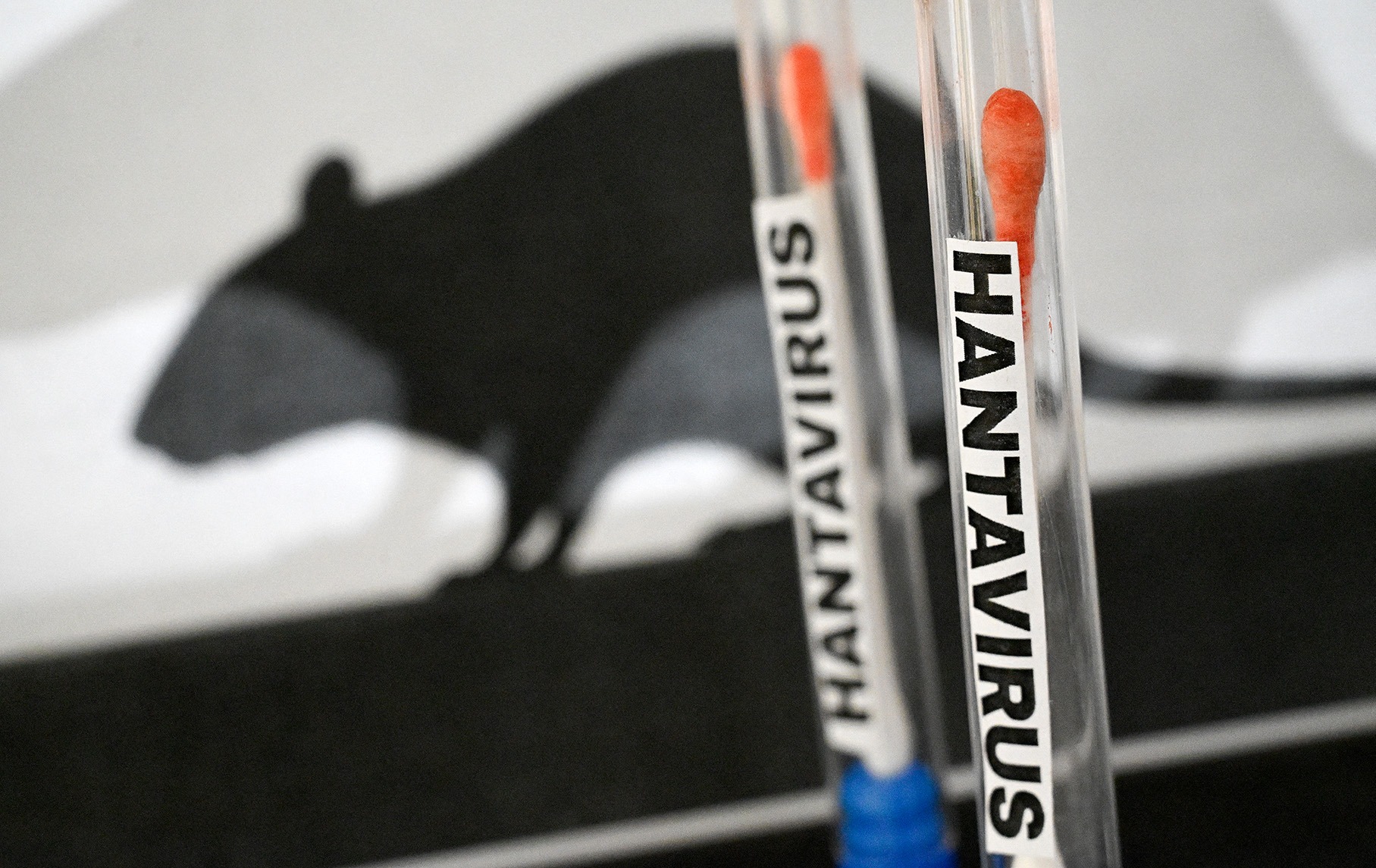
 Hantavirus has been confirmed in a seriously ill patient who was evacuated from St Helena to South Africa after falling ill on the cruise liner MV Hondius. Three others on the ship have died from unknown causes. (Photo: Joao Luiz Bulcao / Hans Lucas via AFP)
 The MV Hondius cruise liner scheduled an emergency evacuation for Monday night after a British passenger tested positive for hantavirus and was flown to Johannesburg for intensive care. With three passengers already dead and two others needing urgent medical care for a “respiratory disease”, health officials are investigating whether the confirmed viral case is linked to the earlier, unexplained deaths on board.
/file/attachments/orphans/AFP_20260503_A9NU4VG_v5_HighRes_TopshotCapeVerdeHealthTourism_517219.jpg "The cruise ship MV Hondius off the port of Praia, the capital of Cape Verde, on 3 May. (Photo: AFP)")
Oceanwide Expeditions spokesperson Kiki Hirschfeldt said the company was continuing to deal with a serious medical situation aboard the MV Hondius, which on Monday was off the coast of Cape Verde. She said a 70-year-old Dutch passenger died on 11 April, and medical staff on board were unable to ascertain the cause of death.
The man’s body remained on the vessel until 24 April, when the crew reached St Helena and arranged for its repatriation to the Netherlands. His 69-year-old widow accompanied the body; however, she collapsed shortly after arriving at Johannesburg’s OR Tambo International Airport on 27 April. Despite receiving emergency medical treatment at a nearby hospital, she also died. Hirschfeldt said she only began showing symptoms during her journey to South Africa.
“It has not been confirmed that these two deaths are connected to the current medical situation on board,” she said, adding that on 27 April another passenger became seriously ill and was medically evacuated to South Africa.
“This person is currently being treated in the intensive care unit in Johannesburg and is in a critical but stable condition. The passenger is of British nationality. A variant of hantavirus has been identified in this patient,” Hirschfeldt confirmed.
She said that on Saturday, another passenger, of German nationality, had died on board the MV Hondius. The cause of death has not yet been established.
On Monday, two crew members on board were displaying acute respiratory symptoms, one mild and one severe. Hirschfeldt said both crew members — one Dutch, the other British — required “urgent medical care.”
There are 149 people aboard the MV Hondius — representing 23 different nationalities — none of whom are South African.
“Hantavirus has not currently been confirmed in the two persons still on board who require medical care,” said Hirschfeldt. “Nor has it been established that the virus is connected to the three deaths associated with this voyage. The exact cause and any possible connection are being investigated. Therefore, the only confirmed case of hantavirus is the passenger who was medically evacuated and is now being treated in Johannesburg.
“The disembarkation of passengers, medical evacuation and medical screening require permission from and coordination with the local health authorities. Local health authorities have visited the vessel and assessed the situation. The medical transfer of the two ill persons on board has not yet taken place,” she said.
She said the ship could sail on to Las Palmas or Tenerife for passengers to disembark and receive medical screening and treatment if necessary.
“Strict precautionary measures are in process on board, including isolation measures, hygiene protocols and medical monitoring. All passengers have been informed and are being supported.”
National Department of Health response
The South African National Department of Health (NDoH) said it had “been informed by the National Institute for Communicable Diseases (NICD) of the medical condition and reported deaths of passengers of an international cruise ship (MV Hondius) travelling from Southern Argentina to Canary Islands via Cape Verde.
“While the ship was travelling past South African shores, some of the passengers experienced serious health complications arising from what was initially considered severe acute respiratory infections.
“The ship, carrying about 150 tourists from various countries, departed Ushuaia, Southern Argentina, for the Canary Islands about three weeks ago. En route to its destination, the ship went past several islands, including mainland Antarctica, the Falklands, South Georgia, Nightingale Island, Tristan, St Helena and Ascension.
“In terms of medical cases, the first patient was a 70-year-old male passenger who suddenly became ill en route from Ushuaia to St Helena, and presented with fever, headache, abdominal pain and diarrhoea. Unfortunately, he passed away on arrival at St Helena Island. His mortal remains are in St Helena, awaiting repatriation to the Netherlands.
“The second affected passenger was a 69-year-old female, the spouse [of] the first patient, who collapsed at the OR Tambo International Airport while trying to connect a flight to her home country of the Netherlands. She was taken to a nearby health facility around Kempton Park for medical attention and, unfortunately, passed away. Laboratory test results for this patient are outstanding,” said spokesperson Foster Mohale.
“The third patient, a British national, also became ill while the ship was travelling from St Helena to Ascension. Despite medical treatment provided to him at Ascension, his condition did not improve and necessitated his medical evacuation to a South African private health facility in Sandton for further medical management. His laboratory test results came back positive for hantavirus — a rare but potentially deadly virus transmitted primarily by rodents. The patient is still in critical condition in isolation, but receiving medical attention.”
Mohale said the man was evacuated by plane to South Africa by his medical insurer and that the NDoH had begun contact tracing for anyone who may have been exposed to the infection.
“In our view, there is no need for the public to panic because only two patients from the cruise ship have been within our borders. The World Health Organization [WHO] is coordinating a multicountry response with all affected islands and countries to contain further spread of the disease.
What you should know about hantaviruses
Hantaviruses are a group of viruses found in rodents, which seldom make the animals sick. However, if humans come into contact with urine, saliva or faeces from infected rodents, the virus can make them seriously ill.
Human-to-human transmission of hantavirus is very rare and has only been confirmed in cases of the Andes virus strain. Even in those instances, the specific method of transmission is still not fully understood.
The hantaviruses are endemic to rodents in the Americas, Europe and Asia. In 2014, a study published in the International Journal of Infectious Diseases revealed that of 2,544 small mammal specimens in South Africa screened for hantavirus, all had negative results. Of 1,442 human beings screened for antibodies, 14 tested positive, which was less than 1% of the population.
/file/attachments/orphans/Hantavirusdesign_948106.jpg)
Symptoms
Hantavirus generally appears in two ways. Both start with a fever and headache, but they affect different organs:
- One strain affects the kidneys, causing haemorrhagic fever, which stops the blood from clotting properly.
- Another strain affects the lungs, leading to severe respiratory problems.
In the respiratory version, symptoms usually show up two weeks after infection. What starts as a simple cough or upset stomach can quickly turn into a serious emergency as fluid fills the lungs. This version of the virus is very serious, carrying a 40% mortality rate.
In South Africa, the first case of hantavirus in humans was identified in 2021. The patient was a traveller who came to South Africa from Croatia, where the virus is endemic. It is rare in South Africa.
According to the WHO, there is currently one confirmed hantavirus infection and five suspected cases.
“Of the six affected individuals, three have died, and one is currently in intensive care in South Africa. Detailed investigations are ongoing, including further laboratory testing and epidemiological investigations. Medical care and support are being provided to passengers and crew. Sequencing of the virus is also ongoing,” said the WHO. DM
Comments
Scroll down to load comments...