




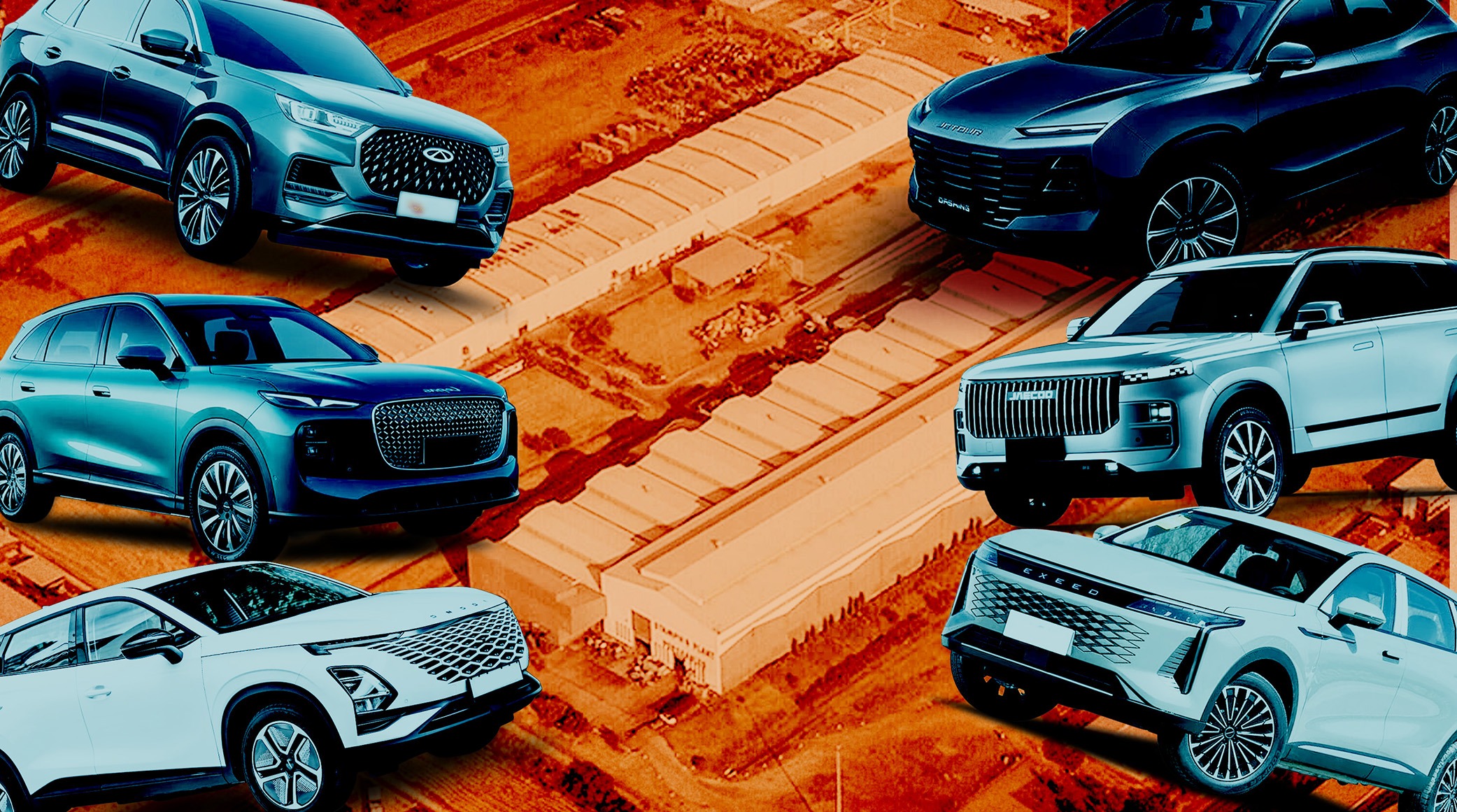
 Illustrative image: Nissan’s Rosslyn Plant outside Pretoria. (Photo: Nissan Global) | Chery Tiggo. (Source: chery.co.za) | Lepas L8. (Source: lepasinternational.com) | Omoda C5 (Source: omoda.co.za) | Jetour Dashing. (Source: jetour.co.za) | Jaecoo J7. (Source: jaecoo.co.za) | Exeed RX. (Source: exeedinternational.com)
 There is a displacement happening in the South African automotive market. According to Naamsa’s April report, passenger vehicle sales across the Chery manufacturing portfolio (Chery – 2,462; Jetour – 1,804; Omoda and Jaecoo – 1,804) amounted to 5,649 cars. There were 15 Jetour models marked as “export” sales, but that is a rounding error on a local market performance that would rank second on the sales list, wedged between Toyota (9,842) and Suzuki (5,363).
Nissan managed 15th place with 875 vehicles sold – a solid 170 units more than the next-best placed marque, BYD.
When Nissan’s regional (Europe and Africa) president Jordi Vila told Double Apex when asked about the brand’s future that “more than a year ago, we said that we are here to stay – even though we sold the factory. The best way to show our commitment is to keep doing what we are doing,” he was not lying.
What is also true is that Nissan is going through a rough time globally, and there is significant restructuring happening in its operations. There was the news that Chery will build electric vehicles in Nissan’s Barcelona plant, and a couple of weeks ago, there was news of talks about the Chinese carmaker taking over production at Nissan’s UK plant in Sunderland as a result of the Japanese brand’s aggressive cost-cutting.
As it turns out, South Africa is just another unfortunate page in the global automotive story.
Jetour means ‘victory road’
“Nissan has a long and proud history in South Africa and has been working to find the best solution for our people, our customers and our partners,” Vila said in the media statement about the South African plant sale.
“External factors have had a well-known impact on the utilisation of the Rosslyn plant and its future viability within Nissan.”
Nissan’s local market outlook is a long way from the enthusiasm that was shared in an excited company dispatch from SA to Japan in 1965:
More Datsun Pickups were sold in the Republic of South Africa last year than any other foreign make with less than two tons loading capacity, according to information recently received from Capetown by Nissan Motor Co. During the 12-month (Jan-Dec) period of 1964, Datsun Pickups led the field of the ten top competing foreign commercial vehicles having under 2-ton payload with 5,947 registrations out of a total of 18,974 in that part of the world.
This means that Datsun accounted for 31.6 per cent of the foregoing registrations. Currently, 500 to 600 Datsun Pickups are being exported every month to South Africa where they are very popular. Their last year’s penetration was 21.5 per cent of all imported commercial vehicles in South Africa last year.
What a difference 60 years and the emergence of aggressively priced competition make. There is, of course, the accelerated de-industrialisation happening in the country, but the data do point to a problem bigger than what is happening at Africa’s southern tip.
Even if you tried to get a view of the market specifics, the continental numbers go dark because regional sales are lumped into a broader “Others” category – which also includes markets such as Taiwan, Thailand, Brazil, India and Argentina.
The collective sales in the nebulous regional line on the March 2026 report accounted for about 14.2% of Nissan’s total global sales in March 2026 (46,816 units out of 328,860).
Nissan, to its credit, is at least investing $45-million into expanding its Egypt operations to crank out new Patrol models and the forthcoming Tekton light commercial vehicle.
Jaecoo means ‘cool hunter’
Chery’s executive vice-president Charlie Zhang has an understandably optimistic view of Nissan’s decline.
“Chery’s investment in South Africa is not only an important step in the company's globalisation development, but also our long-term commitment to the economic and industrial development of South Africa,” he said of the rapid expansion in the country and the strategic use of the Rosslyn plant to manufacture new energy vehicles.
It was then the pleasure of Jetour international president KE Chaundeng, who was quite upbeat when speaking to South African media at AutoChina 2026 (which is now probably the biggest automotive show in the world), to deliver the important news of the T1 and T2 models being built in Mzansi.

Chery SA will officially acquire Nissan’s manufacturing assets in Rosslyn, South Africa, including the main factory and a nearby stamping plant.
Following this acquisition, the Rosslyn manufacturing plant will be decommissioned and retrofitted over 12 to 18 months, with the start of new production aimed for mid-to-late 2027 – although Chaundeng said of the timeline, “it’s not fixed yet… but now we are making the planning”.
At its height, the Rosslyn facility was the operational hub for 45 other countries in sub-Saharan Africa, successfully serving markets such as Angola, Ghana, Kenya and Nigeria. But that time has passed. Now it’s the turn of the new, excited market entrant to send dispatches to head office. DM