




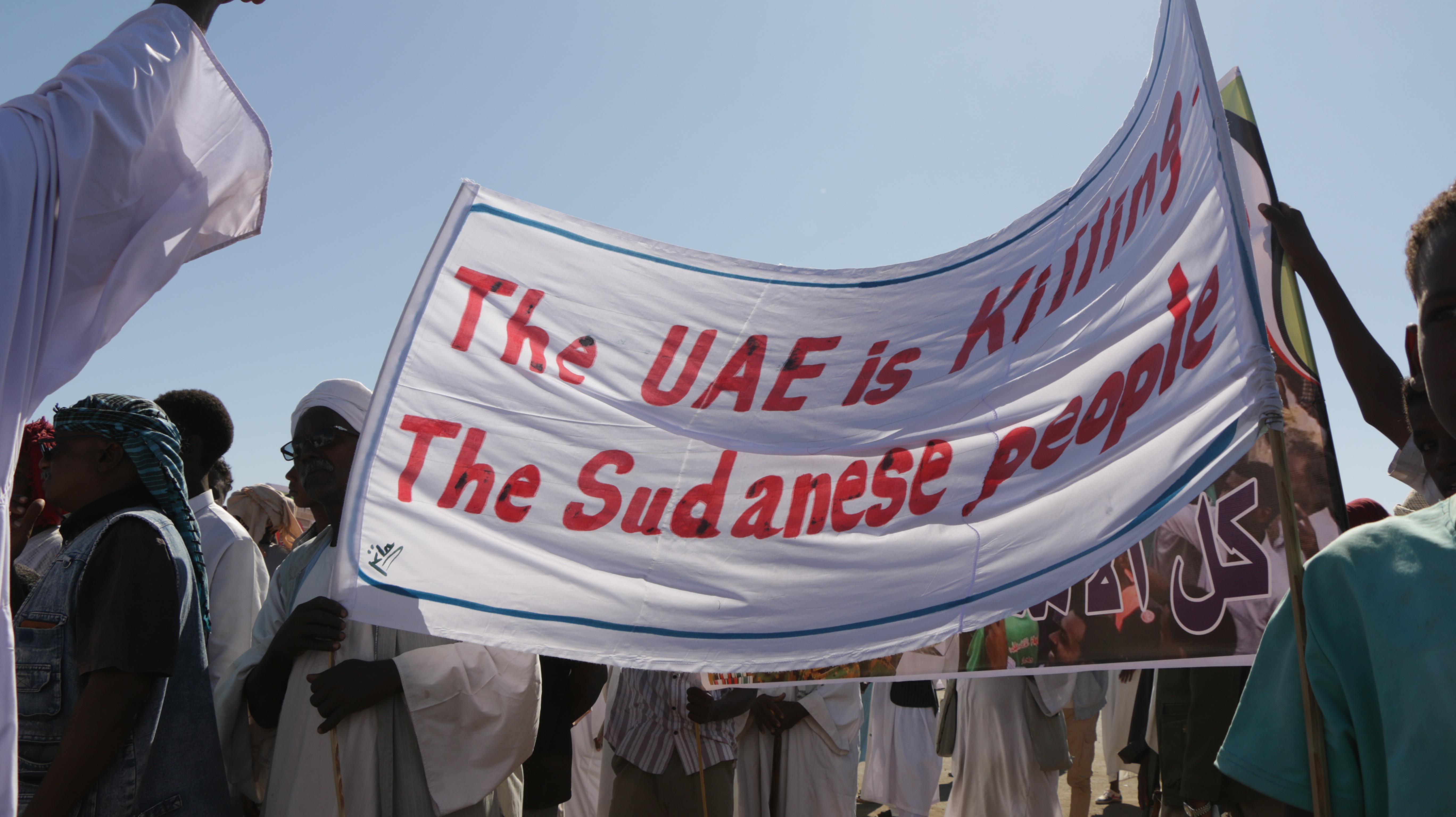
 Sudanese protesters take part in a rally in support of the Sudanese Army and against the paramilitary Rapid Support Forces in Merowe, about 330km north of Khartoum, Sudan, on 13 December 2025. (Photo: Stringer / EPA)
One of the most brutal, protracted and deadly conflicts in Africa is being supported and armed by the United Arab Emirates (UAE), among other regional and international actors. The Gulf state also stands accused of sowing discord in other global conflicts.
The UAE has been accused of secretly supplying weapons to Sudanese paramilitaries, specifically the Rapid Support Forces (RSF) militia via neighbouring Chad, The Guardian reported.
Sudan is in the fourth year of its latest civil war as the Sudanese Armed Forces, led by General Abdel Fattah al-Burhan, battle the RSF militia, led by Mohamed Hamdan “Hemeti” Dagalo, in a deadly power struggle for control of the north African country.
Ironically, these two belligerents previously joined forces and overthrew former dictator Omar al-Bashir and his government in the 2019 coup as his excesses sparked outrage and civil unrest in the country.
Sudan’s long and bloody history is intertwined with Bashir, a former army officer in the Sudanese Armed Forces, a convicted war criminal and an Islamic extremist and supporter of sharia (law). He deployed the predecessor of the RSF, the Janjaweed militia, to carry out widespread atrocities during the Darfur war in the west of the country in 2003, which the International Criminal Court said included acts of genocide. Bashir also used the RSF for his own security to protect him from assassination and coup attempts.
The Janjaweed, which comprised mostly Arabs and Muslims from the north of Sudan, were deployed in Darfur, where they carried out attacks on non-Arab communities. Sudan’s long-running north-south conflict eventually led to South Sudan seceding from Sudan in 2011. During the second Sudanese war from 1983 to 2005, an estimated two million people were killed, and there was widespread documentation of famine and atrocities.
War fallout
Earlier this year, a UN fact-finding mission identified the “hallmarks of another genocide” in Darfur, an area now under RSF control.
The current civil war’s death toll is estimated to be anywhere from 61,000 to hundreds of thousands. Human Rights Watch reported that the conflict has provoked one of the world’s biggest humanitarian catastrophes, with famine confirmed in the largest displacement camp in Darfur in August and looming in other regions.
/file/attachments/2991/12986871_342869.jpg "Sudanese people who fled from the internally displaced persons Zamzam camp make their way to the Tawila camps in North Darfur, Sudan, on 14 April 2025. The conflict between Sudan’s army and the Rapid Support Forces has caused millions to be displaced. (Photo: Marwan Mohamed / EPA)")
“Sudan reached the world’s highest level of internal displacement, with over 10.8 million people as of September 2024, including 8.1 million displaced since 2023,” said Human Rights Watch.
“As of September 2024, over 25 million people faced acute food insecurity, yet only about half of the humanitarian response plan was funded. More than 17 million children are out of school. People with disabilities faced additional challenges, given the limited humanitarian response.”
The UAE disputes that it fuels destabilisation and supports brutal militias, instead arguing that it is a force for stability, combating extremism, filling security vacuums and protecting critical maritime routes.
However, although the UAE continues to deny that it is fuelling the civil war, an internal report, seen by The Guardian, mentioned multiple flights from the UAE in which transport planes made apparently deliberate attempts to avoid detection as they flew into bases in Chad, where arms smuggling across the border into Sudan has been monitored.
Regional player
Furthermore, the Tactics Institute for Security and Counter-Terrorism argues that the UAE’s support for Hemeti in Sudan is a part of its broader foreign policy in the region, which has been focused on expanding its influence.
“In recent years, the UAE has increasingly become involved in the affairs of other countries, particularly in conflicts and political transitions. This has been driven by a desire to project its power and assert its position as a regional leader, as well as to secure its own economic and security interests,” a report from the institute said.
The UAE has also been involved in Yemen in an effort to reduce Iranian influence, as Tehran supports the Shia Houthi rebels.
However, Jean-Paul Ghoneim from the French Institute for International and Strategic Affairs says while the UAE is concerned about Iran’s policy in Yemen, it is also trying to extend its influence in southern Yemen, in Aden and on the Socotra archipelago.
To this end, “the UAE has supported the Southern Transitional Council by providing military backing to militias stemming from this political entity, whose ambition is to secede from the north of the country”, said Ghoneim, who added that the UAE’s regional ambitions were irritating its neighbours.
/file/attachments/orphans/RC2OP5AJ5U6I_171955.jpg "Sudanese refugees collect water from a borehole at the Gorom refugee camp hosting Sudanese refugees who fled recent fighting near Juba in South Sudan on 26 January 2024. (Photo: Samir Bol / Reuters)")
Ghoneim said this irritation extended to the UAE’s close relationship with Israel and the US, including its intermediary role in rapprochement between Somaliland and Israel – which has become the first state in the world to recognise Somaliland.
This subsequently triggered strong opposition from Saudi Arabia, Turkey and Egypt, while also spiking tensions with Somalia as the UAE tried to gain a foothold in the Red Sea corridor.
The UAE established a military base in Somaliland and secured the presence of DP World, one of the giants of maritime transport, in Berbera in 2016 to make it the main logistical port of the Horn of Africa, with investments exceeding $440-million.
In Libya, the UAE is involved in supporting warlord Khalifa Haftar’s Libyan National Army, which opposes the UN-recognised government in Tripoli and helps to keep the country fractured and divided.
Libya has been a mostly failed state since Nato’s military intervention in 2011, which led to the downfall of former leader Muammar Gaddafi’s government and a divided country, split since about 2014 between authorities in the west (Tripoli) and the east (Benghazi and Tobruk).
‘Surrogate warfare’
Ghoneim says the UAE spends millions of dollars on lobbying and public relations in the US and UK to shape foreign policy and enhance its global image. These efforts often involve cultivating relationships with high-ranking officials.
The country is also accused of employing “surrogate warfare”, enabling local militias and separatist movements rather than working through legitimate central governments.
Human Rights Watch asserts that although the UAE has promoted a public image of openness by hosting events like the COP28 climate change conference, it has restricted scrutiny of its rampant systemic human rights violations and fossil fuel expansion. Migrant workers in the UAE face widespread abuses and exposure to heat-related health risks.
/file/attachments/2991/12986875_543202.jpg "Sudanese people in North Darfur on 14 April 2025. According to the UNHCR, more than four million people have fled Sudan to neighbouring countries since the outbreak of the armed conflict in April 2023. (Photo: Marwan Mohamed / EPA)")
“The UAE, one of the world’s largest oil producers, sought to position itself as a global leader on climate and health issues at the UN Climate Change Conference COP28 despite plans to expand its fossil fuel operations, undermining efforts to confront the climate crisis and protect human rights,” Human Rights Watch said.
The UAE’s plan to increase fossil fuel production is inconsistent with the government’s commitments under the Paris Agreement that aims to limit global warming to 1.5°C, it added.
Meanwhile, after Iran’s repeated attacks on its infrastructure, the UAE might have strained its relationship with Washington when the oil-rich country threatened to turn to the Chinese yuan for its oil sales and other transactions if it ran out of dollars. Such a move would significantly undermine the dominance of the US dollar. DM
This story first appeared in our weekly DM168 newspaper, available countrywide for R35.
/file/attachments/2991/DM-3004_286371.jpg)
Comments
Scroll down to load comments...