




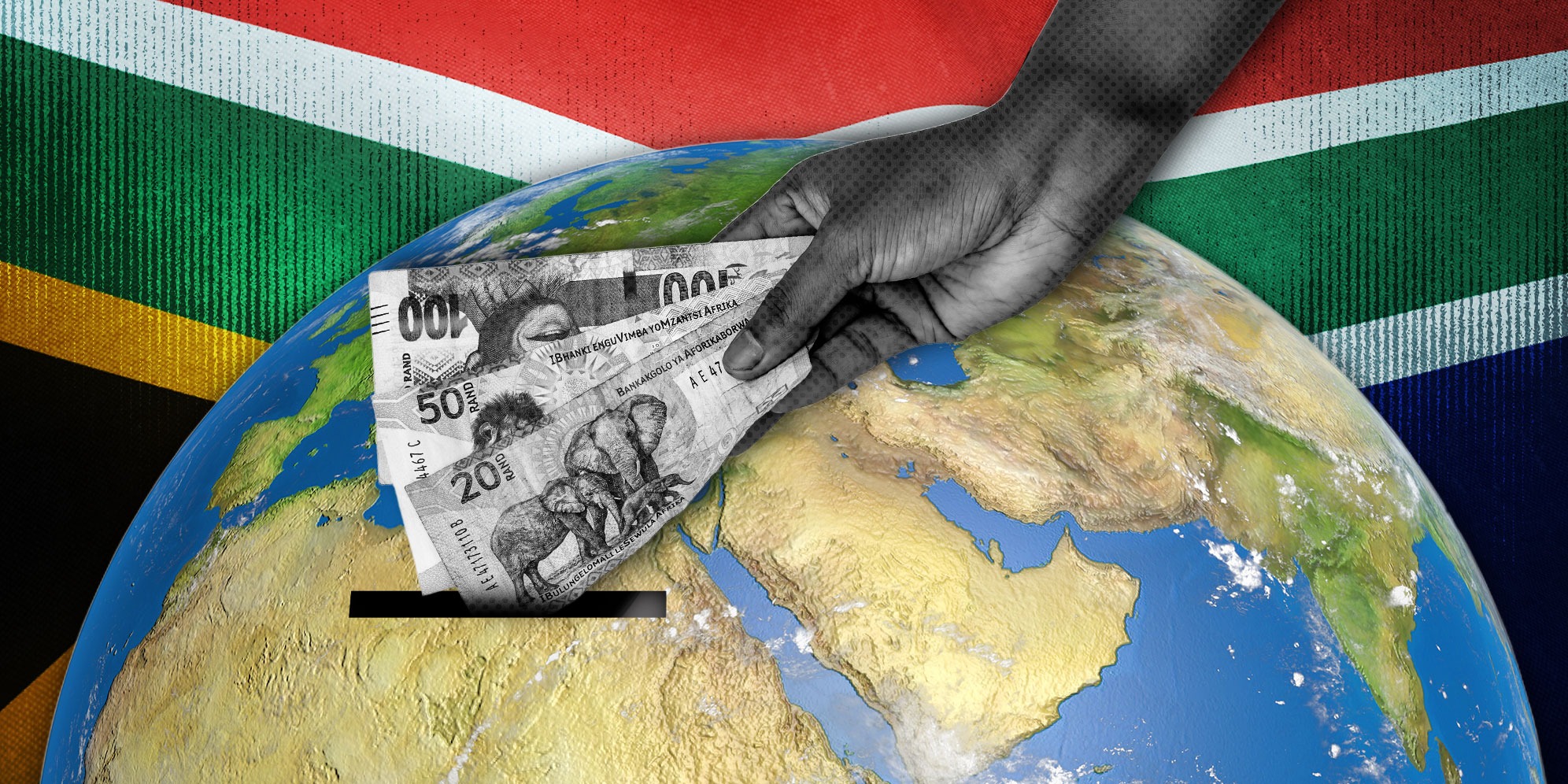
 Illustrative Image: South African flag. | Hand holding money. (Image: Freepik) | Globe. (Image: Istock) | (By Daniella Lee Ming Yesca)
 This is Part 2 of a three-part Daily Maverick Op-ed. Read Part 1 here.
If we are to move our economy onto a new trajectory, or “turn the corner”, we need a bold policy package commensurate with the scale of the challenge outlined in Part 1. In the first part of this article, we maintained that progress being claimed in turning the corner is extremely limited and partial, and far from the levels of growth, investment and development required to fundamentally shift our economic trajectory. Evidence from the past 30 years shows that tinkering around the edges will only serve to reproduce the same features of our growth path that continue to generate many social crises.
Some people will be understandably sceptical that the ideas contained in this article are realisable, because of: the decline in morality of our leaders; the entrenchment of criminal networks in society, political parties, the state and business; the hollowing out and incapacity of government; and the perception that we lack the resources for the bold national project that is proposed. While not claiming to provide the answers to all these complex challenges, this article focuses on the economic dimensions, and argues that, with the necessary focus, we will be able to fundamentally turn our economic situation around.
The alternative is to continue muddling along in a high-inequality, low-growth, low-development trap, and allowing the many crises to fester until they finally explode.
Our challenge is complicated by the fact that we don’t have the luxury of time – there are urgent issues that need to be addressed in the short to medium term, such as hunger, economic depression in poor communities, and industrial decline, while we leverage the deeper structural transformations that are required to place us on a different development trajectory.
We also face the spectre of a global economic recession, combined with rising prices, driven by high oil and food inflation, as well as other key commodities affected by the Iran war.
An economic strategy to turn the corner
This situation therefore calls for a carefully sequenced strategy connecting high-impact interventions that rapidly address some of the most pressing challenges, to structural changes in our economy, which will take longer to effect.
Such a strategy can build on itself, given the positive economic dynamics such interventions are able to unleash, as well as their ameliorative benefits in addressing urgent social challenges. For example, rolling out basic income interventions not only addresses hunger, but increases effective demand and economic activity in the most economically depressed communities, while providing an expanded market for domestic producers.
It is not difficult to see the importance of connecting key elements of such a strategy. In the above example, if the intervention of stimulating local economies through cash transfers is to be optimised, it would also need to be combined with the necessary small business and industrial support, as well as effective competition measures, in order to have the desired economic development impacts (to avoid the transfers being disproportionately swallowed up by imports, or large retailers).
Stabilise, stimulate, structurally transform
It helps to think about this integrated economic strategy using three simple concepts:
- Stabilise;
- Stimulate; and
- Structurally transform.
This article deals with some of the high-impact short- to medium-term interventions (stabilise and stimulate), while Part 3 will address the more medium- to long-term interventions (structurally transform) aimed at transforming our economic structure. It is important to note that these interventions are not purely sequential, they are connected, and rolled out together, even though some are longer-term in nature.
/file/attachments/2991/image1-Firefly-Upscaler-4x-scale_792342.jpg)
Stabilise
Some social and economic problems are urgent, and threaten to cause long-term damage if they are not addressed fairly rapidly. These relate to dysfunction in the public sector, crises in the private sector and crises in communities. Stabilisation is critical here.
Public sector: gradual progress is being made in stabilising public sector entities (although some strategies being used are controversial and contested, and likely to have unintended consequences). The best-known recent example of stabilisation in the public sector is that of ending load shedding and returning a greater degree of stability to electricity provision. Similarly, some progress is being registered in the stabilisation of transport and logistics. However, the stabilisation of state-owned enterprises is far from complete.
The provision of reliable services in key sectors by our state-owned enterprises is important for the economy and needs to be consolidated. At the same time this needs to be done in a manner that doesn’t only benefit the few but also ensures reliable and affordable public services for the majority. The current model of contracting out public services to the private sector fails to do this, because it makes services subject to the logic of profit, thereby making them unaffordable and inaccessible to poor communities, and needs to be reassessed in this respect.
The need for public sector stabilisation extends beyond state-owned enterprises to all levels of government. This includes functions such as safety and security, not often thought of as economic in nature, but which nevertheless have important implications for the economy. This also applies to key social services, such as health, education, water and social protection. However, because shortages are preventing these services from being provided effectively, their stabilisation can only be achieved if adequate resources are allocated to the basics needed for them to function, such as school infrastructure and medicines for clinics; and filling critical frontline vacancies in the public service, to immediately improve services and provide much-needed employment.
Private sector: crises in the private sector that need to be addressed relate particularly to sectors or strategic companies that are shedding large numbers of jobs, something we cannot afford, especially in the context of chronic levels of unemployment. Urgent consideration should be given to using emergency measures to stabilise these sectors, including those introduced after the 2008 global financial crisis (such as the training layoff scheme), and in 2020 after the Covid crisis the Temporary Employer/Employee Relief Scheme (TERS). These need to be complemented by other measures, such as industrial policy interventions by the state, and deployment of trade measures, to protect strategic industries.
Particularly worrying is the continuing loss of productive capacity in the manufacturing sector, and ongoing deindustrialisation. This needs to be stemmed, both to save jobs and to lay the basis for the programme of economic diversification that is so critical to move our economy onto a new growth path, beyond our current overreliance on raw materials and commodities.
Communities: There are acute crises in our communities, some of which could be mitigated fairly rapidly using targeted measures. Most notable are the crises of hunger, and the low levels of economic activity in large parts of our rural and township economies, which are characterised by economic stagnation or depression.
The evidence is clear in South Africa and internationally that cash transfer programmes are the quickest and most efficient way to get income into the hands of those who most need it. Expansion of the Social Relief of Distress (SRD) grant into a basic income programme, through increasing its value and extending it all households in poor communities, would have the dual benefit of combating hunger and supporting a broader economic stimulus through the circulation of income, given the proven multiplier effects of government expenditures on social protection in raising the level of demand, employment and business activity.
There are a number of measures being considered by the government to support livelihoods in communities, from labour market support to support for small businesses. These will be far more effective if they are used to complement access to income support, rather than as a substitute for it.
Other interventions should include:
- Action to contain the cost of essentials (such as food and transport);
- The expansion of public employment programmes such as the Presidential Employment Stimulus; and
- Support measures for particularly depressed regions.
This is particularly urgent given the looming threat of global recession, and rising prices. Consideration should also be given to introducing measures similar to those being used by more than 75 countries in response to the emerging global crisis, spanning subsidies, social protection and other supportive interventions.
A number of these stabilisation measures could be financed through a fiscal stimulus, and would partly pay for themselves, given their significant multiplier effects in raising the levels of income, and effective demand, in poor communities.
Such concrete measures, which immediately improve peoples’ lives, would help to create a different economic and social dynamic, and give ordinary people and businesses confidence that we are truly turning the corner, while the structural economic interventions, some more medium term in character, are implemented.
/file/attachments/2991/image2-Firefly-Upscaler-4x-scale_733313.jpg)
Stimulate
A coordinated economic stimulus package needs to be implemented with two critical objectives in mind:
- First, a quantitative objective – to release resources to generate a greater rate or quantum of growth, employment and investment, to end economic stagnation, and “get the giant wheel of the economy moving” (A phrase used by President Lula da Silva of Brazil to describe the impact of a deliberate policy of raising the minimum wage, and rolling out cash transfers, in successfully generating economic activity in his country); and
- Second, a qualitative objective – to deliberately direct the resources that are released to promote structural transformation of the economy, and ensure economic diversification, thus changing the quality or composition of growth, and its impact on developing the real economy, promoting greater labour absorption and reducing inequality.
The first would have a relatively rapid, high-impact economic effect, while the second is more medium term in character.
A macroeconomic stimulus and investment package should rest on three legs:
- A fiscal stimulus, using the national Budget;
- A more accommodative monetary policy stance through the Reserve Bank; and
- The mobilisation of public and private domestic resources
Governments globally have successfully used what are called countercyclical economic policies, particularly through the adoption of expansionary fiscal and monetary policy measures in periods of economic stagnation or recession, to stimulate the economy and promote investment and employment. This is particularly relevant in the South African situation, which is characterised by a low-growth trap, combined with astronomical unemployment levels.
I Using the Budget to provide a fiscal stimulus
Since 1994 our fiscal policy has in general followed a logic that is the opposite of well-tested countercyclical policies – in the face of economic stagnation and rising unemployment Treasury has tended to cut rather than increase public spending. This strategy aims to decrease debt, and reduce deficits, but has had the effect of deepening the downward economic spiral (including on these macroeconomic indicators) as growth is further suppressed. Treasury’s strategy is what economists refer to as procyclical, because it deepens the negative economic cycle.
The International Monetary Fund (IMF) has historically been the main institution promoting “fiscal consolidation” policies characterised by austerity. Yet a recent study by the IMF of 14 sub-Saharan African countries between 1990 and 2024 found that austerity measures in the region (based in budget cutbacks) have had larger contractionary effects on growth than previously believed, and that these negative economic effects were particularly pronounced during downturns (reducing output by on aggregate 0.54% after two years, and higher when implemented through spending cuts).
South Africa has paid a high price for austerity, economically and socially. Some direct indicators include the fact that public investment dropped from 6.3% of GDP in 2010 to 3.9% in 2025; we have 150,000 vacancies in the public service, many of them in key areas of frontline delivery such as health, education and policing; and spending on public services, such as health and education, has fallen for each member of the population, from about R30,000 in 2019 to about R28,000 in 2023.
Indirect, but no less real, indicators include the dampening effect austerity has had on private sector investment, and economic activity, particularly in the most depressed areas of the country.
Some economists will probably argue that we shouldn’t be implementing expansionary countercyclical policies “if the economy is growing”, as is currently the case. However, we have negative per capita growth, or relative economic decline, because the rate of GDP growth is below population growth, and has been for many years. This is combined with extremely high, and rising, unemployment. To make matters worse, high levels of inequality result in even the limited benefits of growth going disproportionately to a small group at the top. Productive sectors of the economy continue to decline, and there is a drop in real living standards for the majority.
In these conditions a fiscal stimulus is essential.
What should be the size of the stimulus? Many argue that in cases of extreme economic distress, as characterises the South African economy, a fiscal stimulus should be at least 5% to 10% of GDP if it is to have the necessary impact.
But it is not only about the size of the stimulus. It is also important that the increased spending is well targeted, minimises unnecessary bureaucracy, raises the level of investment in the productive economy and has strong impacts on employment. Equally important is to ensure critical social investment, through promoting health, quality education and training, and addressing poverty and hunger. Wherever possible these functions should not be contracted out, but be performed directly by the relevant government department, with the necessary safeguards, to combat the waste and corruption associated with outsourcing and tenders.
There is a narrative suggesting that these objectives can be achieved purely through reprioritisation – that is, without increasing the budget envelope. While significant resources can and should be released by cutting wasteful spending and reprioritising, the size of the challenge is far greater than the amount that can be saved in this way. This has been seen with the government’s so-called Targeted and Responsible Savings (Tars) programme, introduced recently. In the 2026 Budget Tars “saved” a mere R12-billion, or less than half a percent of total expenditure. Further, because so many areas have been cut to the bone, Treasury is focusing on the most vulnerable to make the cuts, such as social grant beneficiaries, by imposing conditions that unfairly exclude thousands.
If we recognise the scale of the challenge it becomes obvious that the Tars exercise is not able to meet the objective of releasing the required resources. Consider for example that public investment (as well as private sector investment) needs to be increased by 200% to 300% if we are to get close to reaching the NDP target of an investment ratio of 30% of GDP. Or that spending on health, education and policing infrastructure needs to be massively ramped up, and that we need to fill up to 150,000 frontline vacancies in the public service. Or that we should be doubling the number of adults receiving the SRD grant, if we are to reach those being unfairly and unlawfully excluded; and double its current value to link the grant at minimum to the food poverty line of R855 per month.
Interventions along these lines would require expenditure on a large scale, and should be understood as strategic investments, both directly into our productive capacity, as well as channelling critically needed income into depressed communities and industries. Such high-impact interventions could make a decisive difference in generating a virtuous economic and social cycle, and breaking the current economic depression experienced by the majority.
Increased investment by the government and state-owned enterprises, strategic industrial policy promotion and the generation of economic activity through the injection of income into poor communities, could play an important role in crowding in private sector investment, which has collapsed in recent years. Private sector investment decreased from about 15% of GDP in 2008 to 9.7% in 2025. Non-financial companies are now sitting on a record R1.8-trillion in cash which could be invested into productive employment, instead of lying idle.
The stimulus should be carefully designed to focus on high-impact areas with high economic and employment multipliers, combined with areas of greatest social need. This ensures that the investment of fiscal resources produces an economic impact that goes significantly beyond the initial value of that investment; while investing in the growth and stability of marginalised communities and economic sectors.
The fiscal multiplier reflects how government spending reverberates through the economy, generating knock-on effects, beyond the initial outlay. The extent of the multiplier varies depending on the nature of the expenditure. Multipliers resulting from infrastructure investment, and income transfers for example, have been shown to be high when properly spent. And in general, in conditions of slack demand and high unemployment, fiscal multipliers tend to be larger, with less danger of inflationary impacts.
Improvement in some economic indicators, better revenue collection, the commodities boom and the stabilisation of state institutions also create space for a more assertive fiscal intervention. This opportunity should not be squandered.
Further, we need to get ahead of the curve before the global economic downturn reaches our shores. A well-timed stimulus could play an important role in mitigating its worst effects.
II A shift in monetary policy
High real interest rates are choking economic activity by raising the cost of capital, making investment expensive for business, and increasing the debt of households. Despite the 2010 letter to the Reserve Bank by the finance minister indicating that they should include growth as part of their mandate and that they had the flexibility to go beyond the 3%-to-6% target band, this has largely been ignored. Instead, the Reserve Bank has chosen to move in the opposite direction, abandoning the range – initially unilaterally – and adopting a far narrower point target of 3% (with a 1% “tolerance band”). This represents a considerable tightening of monetary policy, which will suppress economic growth and investment.
Many inflationary pressures are imported. A policy that raises interest rates to address those prices that are outside our control (such as oil prices) cannot do anything about them, and will only worsen the economic picture.
This is increasingly recognised by mainstream economists.
A study published recently by Dr Roelof Botha quantifies the cost of the high-interest rate regime from 2022 to 2025. The study finds that “cost-push inflation cannot be lowered by restrictive monetary policy. Unfortunately, it can be worsened – as occurred in South Africa via the increase in unutilised manufacturing capacity. The latter was caused by insufficient demand in the economy, due to households and businesses being forced to spend a larger slice of disposable income and revenue on servicing the cost of debt.”
Econometric modelling by Botha of a “modestly lower interest rate trajectory” after 2021 concludes that we have paid a huge economic price for high real interest rates: “GDP (with these lower interest rates) would have been R206.4bn higher at the end of the first quarter of 2025, which would have led to higher employment and also increased fiscal revenues.”
Brian Kantor, a financial sector economist, writes: “Faster growth over the past 10 years has been an economic impossibility because the demand side of the economy has been so severely and consistently depressed by highly restrictive monetary policy. And faster growth – anything above 2% a year – will remain an impossibility unless interest rate settings become more accommodating of higher levels of spending by households and firms, accompanied by faster rates of growth in the money and credit supplies.”
The implication is clear: there needs to be a deliberate shift in monetary policy to promote economic output, investment and employment.
This first requires a Reserve Bank policy mandate to actively promote growth and employment, as well as combating inflation. Trade-offs should be made in the context of this framework, as opposed to narrow financial sector imperatives, or inappropriate international models. Given sensitivities around the operational independence of the Bank, it would be preferable that such a mandate change is clearly reflected in legislation, to avoid claims of political interference.
Second, we must revisit the current inflation target (3%) and interrogate whether reducing inflation to such low levels is of actual economic benefit and outweighs the associated costs (the evidence overwhelmingly suggests it is not).
Third, we must use a broader range of appropriate tools to address inflation. Increasing interest rates most effectively targets inflation caused by “overheating” (too much demand) in the local economy. But South Africa’s inflation is largely “imported” due to oil prices, exchange rate movements and other factors beyond our control. Therefore the interest rate tool is blunt and unhelpful in this situation.
Further, there are a range of monetary policy tools that can usefully be deployed to direct and support economic investment. These are dealt with in the next section.
Some may be concerned that the proposed macroeconomic stimulus (both fiscal and monetary) will lead to overheating of the economy and an inflationary spiral.
However, with high unemployment and declining per capita incomes, domestic inflationary pressures tend to be muted. Economists further recognise that targeting spending towards productive investment and social protection helps to avoid overheating. Social protection helps to stabilise domestic demand, and investment in the productive economy develops the capacity to respond to increased demand (and avoid a situation of “too much money chasing too few goods” or demand inflation, where demand outpaces supply).
III Mobilisation of domestic resources
The narrative that economic development in South Africa will be driven by foreign investment is misleading. The international experience is that development is almost always led by domestic investment. But as we outlined in Part 1, there is an investment strike by both the public and private sectors in South Africa.
So the question is: where is the much-needed investment going to come from?
Some hold the view that we have low levels of investment in South Africa because we lack the resources to meet our massive development challenges. The evidence doesn’t support this contention. Rather, it suggests that we have abundant domestic resources, and that we have been failing to mobilise and channel them.
A recent study for the National Planning Commission (NPC) on South Africa’s financial architecture found that the total value of all South Africa’s balance sheets was R49-trillion or eight times GDP in 2021! This includes “apex institutions like the South African Reserve Bank and the National Revenue Fund, and down through commercial banks, pension funds, insurance funds, development finance institutions, state-owned enterprises, shadow banks, households, and non-financial corporations (big and small)”.
If we were able to mobilise even a small percentage of these resources, many of which are currently lying idle, or focused on speculation, the challenge would become eminently manageable.
Broadly speaking, domestic resources can be mobilised through three channels: resources available in public sector institutions; the national Budget; and through the private sector and households. The NPC study calculates the composition of the R49-trillion figure in 2021 as follows (their 2021 figures are indicated with a *), with some figures updated by us (the overall total doesn’t equate to the NPC’s R49-trillion figure, because some of the figures are updated):
Public sector: Large volumes of resources totalling about 5.72 trillion are controlled by the public sector off-budget through, among others:
- The Reserve Bank (publicly controlled, despite private sector shareholding): R1.38-trillion (as at 31 March 2026);
- The Public Investment Corporation: R3-trillion, of which the Government Employee Pension Fund (GEPF) is R2.69-trillion (the NPC study puts this at R1.9-trillion, but the updated figure is significantly higher as at March 2025);
- State-owned enterprises: R1.3-trillion*; and
- Development finance institutions: R0.345-trillion*.
Budget: In addition to resources in these public institutions, the revenue fund of the national Budget currently mobilises about R2.1-trillion.
Private sector: Companies and private households control about R39.6-trillion:
- Commercial banks: R6.7-trillion*;
- Non-financial corporations (listed): R12.7-trillion*;
- Formal small businesses (unlisted): R2.5-trillion*;
- Shadow banks: R3.2-trillion*;
- Private pension funds: About R3.5-trillion (Private retirement funds, excluding public sector funds invested in the GEPF); and
- Households: R11-trillion (the bulk owned by the top 10% of the population)*.
While it is not possible to go into detail here, a variety of mechanisms can be used to mobilise these resources. These include:
- A requirement that a percentage of public and private retirement funds (RFs) are invested in areas of critical need, including infrastructure, through a public vehicle such as a reconstruction bond. A 10% to 20% requirement** could unlock resources needed to meet the investment shortfall in, for example, water, transport, energy and other critical infrastructure; while addressing the challenge of financing the SOEs battling to get access to credit, after years of State Capture. To ensure proper governance, and public confidence, there would need to be radical transparency around such an instrument, with public oversight through parliamentary and other oversight mechanisms. Such a bond would ensure guaranteed returns for the funds, as well as meaningful benefits for members of the funds and their communities. This is in contrast to the high proportion of RF investments currently going into equities, and offshore instruments, which are often neither reliable, or of real benefit;
- Large pools of undertaxed wealth, especially resources concentrated in the hands of the top 1% and large corporations, can be mobilised through various measures including a modest net wealth tax on the super-rich; a minimum effective tax on companies (small companies currently pay a far higher rate than large companies); the levying of a small tax on financial transactions (for example 0.05%); a crackdown on illicit capital flows, and the introduction of capital controls to stem excessive short-term flows; and capturing resource rents from the commodities boom. Such resources, currently concentrated in speculative and financial circuits, can be mobilised for investment in the real economy, development and expanded social protection. Incentives could also encourage non-financial companies to invest the R1.8-trillion in cash currently lying in their accounts;
- Various public institutions control resources that could be harnessed to promote investment and employment. These include the development finance institutions (DFIs) and the Reserve Bank. The DFIs are able to strategically advance preferential lending rates to businesses currently struggling with the high cost of credit. The Bank, in addition to a more accommodative monetary policy that lowers the cost of capital, could use direct financing and credit easing to support productive sectors of the economy. These policies could directly aid small and medium enterprises and specific sectors designated by the government. Further, the Bank could encourage commercial bank lending through explicit incentives to target productive, job-creating sectors. While the Bank has largely adopted an ultra-orthodox posture, their decision to respond positively to civil society calls to mobilise funds from Bank’s GFECRA account, together with Treasury, is a positive sign that more openness may be possible;
- There are several other low-risk and judicious options the government could explore to release resources currently lying idle or underleveraged in these balance sheets. For example, reversing the problematic (and ideologically driven) decision taken before 1994 to convert the GEPF from a pay-as-you-go system into a fully funded model. That decision resulted in the GEPF being massively overfunded, using scarce public resources. Reversing this could release billions of rands currently locked into a fund that doesn’t need to be funded at this level.
** Legislated requirements in the form of prescribed asset requirements (PARs) were widely used before 1994 to fund public investments (PARs of as much as 50% of pension fund investments were instituted) but were abolished before the democratic government was established.
Some of the measures to mobilise these resources can be realised relatively rapidly. Others may be more medium term in character. The selection, mix and sequencing of these measures to release resources for development needs careful consideration, but in any event will require political will to take on powerful vested interests who are likely to resist them. DM
The next part of this article, Part III, will deal with a package of measures to promote structural economic transformation.
The ideas in this article are intended to provoke debate, and don’t necessarily reflect the views of the Institute for Economic Justice.
This three-part article forms part of a debate series curated by the Institute for Economic Justice, published by Daily Maverick, to deepen understanding of South Africa’s economic challenges. It accompanies the IEJ’s podcast series Economic Justice Matters. The first podcast of the 2026 season asks whether the economy has turned the corner. The next episode will deal with debates around the Reserve Bank’s role and monetary policy.
Neil Coleman is coordinator of the IEJ Economic Justice Matters series, and Senior Policy Specialist at the Institute.
Comments
Scroll down to load comments...