




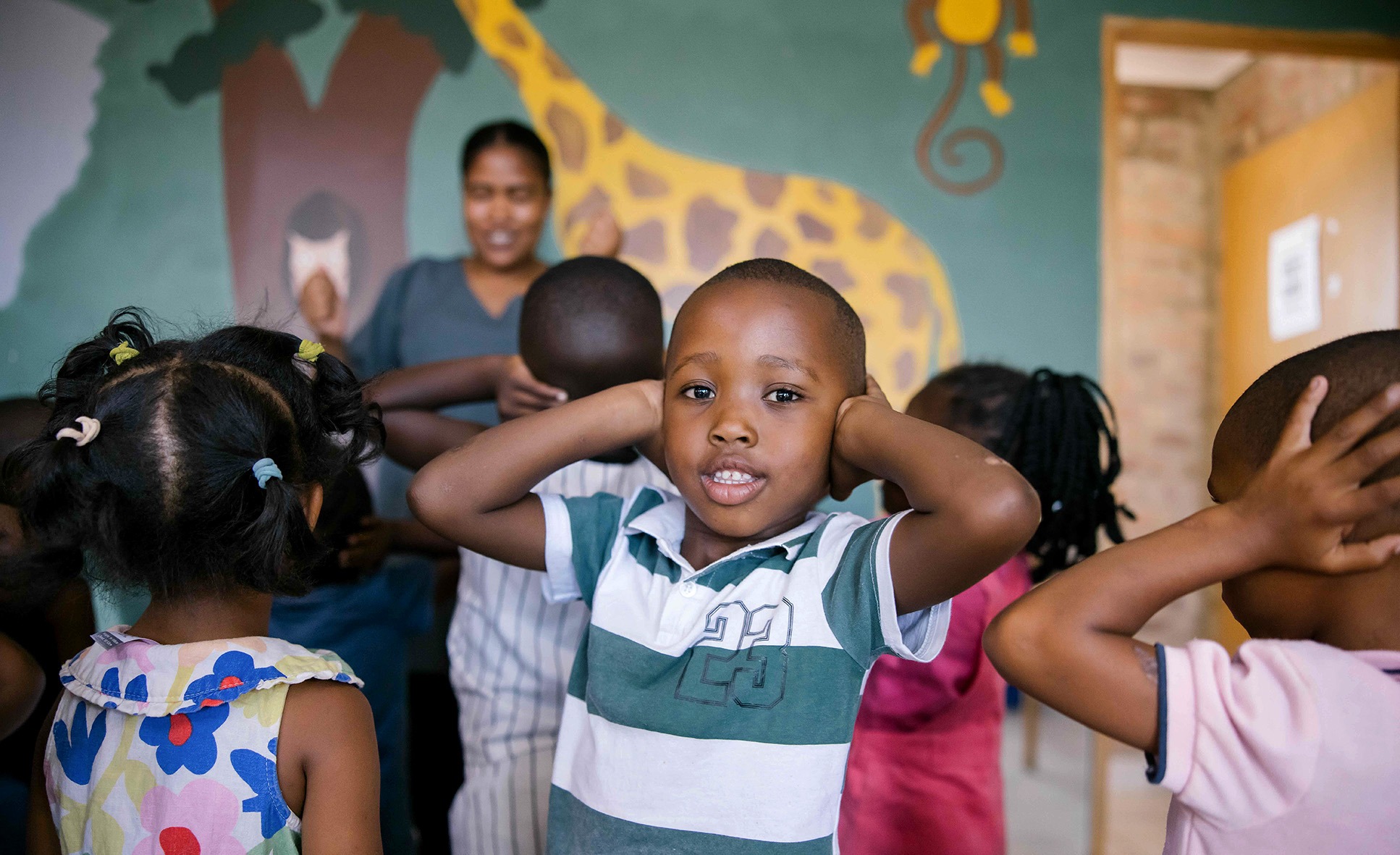
 In South Africa alone, an estimated 200,000 children younger than five are living with some degree of hearing loss, most of it caused by preventable conditions like middle ear infections. (Photo: De Wet Swanepoel)
 For a child with untreated hearing loss, the classroom is an exhausting guessing game. The teacher’s voice arrives stripped of sharp consonants, leaving only a muffled blur of vowels. Every sentence is a high-stakes puzzle with half the pieces missing. Did she say “pen” or “ten”? You constantly scan your classmates for clues, desperately trying to slot words into context and pretending you understand before your name gets called.
The scale of this crisis is staggering. Globally, about 90 million children between the ages of 5 and 19 live with hearing loss. In SA alone, an estimated 200,000 children younger than five are living with some degree of hearing loss, most of it caused by preventable conditions like middle ear infections.
Yet, when these children enter the South African schooling system, they are frequently left undiagnosed, unsupported and increasingly left behind. Professor De Wet Swanepoel, Professor in Audiology at the University of Pretoria, refers to this crisis as an “invisible epidemic”.
“As children grow older, they often show signs of hearing difficulties, but we don't recognise them as hearing difficulties. We often recognise it as other issues, like a child is being naughty because they’re not listening in class, not concentrating, or they have an attention disorder,” he explained.
/file/attachments/orphans/20260227_114226_659283.jpg "De Wet Swanepoel, a professor in audiology at the University of Pretoria, warns that undiagnosed hearing loss is an ‘invisible epidemic’. He was part of a team of researchers that developed the AI WhatsApp chatbot to turn teachers into the first line of defence against childhood hearing loss. (Photo: De Wet Swanepoel)")
People rarely connect a child's behavioural issues to an underlying hearing impairment, and Swanepoel notes that this is not only unseen but also incredibly widespread. Across Africa, an estimated three to four out of every 100 children are living with some form of hearing impairment at any given time.
In SA, hearing loss often goes undetected until a child enters the schooling system. Even then, they are usually flagged only for evaluation because of behavioural struggles or delayed speech. By the time they are lucky enough to receive a proper diagnosis, Swanepoel notes, these children have often developed an array of secondary impairments.
The gap between policy and reality
On paper, SA has a safety net designed to catch these issues early. The Integrated School Health Policy, a joint effort by the departments of Health, Basic Education, and Social Development, mandates that every child entering the school system receive both hearing and vision screening.
In an ideal world, that translates to roughly one million young learners having their hearing tested every year. In reality, less than 10% of those students ever receive this vital checkup.
Swanepoel explained that there are massive human resource constraints, resulting in a severe shortage of school health nurses to administer the tests. Furthermore, the nurses who are available often lack the specialised training and the highly expensive audiometric devices required to conduct proper screenings.
A pocket-sized lifeline for educators
Since children spend most of their waking hours in the classroom, teachers are uniquely positioned to be the first to observe the subtle signs of hearing loss. Swanepoel added that it was absolutely critical to equip teachers with the knowledge to identify these problems as early as possible.
To meet this need, researchers at the University of Pretoria’s WHO Collaborating Centre for the Prevention of Deafness and Hearing Loss partnered with the hearX Foundation to develop a fully automated, AI-powered training programme. As an NGO specialising in mobile health screenings for under-resourced communities, hearX helped co-develop the material to ensure it was highly practical for everyday educators. By leveraging the NGO’s vast network of Early Childhood Development centres, the team delivered the tool free of charge via WhatsApp, equipping teachers nationwide with the exact knowledge they need to intervene.
/file/attachments/orphans/hXF4_153590.jpeg "The hearX Foundation, an NGO specialising in mobile health screenings, partnered with the University of Pretoria to ensure the new AI training material was highly practical for everyday classroom environments. (Photo: De Wet Swanepoel)")
Operating completely through a WhatsApp AI chatbot, the programme eliminates the need for data-heavy videos, formal classrooms or extra apps.
Swanepoel explained that the chatbot guided educators through a series of accessible, bite-sized modules. Teachers learnt to identify early warning signs of hearing impairment, understand the severe impact of untreated hearing loss on academic development, and discover actionable strategies to support learners and facilitate timely medical referrals.
“We wanted this to be a kind of micro-module that we can offer to teachers without burdening them. While the entire training only takes about 30 to 40 minutes to complete in one sitting, it is specifically structured to be absorbed in bite-sized pieces over four days,” Swanepoel said.
Each day, teachers receive a simple infographic accompanied by a two-minute voice note that walks them through the material.
The curriculum is built around the acronym E.A.R.S:
- Education: Spotting the early signs and symptoms of hearing difficulties.
- Academics: Understanding the direct links between hearing loss and educational attainment.
- Referral: Knowing exactly what steps to take, who to contact, and what information to share with parents when a problem is suspected.
- Support: Implementing highly practical, immediate adjustments in the classroom to help a struggling learner make the most of the information they receive.
After reviewing the daily infographic and voice note, teachers can interact directly with the platform’s AI agent.
“The AI agent is always there to clarify anything or to get further information,” explained Swanepoel. Because the University of Pretoria’s department served as a WHO Collaborating Centre, the AI was trained solely on the latest World Health Organization resources on classroom environments.
To ensure the programme was actually moving the needle, participants completed a brief questionnaire before and after the training to measure changes in their understanding. If they passed a final, quick multiple-choice quiz, the system automatically generated a personalised PDF certificate and sent it directly to their WhatsApp.
Swanepoel noted that the tool had been enthusiastically adopted not only by traditional teachers, but also by early childhood development practitioners.
Scaling the solution nationwide
Swanepoel said his team had been overwhelmed by the programme’s uptake since its launch on World Hearing Day (3 March 2026). Within the first month alone, more than 12,000 South African teachers enrolled in the training with an overall completion rate of more than 80%.
/file/attachments/orphans/WhatsAppImage2026-03-02at165741_524578.jpeg "The fully automated, AI-powered WhatsApp chatbot guides teachers through bite-sized micro-modules, entirely eliminating the need for data-heavy apps or formal classrooms. (Image: De Wet Swanepoel)")
A key metric of success is the actual transfer of knowledge. Swanepoel said that of those who completed both the pre- and post-training assessments, 97% passed, with more than half achieving a perfect score. He said that the data showed that teachers who entered the programme with the lowest baseline knowledge gained the most, confirming the tool was successfully reaching those who needed it most.
The feedback from educators has been positive, with one in seven teachers indicating they planned to change their classroom practices or share the programme with colleagues and parents.
“We are working on accrediting the micro-module so that teachers can actually get Continual Professional Development (CPD) points from the Department of Basic Education,” said Swanepoel.
By equipping educators with the right information, the initiative aims to address this invisible epidemic before it derails a child’s future. As Swanepoel concluded: “We want to offer something scalable, affordable and digital to every teacher in SA. If they have the knowledge, they can make changes right there in the classroom that can truly help a child.” DM
What should educators be looking for?
Swanepoel explained that the red flags often shifted as a child progresses through the schooling system:
Preschool and Grade 1: The signs are largely developmental or physical. Teachers should look out for speech and language delays, or children constantly pulling at their ears and complaining of pain, telltale signs of middle ear infections.
Primary School: As classroom environments become more structured, hearing loss often masquerades as poor behaviour. Red flags include a lack of concentration, constantly needing repeated instructions, or students who frequently “zone out” and require extra effort to bring their attention back to the front of the class.
Secondary School: As the academic material intensifies, the impact becomes heavily tied to performance. “If you can’t hear well, you can’t learn a lot,” Swanepoel noted, explaining that older students with undiagnosed hearing loss often experienced sudden or persistent drops in reading and writing scores.