



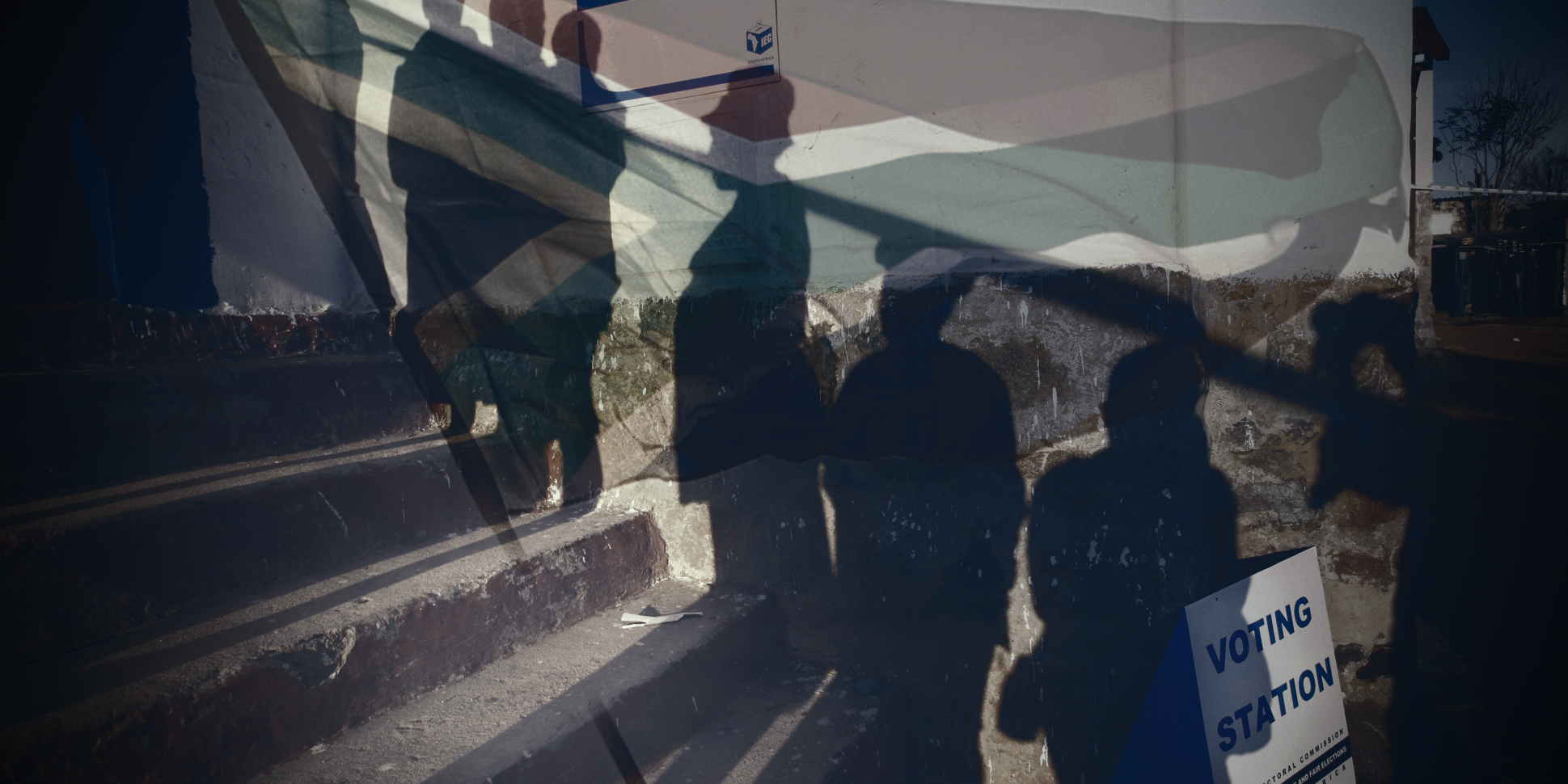
 Illustrative image | South Africans queue to vote in the 2011 local government elections. (Photo: Kim Ludbrook / EPA) | SA flag. (Jaco Marais)
 With the local government elections on 4 November rapidly approaching, “South Africa faces its most challenging electoral climate in decades,” says Dr Benjamin Roberts of the Human Sciences Research Council (HSCR), which is responsible for the IEC Election Research Survey that gauges the mood of South Africa before an election. He says SA faces a “low-trust, high-risk” election.
Researchers have found “widespread dissatisfaction with political leaders,” he said at an Electoral Commission of South Africa (IEC) research presentation in March. “There is an appetite for authoritarian decision-making,” said Roberts, with Gauteng a particular flashpoint.
“Support for democracy as the preferred system is not a majority view in any province, indicating that commitment to democracy is present but not dominant.”
Gauteng is highlighted because only 28% of those surveyed in that province said democracy is preferable to any other kind of government. Similar results were recorded in the Northern Cape and the Eastern Cape. Just under half of those surveyed in the Western Cape (46%) said electoral representation through regular elections is the best system.
Support for non-democratic alternatives is highest in KwaZulu-Natal (33%) and Mpumalanga (30%). This mirrors a continent-wide trend to favour strongmen, authoritarians or populists, who are big on talk and promises. In KZN, only 7% of respondents said they were satisfied with the functioning of democracy.
Popular patience has worn out as national issues (corruption, unemployment) and local failures (electricity, water, transport) fuel a growing sense that no current party offers real solutions, reinforcing the lack of trust. Voters rarely know or make a distinction between which sphere of government is responsible for what in their lives.
In the past, voters have punished incumbents by swing votes or have unveiled new populist figures at local polls.
It’s the economy and corruption
Here’s something that should keep hands out of the cookie jar: 82% of those surveyed said that corruption had become worse in the past five years; 81% said the same about the cost of living; 80% about unemployment. “A clear majority thought economic problems (like unemployment and inflation) would get worse in the next five years,” the survey found.
The outcome will not please President Cyril Ramaphosa, whose mantra is that state-led reforms are working and that South Africa is about to turn the corner.
/file/attachments/orphans/138164241_182530.jpg "President Cyril Ramaphosa will not be pleased by the findings of the latest IEC Election Research Survey. (Photo: Andre Borges / EPA)")
If the war in Iran does not end soon, South Africa’s green shoots could turn into blue moods, with inflation set to rise due to the knock-on effects of high oil prices and interest rate hikes.
But democratic (or anti-democratic) sentiment is not being driven by exogenous factors alone. “Even adults who support democratic values tended to state their democracy was not working — there is a significant positive association between satisfaction with democratic functioning and satisfaction with the economic situation,” said Roberts in his presentation.
Politicians, said those surveyed, simply do not listen to them: this led to declines in trust. Trust in the national government is down from 64% in 2004 to 19% in 2025; trust in Parliament is down from 65% in 2004 to 20% in 2025; trust in local government is down from 55% in 2004 t0 18% in 2025.
The plummeting local government trust numbers reflect local state collapse across most of the country. Apart from the odd shining-star council, most of them in the Western Cape, it is a picture revealed annually in the Auditor-General’s reports.
Almost one in two of people surveyed in a different poll said none of the more than 500 parties registered with the IEC represents their views.
/file/attachments/orphans/ED_346629_322261.jpg "Municipal election campaign posters on 29 October 29, 2021 in Pretoria. (Photo: Gallo Images / Beeld / Deaan Vivier)")
“Nearly half feel no party represents them, yet the majority still want to exercise their democratic right. This tension will define the upcoming local government elections,” said Ipsos director Mari Harris, analysing results of the Ipsos Khayabus Pulse of the People survey.
In that survey, just 38% of those surveyed in at-home interviews said local government is doing its job well. The political landscape needs consolidation, said Harris.
“Too many parties with conflicting messages, focused on winning the support of voters, can create confusion rather than clarity. It’s telling that almost half (47%) of South Africans agree that parties with less than 1% national support should be excluded from Parliament,” said Harris.
“While that question referred to national politics, the same dynamic plays out at local government level, where small parties can become ‘kingmakers’ without necessarily contributing to stable governance in the municipality, with the result that service delivery invariably suffers.”
Johannesburg is a classic example of small-party coalition malaise: infrastructure collapse and the end of viable city services ran parallel to the election of two Al-Jama-ah mayors in quick succession. Patronage is high, rent extraction is diffused across many political parties rather than concentrated in one or two, and it costs more in corrupted budgets.
Rise, decline and what the by-elections tell us
/file/attachments/orphans/Screenshot-2026-05-03-174319_373770.jpg "(Image: IEC by-elections dashboard | Gareth van Onselen)")
Political analyst Gareth van Onselen has developed a by-election tracker that goes back to 2000 and draws on 2,469 by-elections. He concedes that by-elections are imperfect snapshots of general election outcomes, but, analysed on a long trend-line this way, they do present an interesting picture.
The good news, he says, is that turnout rates are stabilising and could improve.
What the tracker suggests about major parties
ANC
The tracker correlates with election results and polling to show that the ANC is in decline. The party has contested the most by-elections, so the research base is fairly robust. Its support has floored in the metros — the ANC governs with a majority in only two of South Africa’s eight metros.
DA
The DA is doing better than its historic curve, while its support in the metros is growing, the tracker shows. It is consolidating its base but not growing into new markets (a black support base).“The DA has not yet got the winning formula,” said Van Onselen.
MK
The MK party has not been tested at a local election and is far harder to read, says Van Onselen, noting that the tracker “suggests it will do well”.
EFF
The EFF vote is stable and slowly rising, like the DA, says Van Onselen.
IFP
The IFP is doing very well and has benefited from a swing away from the ANC. It looks set to improve on its last local government election result.
PA
The winner. The PA is on a steep upward incline compared with its inaugural performance in 2021. DM
Note: The Voter Participation Survey for the IEC was conducted by the HSRC. The sample is nationally representative, with 3,500 addresses issued and interviews collected face-to-face. The Ipsos Khayabus Pulse of the People survey is an omnibus study of 3,600 randomly selected South Africans. Results are weighted and projected to be representative.