




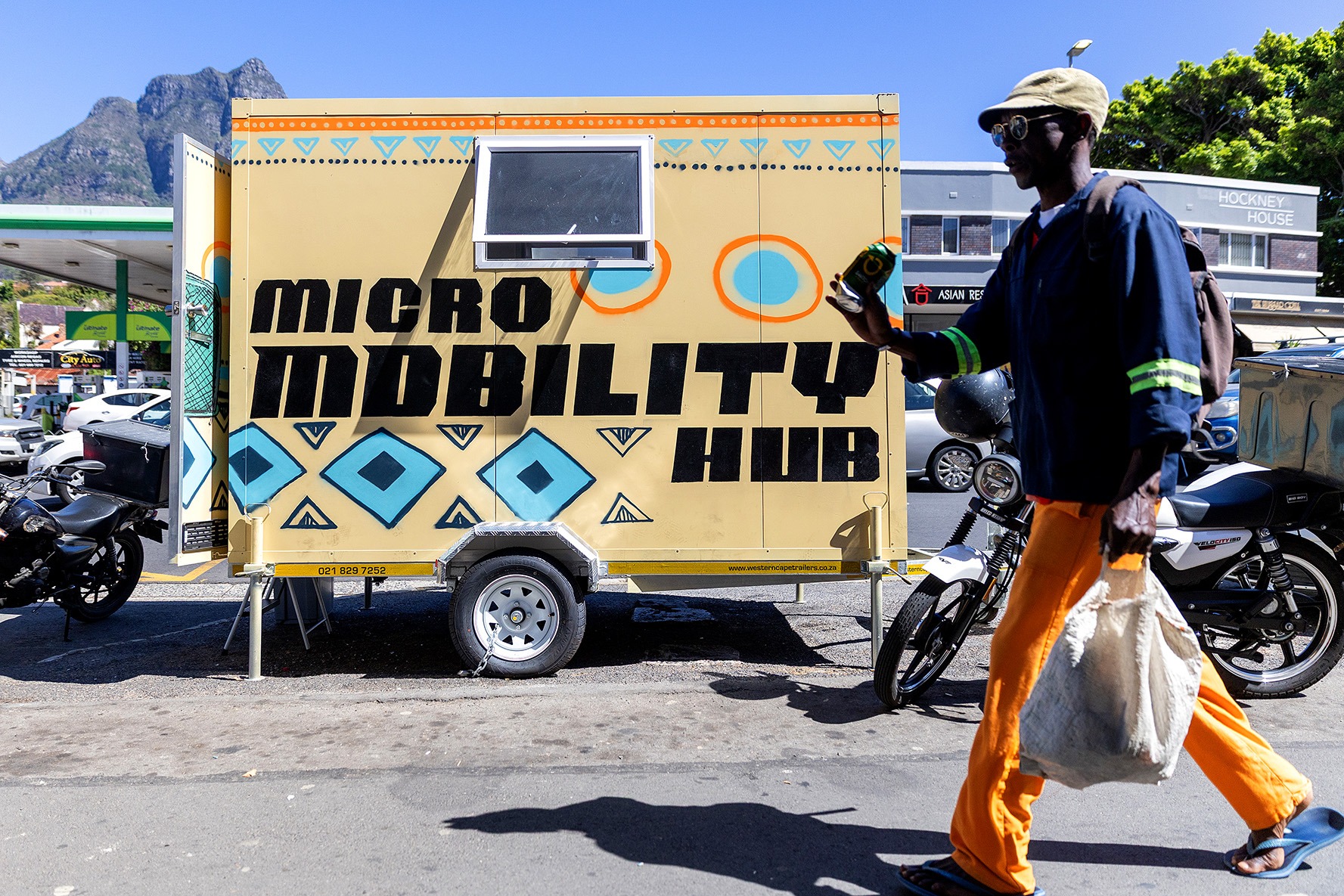
 The Rondebosch hub in Cape Town is a small trailer with Wi-Fi, water and solar charging. (Photo: Ashraf Hendricks)
The city of the future is already here, and its challenges are always evolving.
One issue that remains largely unaddressed in cities around the world is that of micro-mobility deliveries – app-based deliveries by two wheelers such as motorcycles, bicycles or scooters. They are everywhere, and they are increasingly part of daily life. Some people feel strongly that they are a problem. Others love the convenience they provide. Be that as it may, they are now part of how the city works.
The question then is whether we are willing to design for them in a way that is both safer and sustainable for everyone using public space, as well as more dignified for drivers.
Public space is where these pressures become visible first. How we respond to them matters: not only because it can ease the problems we face today, but because it can help us protect and adapt our public spaces for the future.
Because this is still an emerging issue, research is limited and policy is developing slowly. In that context, learning by doing can be a powerful way to understand what is happening on the ground and begin testing practical responses. Non-action is also a response, and at the moment it is not working. What is needed is action: bringing stakeholders together, testing an idea and learning from what happens in practice.
This is what we tried to do through the micro-mobility hub pilot. And this is what we learnt:
A shared problem requires a shared approach
In South African cities, there has been a dramatic growth in micro mobility deliveries. The effects are visible in our public spaces. As we wrote last year, in the absence of infrastructure that addresses this new form of urban logistics playing out in public space, other public space users are displaced, scooter repairs take place on sidewalks, and drivers are left to face the elements in harsh conditions while they wait for their next order.
Together with the University of Cape Town’s Centre for Transport Studies, the Langa Bicycle Hub, and with financial support from the Foreign, Commonwealth and Development Office, we tested a micro-mobility hub. Engaging closely the City of Cape Town’s Urban Mobility team, the idea was simple: provide basic amenities for drivers, including seating, shade, free Wi-Fi, drinkable water and access to a toilet.
The pilot helped us see the issue more clearly. Preliminary research confirmed that most drivers are under 30 and rent their motorcycles. For many, delivery work is one of the few available options because barriers to entry are lower than in many other sectors, particularly for foreign nationals and others with limited access to formal employment.
/file/attachments/orphans/DSC9148_476026.jpg "Motorcycles parked in designated bays outside the CBD micro mobility hub. (Photo: Chris Kets)")
We also tracked how the hub was used throughout the day, and we began to build a more granular picture of the delivery environment. It became clear that this is not only a transport issue, or a public space issue, or an economic issue, or an urban logistics issue. It is all of these things at once. And that is why no single actor can solve it alone.
That was the value of learning by doing. It moved the conversation from abstract concern to practical problem-solving.
Location, location, location
We tried placing hubs in two different kinds of locations. One was where riders were already congregating. The other was in a parking lot two blocks away from rider congregation areas that had space, shade and, we thought, was close and convenient enough.
In the first instance, the hub worked very well and use was extremely high. In the second, there was limited use of the hub by drivers. Even at two blocks it was just too far away given the nature of micro mobility logistics.
This creates a conundrum. Riders are currently gathering in public spaces that were never designed for this purpose, and often in places that are already under pressure. We should not simply give up prime public space for the needs of commercial logistics. At the same time, if this is where riders need to be in order to work, then we have to understand how that can be addressed in practical terms.
/file/attachments/orphans/DSC9117_758816.jpg "A seating area gives drivers space to eat, rest and connect between orders. (Photo: Chris Kets)")
/file/attachments/orphans/MicroMobility-20260227-AshrafHendricks_cards_709724.jpg "Drivers play cards at the hub while waiting for their next order. (Photo Ashraf Hendricks)")
While there may be possibilities for platform operators to nudge riders through their apps, and that may well be part of the solution. But in other cases, we may need to accept that some use of public space is necessary, in much the same way that cities already allocate space for parking, loading or other urban utilities.
The point is not that delivery riders should take over public space. The point is that they are already using it, because we have not yet provided a better alternative.
Trust is part of the infrastructure
Infrastructure is not only about what is built. It is also, and perhaps more importantly, about buy-in. That includes buy-in from the users, in this case the drivers, but also from City officials, private sector actors, businesses and residents.
Building that trust was not straightforward.
Some drivers immediately understood and used the hub. Others were suspicious. For many, the offer seemed too good to be true. Why would someone suddenly provide seating, shade, Wi-Fi and toilets for free? What was expected in return?
Explaining that this was a short-term pilot with a research component was not as simple as putting it into words. Understandably, drivers work in a difficult and often precarious environment. Many are used to being exploited, disrespected and perceived as a nuisance.
We printed flyers, shared information digitally, and engaged some drivers and shop owners to help spread the word. Eventually, people started to come around. But even then, it took weeks before many drivers spoke to our team freely and comfortably.
/file/attachments/orphans/MicroMobility-20260227-AshrafHendricks3_657538.jpg "A mural by local artist Breeze Yoko brings colour to the hub. (Photo: Ashraf Hendricks)")
Trust between the public and private sectors is also an ongoing process, but when a level of trust starts to develop, as it did during the pilot, something else becomes possible. We begin to see that the public realm is a shared responsibility. The priority must always remain public use, rather than the benefit of private actors. But the current situation is not serving anyone well. It is not good for drivers, for surrounding businesses, or for the public at large.
Thinking beyond a pilot
We set out to test a physical space and to observe what worked through the experience of delivery motorcycle drivers. But the logistics ecosystem is much broader and more complex than that, and we should be thinking long term.
How can these spaces support a transition to electric vehicles? Could they provide other services, such as storage, charging, maintenance or basic mechanical support? Could they become enterprise opportunities? Could they help organise a sector that is growing quickly?
That will require appropriate regulation, investment and better use of public space. But it will also require strong public-private partnerships. This pilot has provided valuable lessons, and we hope it contributes to wider processes of research, policy development and experimentation.
The challenge now is to build on it: to keep testing, iterating and learning, so that our city can improve how public space is used and, in doing so, inspire other cities facing similar questions around the world. DM
Marcela Guerrero Casas and Dustin Kramer are the co-founders of Local South. They work to advance local action in the Global South.


Comments
Scroll down to load comments...