




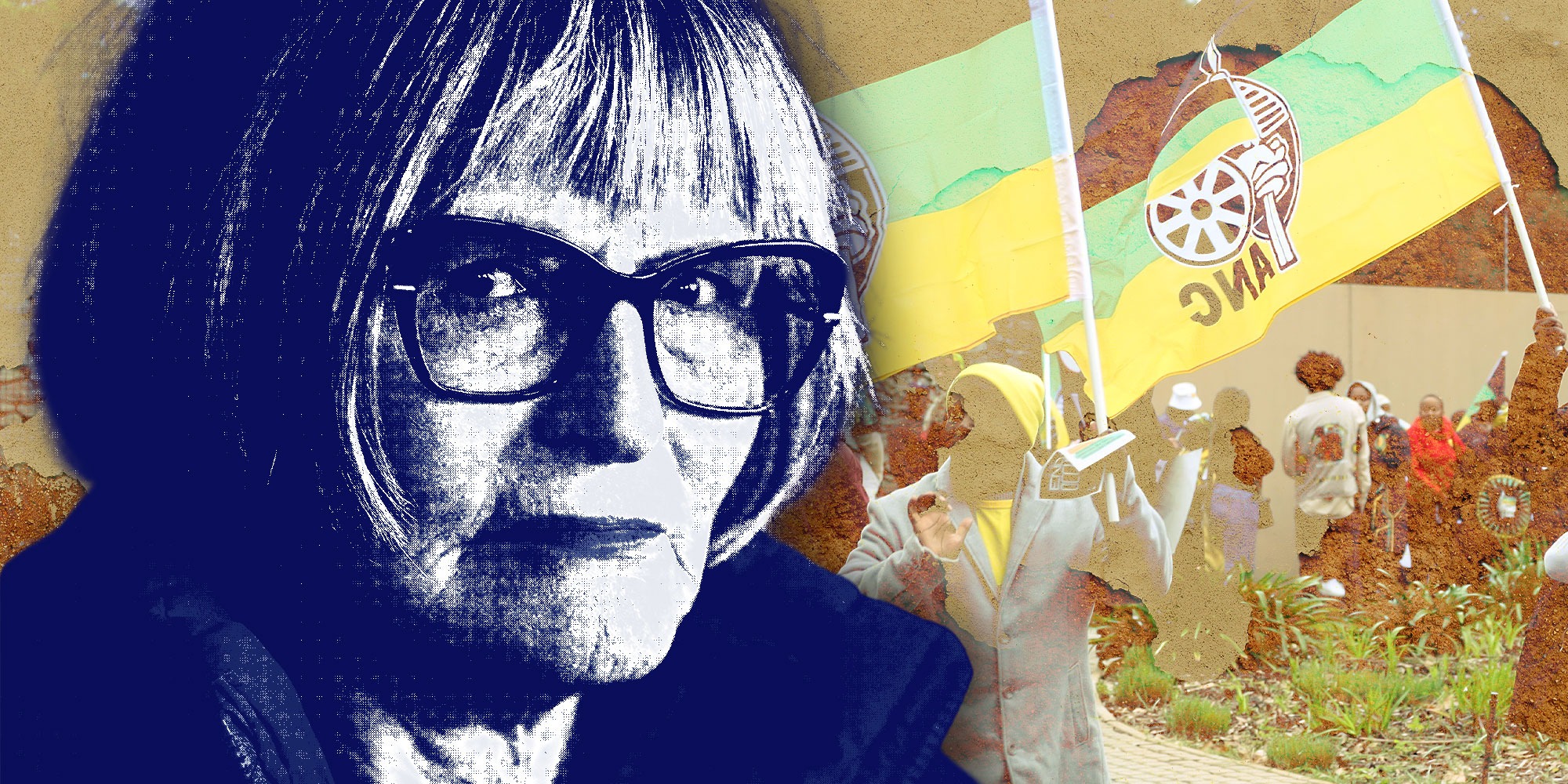
 Democratic Alliance (DA) Mayor candidate for Johannesburg Helen Zille. (Photo: Per-Anders Pettersson / Getty Images) | ANC supporters. (Photo: Gallo Images / Sharon Seretlo) Illustrative image: Daniella Lee Ming Yesca)
 The firing of the local elections starting gun by President Cyril Ramaphosa led, predictably, to a plethora of political parties claiming to be “ready” for the elections.
Joburg, almost certainly the focus of these polls, has already seen extensive campaigning by the Democratic Alliance’s (DA) Helen Zille, while the African National Congress (ANC) says it is still to find a suitable candidate. Joburg could make or break some of the other parties, including the Economic Freedom Fighters (EFF), ActionSA and the uMkhonto Wesizwe (MK) party.
By the time Joburgers vote on 4 November it will have been a full 13 months since Zille started campaigning. There is no doubt that campaigning works.
Then DA mayor in Nelson Mandela Bay, Athol Trollip, said the main reason he had been able to win office in that city in 2016 was because the local elections were held later than expected (owing to a court case over voter registration), so he had been campaigning for a full year.
In national elections many poll-watchers have commented on how the ANC often enjoyed a late surge just before election day. This was also because of campaigning (and why some were expecting a late surge from the ANC in the 2024 elections).
Zille has also been able to set suburban WhatsApp groups alight with her videos showing her swimming, rowing or trying to play tennis in parts of the city.
However, there is also a risk that because she started so early, the novelty will have worn off by November, that in fact voters find her antics “tiring” or just not worth rewarding.
That said, it does appear she has succeeded in one crucial way that might prove decisive.
One of the most important tricks to succeeding in politics can be to try and determine what the playing field of the elections is, what it is that voters will be thinking about on voting day. And then to try and put your opponent on the wrong side of that issue.
For years the ANC would try to make national elections about race to put the DA on the wrong side of that. More recently the DA responded to this by introducing the element of race itself (through adverts claiming Nelson Mandela “would have voted for the DA”, or the advert that first burnt and then restored the flag. (The reasoning appeared to be that if the election was going to be about race anyway, it could at least determine how it was introduced.)
Zille has successfully made the Joburg election, at least for now, only about service delivery.
And worse for the ANC, she has been able to put the party in a position where it can either respond to the service delivery failures she highlights, or ignore them.
In Douglasdale, site of one of her famous swims, current Mayor Dada Morero felt compelled to have the site repaired and then film his own video there.
This meant Zille won what will be a big argument in this election, and she had been able to set the playing field.
This was the aim all along. While some might deride Zille’s actions, she was able to force Morero to either respond to the problems she was pointing to, or to ignore them.
If he had ignored them it was likely there would have been a second (or even a third) season of videos, as she found her oars, wetsuit and tennis racket and revisited those areas to show how the ANC had not fixed them.
It is also obvious that Zille is aware that this strategy will only work if she, the DA and its campaign are not distracted by other issues.
Her public refusal to discuss the situation in Gaza is evidence she is aware of this.
But many of the other parties in this contest will be able to play this game too. They will try to find ways to place Zille and the DA on the wrong side of other arguments. Some may be about race, but others might well be about the perceived nature of Cape Town’s social fabric, the Middle East or other issues.
In particular, ActionSA is likely to claim that its mayor in Tshwane, Nasiphi Moya, has been able to govern more effectively than the DA’s Cilliers Brink did.
This election might be important for ActionSA because it may be an important first test of a political identity which appears to have changed slightly since it last faced voters in 2024.
However, the party with probably the most to lose in Joburg in this election is obviously the ANC.
For the moment, it appears to have no coherent public message.
One of the main reasons for this is that it does not yet have a mayoral candidate, someone who can give its campaign a focus and an identity.
The ANC says that it may consider outsider candidates, people who do not currently hold an elected position in the ANC (surely its candidate will be a long-time member of the party). This means Luthuli House has already usurped what used to be the power of the Joburg ANC region to have a big voice in determining who this person would be.
It also suggests the Joburg ANC leader (and current deputy mayor), Loyiso Masuku, will not be the candidate, and thus possibly, not ever mayor.
While Luthuli House clearly believes it needs a bigger name than hers in Joburg, it may also mean the Joburg ANC will be less than wholehearted on the campaign trail.
It may also say to voters that even the national ANC does not have faith in the Joburg ANC. And if that is the case, why should voters support them?
It may well be that the ANC in fact deploys Ramaphosa on the campaign trail in Joburg as much as possible, believing he could be one person who can help change minds.
One of the variables of the ANC’s campaign is that it is difficult for outsiders to assess the state of its branch network in Soweto. In the past this network would have been able to get voters to voting stations on the day.
But its failure to get to even 35% of the vote in Gauteng in 2024 suggests this network is now much weaker.
There are other important variables in Joburg that cannot yet be quantified.
The Patriotic Alliance has done well in recent by-elections. But while that looks impressive, the fact is by-elections cannot be compared to normal elections because the percentage of people who vote in them is so low.
And of course it’s worth remembering the other big variable in Joburg is still the MK party.
It surprised almost everyone outside KwaZulu-Natal with its showing in 2024, but it has not appeared to be able to grab the national narrative since then. Certainly, in the English-language media and suburbs of Joburg there is very little evidence that it even exists.
Considering the internal chaos in the party it seems unlikely that it has been able to form branches and campaigning machinery in that city.
However, if it is preparing another surprise, it might well be able to win enough votes to create a coalition of some kind with the ANC and others in Joburg.
If it does not do that (which on balance is more likely) and completely fails to win votes, it might open the door for the Inkatha Freedom Party to win some support.
Crucially for the future of MK, Joburg is the one metro outside KwaZulu-Natal where it might have a chance to win a significant share of the vote. Should it fail to do this, it would be proof it is a provincial party and will never be a national party.
Today (Monday, 4 May) marks exactly six months until voting day. There is still much time for the political situation to change.
For the moment Zille has momentum in the suburbs. Other parties will have to work hard to ensure they have similar momentum among their constituencies. DM
Comments
Scroll down to load comments...