




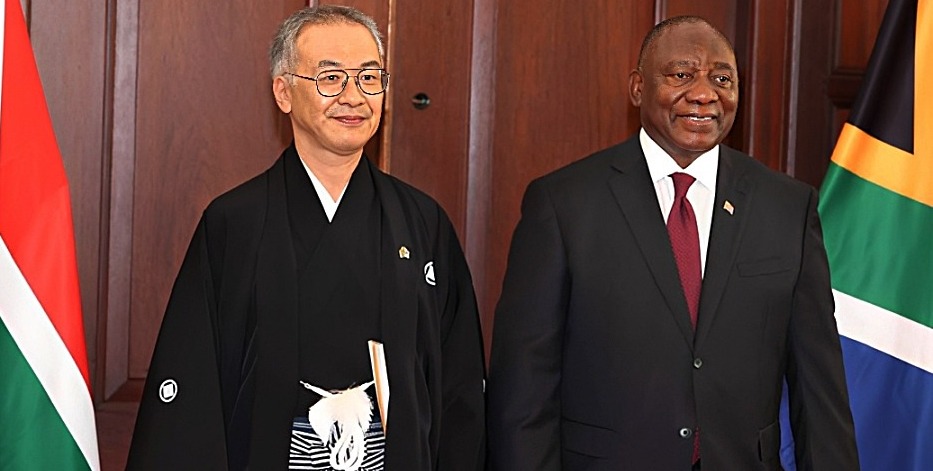
 Japan’s Ambassador to SA, Fumio Shimizu (left), with President Cyril Ramaphosa. (Photo: GCIS)
 In a turbulent world, South Africa is intensifying its already solid relations with Japan, including several high-level visits recently. This week (4 May), Japan’s Foreign Minister Toshimitsu Motegi will visit South Africa on an Africa tour that also includes Zambia, Angola and Kenya.
Japan’s ambassador to South Africa, Fumio Shimizu, explains Motegi’s visit as necessary for Japan to boost relations with the Global South, including Africa, “to strengthen and maintain the international order based on the rule of law” at a moment when “we see the international power balance is changing”.
Shimizu also noted that Motegi will be visiting Africa to explore how to strengthen the supply chains of the continent’s large reserves of critical minerals.
He says there has been “a great development” in SA-Japan relations recently, especially through “very concentrated, high-level exchanges”.
This included President Cyril Ramaphosa’s attendance at the ninth edition of the Tokyo International Conference on African Development (Ticad 9) in Yokohama in August, Deputy President Paul Mashatile’s visit to Japan to meet his counterpart in March, newly elected Japanese Prime Minister Sanae Takaichi’s visit to Johannesburg in November to attend SA’s G20 summit and also visits by the foreign ministers and other ministers of both countries.
Shimizu noted that Ticad 9 contributed towards the success of SA’s G20, especially because the four priority issues on SA’s G20 agenda – disaster resilience and response, a sustainable energy transition, financial mobilisation for the energy transition and the importance of mineral resources – were also all included on the Ticad 9 agenda.
/file/attachments/orphans/FS_3602c_533897.jpg "Japanese Ambassador Fumio Shimizu at the Union Buildings. (Photo: Japanese Embassy)")
Daily Maverick asked Shimizu if Japan is helping to keep alive SA’s G20 agenda, which has been jeopardised by the US dumping most of it in its G20 presidency this year and also barring South Africa from attending its G20.
“It’s better to refrain from commenting upon the US-South Africa relations, but regarding the membership of the G20, the Japanese position is very clear,” Shimizu said, noting that Takaichi and the government have emphasised that it is important for all G20 members to share responsibility for reaching solutions.
However, Shimizu said he could not say if Japan had explicitly objected to South Africa’s exclusion, as some other countries reportedly had done, at the first meeting of the G20 sherpas under the US G20 presidency in Washington last December, because he explained “the sherpa meeting was not open”.
Tokyo has made it clear that cooperation in the development of critical minerals and green energy are an important element of relations with South Africa.
Shimizu noted that in September 2023 the two governments signed a memorandum of cooperation on jointly developing a supply chain of green hydrogen and ammonia, including the promotion of Japanese investment in South Africa and transferring Japanese technology. And then in November 2025, they signed a memorandum on cooperation in a wider decarbonisation programme.
Shimizu noted that Japan and South Africa are involved in two joint ventures to produce green ammonia and hydrogen. A Japanese company and a Japanese bank are involved in the Northern Cape Green Hydrogen Project, which was being developed mainly by Sasol.
Japan is also involved in the Hydrogen plant project in Gqeberha, mainly owned by the UK company Hive.
He said Japan and SA are exploring the possible use of green hydrogen and ammonia to co-fire South Africa’s coal-fired power generating plants, thereby reducing CO2 emissions, during SA’s transition from coal to full renewable energy.
When Takaichi met Ramaphosa on the margins of the G20 summit last November, she stressed that Japan would also like to cooperate with South Africa in establishing highly predictable global supply chains, including in mineral resources.
Shimizu noted that SA is important for a predictable supply chain for critical minerals, though he also noted that Japanese companies are already “deeply involved in the trade and stable purchase of the mineral resources of South Africa, which contributes to strengthening the supply chain of mineral resources, as well as contributing to the development of the South African economy”.
Daily Maverick asked Shimizu if Japan had contributed towards the beneficiation – or value addition – of South African critical minerals and other raw materials, which is a high priority for the SA government.
It seems Japan is not yet involved in any specific projects, though Shimizu said his country recognises the importance of beneficiation, which is why it was included in the Ticad 9 declaration and the G20 joint statement.
He also noted that Japanese companies are mostly investing jointly with South African companies, so ensuring the sustainability of projects is also important.
Investment conditions
Most international investors in SA have issues with the business environment, including complying with measures to redress historical inequities such as BBBEE and Employment Equity. Do Japanese companies have the same issues?
Shimizu said Japanese companies do have concerns about stable water and electricity supply, railway and port functions, and crime.
Despite this, about 260 Japanese companies, including several auto manufacturers, are operating in SA, making Japan the seventh-largest investor in SA. In 2024 Japanese companies invested R70-billion in SA.
“Japanese companies have also transferred technology and developed human capacity and created job opportunities,” he said.
For Japanese companies, though, predictability is important, so they can plan ahead.
He said the Japanese government and its companies “respect the South African effort to tackle historical disparity”.
He noted that different Japanese companies observed the BBBEE rules in different ways. For example, one large auto company has retained all its equity in Japan, but has contributed to the transformation fund for auto makers in SA.
Isuzu established Isuzu South Africa, a local subsidiary, to comply with BBBEE equity requirements, and many Japanese companies have achieved the top-level BBBEE score.
He also noted that the problem that some companies have experienced in renewing visas for their Japanese employees has eased since 2024 with new government regulations.
Trade and defence
South Africa is also targeting Japan for the export of more agricultural products, which so far include rooibos tea and avocados, some fresh, dried and frozen fruits, some alcohol, as well as corn for animal food and wood chips, Shimizu said.
SA has been trying hard to get Japan to lower its relatively high tariffs on wine, and had hoped to do a deal exchanging this for SA lifting a restriction on the import of the most popular size of sake bottles.
But Shimizu made it clear that the two issues are not related. He said Japan cannot lower wine import tariffs only for South Africa as World Trade Organisation rules stipulate that it can only do so by also lowering tariffs for all countries which qualify for Japan’s preferential tariffs. He added that Japan is close to resolving the sake issue.
South Africa is also seeking greater access for other fruit such as citrus, which is subject to strict cooling requirements to get rid of pests in Japan. Shimizu said Japan is consulting its scientific experts but noted his government is responsible for the safety of Japanese consumers.
/file/attachments/orphans/AmbassadorSHIMIZUFumio_717847.jpg "Japanese Ambassador Fumio Shimizu. (Photo: Japanese Embassy)")
When SA’s Minister of International Relations and Cooperation Ronald Lamola met his then Japanese counterpart, Takeshi Iwaya, in Tokyo in August 2025, both expressed a desire for greater defence cooperation.
“For a long time Japan and South Africa have had defence exchanges, especially in the area of peacekeeping operations,” Shimizu said.
He noted that Japan supported SA’s peace mission training centre, including by despatching lecturers. He recalled that in July 2024 the Japanese Maritime Self Defence Force (it does not call this a navy, under its strict post-World War 2 anti-war constitution) sent two training ships to Cape Town to participate in joint drills with the SA Navy.
Shimizu said that on his current Africa tour, Foreign Minister Motegi was scheduled to make an important speech in Kenya on the 10th anniversary of then Prime Minister Shinzo Abe’s unveiling of Japan’s Free and Open Indo-Pacific (FOIP) policy in the same country. Motegi would update FOIP in the light of changed international circumstances.
FOIP is widely regarded as a response to China’s efforts to exert greater control, especially over the South China Sea and the East China Sea, where it has territorial disputes over islands with Japan and several other nearby countries.
Shimizu noted that the vision of a Free and Open Indo-Pacific could apply anywhere, “putting the emphasis upon freedom, openness, diversity, inclusiveness and rule of law. And these values are important at the time when the world is witnessing a great structural change.
“And I believe, that this idea could resonate with South Africa”, especially because it supported the international rule of law, he added, referring to the United Nations Convention on the Law of the Sea, which demands free passage through international waters.
Shimizu noted that Japan has consistently stated that “Russia’s aggression to Ukraine is an outrageous act of shaking the international order”.
“We know the South African voting behaviour,” he added, referring to Pretoria’s abstention from most UN General Assembly resolutions condemning Russia’s aggression.
But he also welcomed SA’s vote late last year in favour of a UN General Assembly resolution demanding that Russia return the Ukrainian children it has abducted during the war, conservatively estimated at about 20,000.
Last November, shortly before visiting SA for the G20 summit, the hawkish Japanese Prime Minister Takaichi ignited a diplomatic storm with Beijing by telling Parliament that a Chinese attack on Taiwan could amount to a “survival-threatening situation” for Japan and trigger a potential military response from Tokyo.
But Shimizu was clearly intent on pouring oil on these troubled waters, insisting that both Japan and China designated the relationship between them as “mutually beneficial […] based on common strategic interests”.
“And regarding Taiwan, our position is always the same. And we wish that the Taiwan issue could be resolved peacefully through dialogue,” he said. DM