




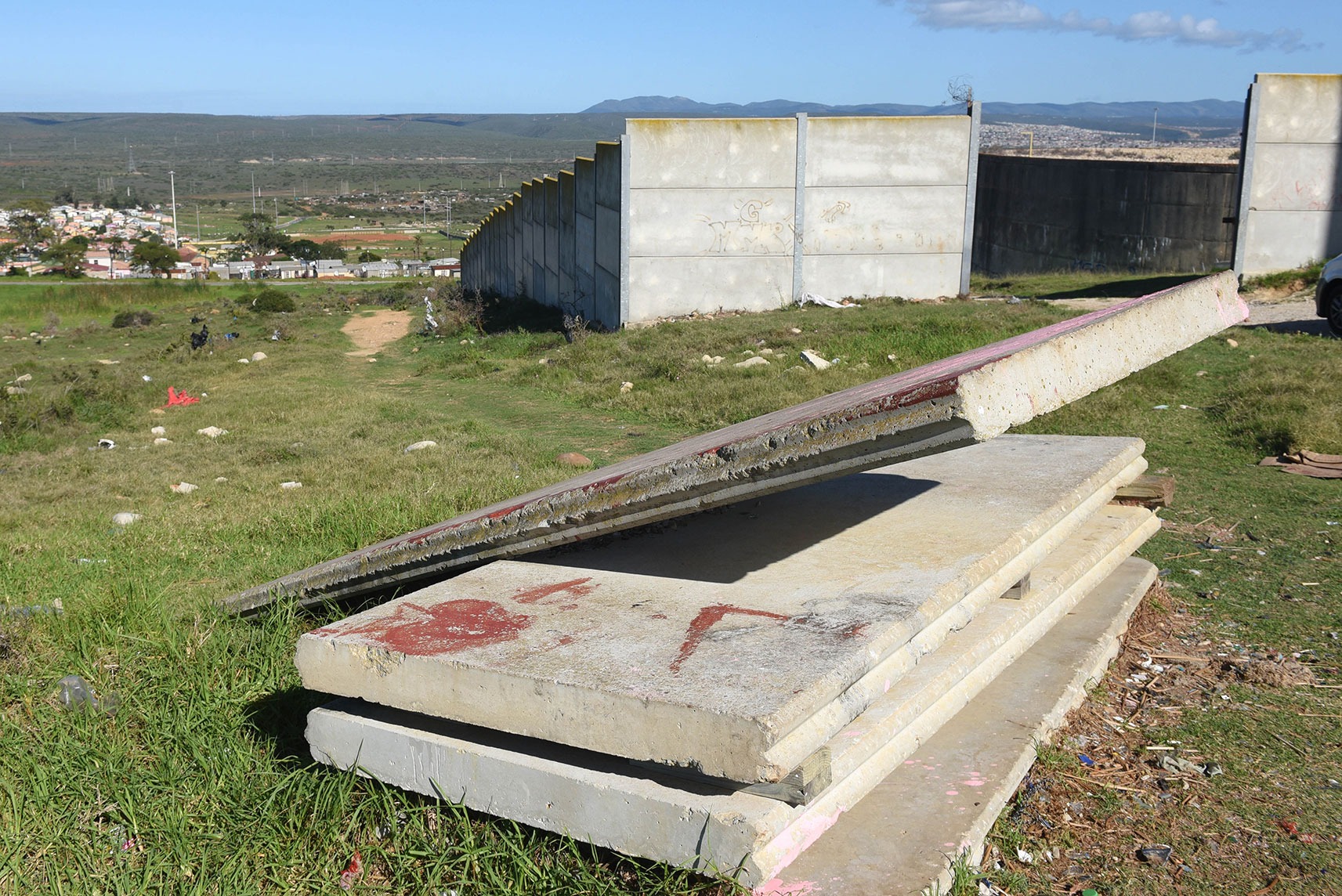
 Damage to a reservoir wall in Nelson Mandela Bay has created unrestricted access to the site. (Photo: Deon Ferreira)
After the Nelson Mandela Bay Municipality confirmed that Despatch residents had unknowingly consumed water contaminated with E. coli, a visit to several other reservoirs across the metro revealed widespread vandalism, poor security and mounting public health risk.
On 23 April , the municipality said routine sampling between 7 and 21 April detected E. coli in a Despatch reservoir, with a count of three E.coli per 100ml. According to national standards, the presence of any E. coli is a potential health risk.
At reservoirs near residential areas in the metro, concrete fencing has been cut or removed entirely, leaving sites easily accessible to both people and animals. At some facilities, entire sections of boundary walls are missing.
Following the discovery of E. coli in the Despatch reservoir, attention shifted to a second site: the Glendinning reservoir. Fears of further contamination emerged there after reports that a drain was being used as a makeshift toilet by unhoused people.
Municipal spokesperson Sithembiso Soyaya said water quality tests at the reservoir showed zero E. coli — but the incident underlines how widespread the problem of illegal access to reservoirs in the metro has become.
/file/attachments/orphans/People_859168.jpeg "The Tulbagh reservoir in Despatch, where water contamination was detected in April. (Photo: Supplied / Mthokozisi Nkosi)")
Soyaya said, “Municipal maintenance teams conduct routine inspections of reservoirs on a monthly basis ... [and] ... where defects, damages or security-related concerns are identified, job cards are generated to ensure corrective action and repairs are undertaken.”
At and around some reservoirs in the metro, there is litter, overgrown vegetation, and signs that people are living in or near the infrastructure.
/file/attachments/orphans/Image_2_679774.jpg "A gate that restricts access to a reservoir in the Nelson Mandela Bay municipality has been knocked down. (Photo: Deon Ferreira)")
Makeshift bedding and shelters, alongside heaps of trash, were visible. In some areas, waste — including what appeared to be faeces — lay scattered close to infrastructure intended to supply potable water.
A food safety consultant at ASC Public Health & Food Safety, Onele Kutu, warned that these conditions present serious risks.
“Having people living around the city’s reservoirs leads to vandalism. There is obviously the risk of contamination of the reservoir, which could have an impact on the safety of the people who depend on the water being supplied by the municipality.
"There are microorganisms — basically E. coli — that could affect the water which is consumed by the people.”
/file/attachments/orphans/Image_6_921948.jpg "A manhole cover at a reservoir in Nelson Mandela Bay has been stolen. (Photo: Deon Ferreira)<br>")
Kutu warned that, beyond biological contamination, people with access to the reservoirs may be dumping chemicals in the water, which could escape detection in standard monitoring processes.
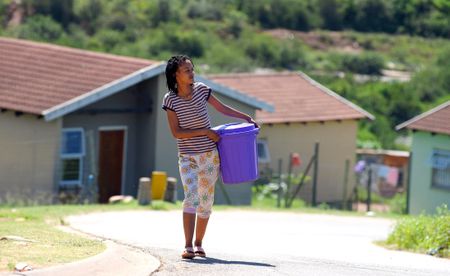
He said, “You could find that the same people living around this water infrastructure might end up disposing of other materials that they collect, like needles, and other trash around the reservoirs could end up in the water systems and definitely affect water quality.”
/file/attachments/orphans/Image_5_744906.jpg "Evidence of a fire set near a manhole at a reservoir in Nelson Mandela Bay. (Photo: Deon Ferreira)")
Kutu also raised concerns about broader economic implications, particularly for industries dependent on municipal water.
"Food industries that are situated in the city, whether dairy or breweries, depend on reservoirs and municipal water. For our reservoirs to be vandalised and be in the state that they are in is not desirable,” he said.
Illegal access
Soyaya said the city conducts biweekly water quality testing and acknowledged the challenge of illegal access and activity around reservoir sites.
He said the municipality had implemented a “multilayered infrastructure protection strategy”, including private security, design changes and collaboration with law enforcement.
/file/attachments/orphans/Image_7_395824.jpg "Leaks have been detected at reservoirs in Gqeberha, raising concern as the city’s dam levels remain critically low. (Photo: Deon Ferreira)")
Soyaya added, “With respect to reservoir patrols and on-site security, the municipality currently manages more than 89 reservoirs across Nelson Mandela Bay. Due to the scale of the network and financial constraints, it is not practically feasible to station permanent security personnel at every facility.
“However, the metro is at an advanced stage in procuring and implementing additional technology-driven security interventions, including alarm systems, surveillance cameras and other modern monitoring solutions aimed at improving response capability and reducing vulnerabilities.”
/file/attachments/orphans/Image_4_296351.jpg "Barbed wire fencing at a reservoir in Gqeberha has been stripped, making access significantly easier. (Photo: Deon Ferreira)")
He said municipal maintenance teams conduct monthly inspections of reservoirs. Where defects, damage or security-related concerns are identified, job cards are generated to ensure corrective action and repairs are undertaken.
Beyond security interventions, he said, the municipality conducts ongoing maintenance, rehabilitation and upgrade programmes for ageing water and sanitation infrastructure.
/file/attachments/orphans/Filth_687009.jpeg "Rubbish and human faeces are strewn around the Despatch reservoir, where a small community of unhoused people is living. (Photo: Supplied/ Mthokozisi Nkosi)")
Rehabilitation work, he said, is prioritised based on technical assessments, operational requirements and budget allocations.
“As with many municipalities nationally, infrastructure demands continue to exceed available financial resources. Currently, the Water and Sanitation Directorate spends approximately R29-million annually on security and infrastructure-related maintenance interventions.
"However, the municipality acknowledges that infrastructure investment needs remain significant and continue to grow.” DM
Comments
Scroll down to load comments...