




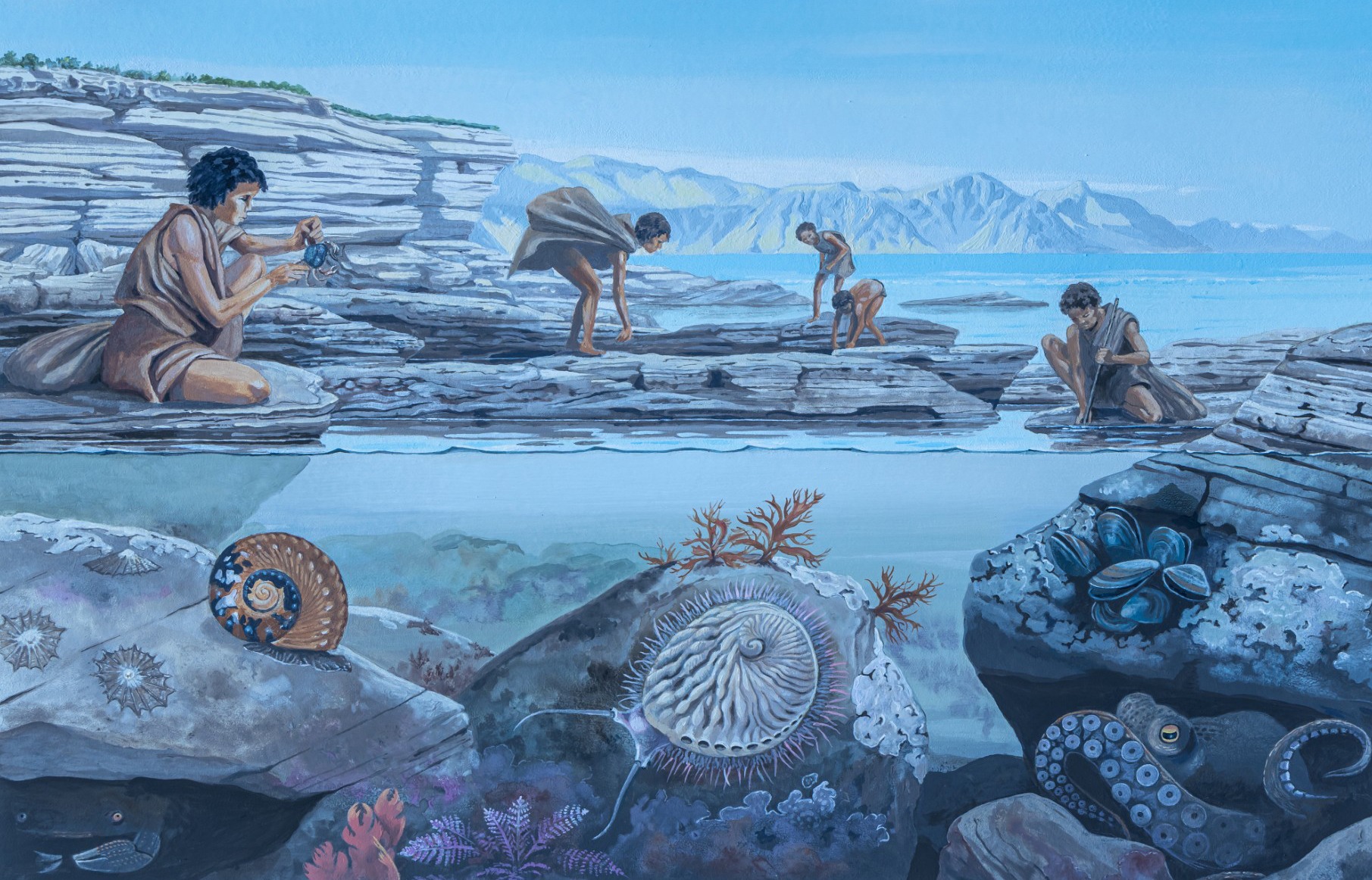
 The evolution of modern humans in the southern Cape
was likely facilitated by a combination of environmental factors and the increasingly close association by these hunter-gatherers with marine resources in the intertidal zone. (Image: Maggie Newman)
The evolution of modern humans in the southern Cape
was likely facilitated by a combination of environmental factors and the increasingly close association by these hunter-gatherers with marine resources in the intertidal zone. (Image: Maggie Newman)A stone hand axe found on a wet day near the Elands estuary lit the spark. Alan Whitfield, a lifelong estuarine ecologist at the South African Institute for Aquatic Biodiversity in Makhanda, had been on a field excursion during a workshop when a coastal geologist picked up a beautifully worked Early Stone Age tool and placed it in his hand.
“I’d never seen one of these in my life,” Whitfield recalls. “It fitted into my hand and it felt like holding something that was precious and so utilitarian. It really resonated with me.”
The object, he was told, could be more than a million years old. “It was beautifully carved. You could see where the flakes had been chipped off on both sides. It was a teardrop shape and fitted perfectly into my hand.”
Then came the thought that would not leave him: “Did an ancestor of mine either make this implement or use it?”
Whitfield did not suddenly become a palaeoanthropologist. “For more than half a century, I’ve been immersed in estuarine ecology,” he says. “I think of myself as an estuarine ecologist.” But the spark stayed alive.
Years later, as he approached retirement and had time to read more widely about early human life in the southern Cape, “the flame eventually grew into a fire”.
That fire has now become a provocative scientific paper, co-authored with Charles Helm, Renée Rust, Willo Stear and Francis Thackeray.
Published in Transactions of the Royal Society of South Africa, it proposes what the authors call the Coastal Hypothesis: that a mobile, technologically advanced, coastally adapted group of Homo sapiens left the southern Cape around 70,000 years ago and moved out of Africa between roughly 50,000 and 40,000 years ago, eventually reaching Eurasia, Australia and the Americas.
This isn’t a claim that Homo sapiens as a species began in the southern Cape. Whitfield is clear about that. “Homo sapiens started about 300,000 years ago,” he says. “There’s no one place in Africa that you can say Homo sapiens arose here in southern Africa, or arose there in west or central Africa.”
The exit hypothesis
The question is different: not where we first appeared, but which Homo sapiens made the great, lasting exit from Africa.
For decades, that story usually looked north-east, towards east Africa, the Levant and the Horn of Africa. Whitfield wondered whether scientists had been staring so hard at one doorway that they’d missed a long, edible highway running all the way up the continent’s coast.
“I was quite surprised that no southern African scientists pushed the southern Cape origin for Homo sapiens globally,” he says. “There’s no wide acceptance of the coastal hypothesis from the southern Cape.”
But the southern Cape, between Cape Agulhas and Cape St Francis, was no marginal backwater. In the paper, the authors describe it as a possible Garden of Eden for Middle Stone Age people: a shifting world of caves, coastal plains, rivers, plants, animals, intertidal zones and, at times of lowered sea level, the vast Palaeo-Agulhas Plain stretching out where the sea now lies.
This coast provided a remarkable mixture of edible roots, bulbs, tubers, corms, honey, terrestrial animals and marine foods.
The sea was the crucial addition. “Their knowledge of inland savannahs […] was very good,” says Whitfield. “But they had the added advantage of being very au fait with the resources of the sea. And those resources were incredibly valuable in terms of their development, brain development in particular, which may have contributed towards advancements technologically.”
The scientific paper frames it more cautiously, but points in the same direction.
Marine molluscs were favoured food at Cape coastal cave sites, while fish and shellfish provided protein and long-chain omega-3 fatty acids, which are important for brain development in foetuses and growing children.
The authors suggest this may have enhanced cognitive capacity in the evolution of a more “modern” Stone Age society in the Cape.
“Marine food, particularly many of the invertebrates in intertidal pools, and shellfish in particular, have very high levels of omega-3 fatty acids,” Whitfield explained in an interview. “And omega-3 fatty acids are very important for brain development.”
The important point, he says, is who was eating them. “It’s likely that the women and children would be the ones that would spend most of the day harvesting intertidal seafoods. So particularly pregnant women eating the shellfish, which they probably ate on the hoof […] gave an advantage in terms of brain development to their offspring. And young children eating shellfish would also benefit from food that’s good for their brains.”
This doesn’t mean shellfish magically created a new species. “The seafood doesn’t change the brain,” Whitfield says. “But it does promote brain development; […] it’s good for your brain to eat omega-3 fatty acids.”
Brainwork required
/file/attachments/orphans/AdvancedmodernhumansonPaleo-AgulhasPlaincopy_809985.jpg "A depiction of life on the Palaeo-Agulhas Plain of the southern Cape during the Last Glacial Period. (Photo: Maggie Newman)")
Diet was only part of it, however. Coastal life demanded timing, observation and planning. These people had to read tides, lunar cycles, seasons and shifting coastlines. They had to know when the spring low tide would expose the best shellfish beds. They had to understand both the sea and the land.
“If you’re going to harvest intertidal seafood, you become familiar with the tidal regime,” says Whitfield. “You become attuned to events in your universe, which required mental calculations, mental acuity, which other Homo sapiens would not be challenged with.”
And, crucially, a reliable coastline bought time.
“On the coast, you have time to reflect because you’re not having to urgently find food on a daily basis,” he says. “You have the option of thinking about things, of developing religions, of developing rituals.”
That is where the story begins to gets compelling. The southern Cape record contains some of the world’s most famous signs of early symbolic and technological behaviour: Blombos Cave, with its ochre-rich artefacts and abstract designs; Pinnacle Point, with evidence of marine resource use from at least 160,000 years ago, pigment use, heat-treated stone and bladelet production; and the wider Cape tradition of Still Bay and Howiesons Poort technologies.
/file/attachments/orphans/Map1_250244.jpg "Some of the rock caves and shelters occupied by Homo sapiens in the past along the Palaeo-Agulhas Plain in the southern Cape, now under 130m of water. (Photo: Alan Whitfield et.al.)")
The paper describes the Cape’s Middle Stone Age people as culturally, technically advanced and “ideal contenders for the initial colonisers of the planet”.
For Whitfield, one of the most convincing signs of modernity is not only art or ochre, but weapons.
“The technology which was key to the success of the southern Cape Homo sapiens was bow-and-arrow technology,” he says.
There’s no evidence of bow-and-arrow technology anywhere in the world before about 80,000 years ago when it was developed in the southern Cape. And it was very sophisticated bow and arrow technology.”
“This may have given them the advantage over Neanderthals they would later encounter in Eurasia.”
The shafts are gone, of course. Wood rarely survives tens of thousands of years. But the points remain. “The arrowheads are well known,” he says. “They didn’t just make one type of arrowhead, they made different types of arrowheads […] various shapes, sizes and whatnot. And they probably had different functions.”
This changes the daily equation of survival. “The big advantage of arrows is that you can approach a large animal without risking your life. When they had spears, they had to get in close. But with arrows, they could fire from a distance.”
“Incidentally, this may have given them the advantage over Neanderthals they would later encounter in Eurasia.”
Ice Age challenges
/file/attachments/orphans/migrationscopy_158757.jpg "It is likely that increasing pressure from successful and growing competing bands, possibly in combination with climatic and environmental changes provided the trigger for an initial eastwards and then north-eastwards migration. (Photo: Alan Whitfield et.al.)")
/file/attachments/orphans/Image4copy_370985.jpg "The possible coastal route taken by modern humans, together with a hypothetical timeline for the journey. The shaded area shaded represents the shelf area that would have been exposed during Glacial Maxima. (Photo: Alan Whitfield et.al.)")
“From around 90,000 to 80,000 years ago, as Ice Age conditions intensified, the interior became colder, drier and less forgiving. “Plants were growing slowly or not at all. There was less game in the interior,” says Whitfield.
“One of the saving graces for the people of the southern Cape was they could always turn to the sea as a sole source of food if they needed to, which wasn’t the case for the people living more inland.”
Why move east and north? Follow the warmth.
“The reason I proposed that they went up the coast was because, as the cold increased, they realised the warm water from the Agulhas Current was emanating from that side,” he says. “The cold side was to the west and the warmer side was to the east. If you’re people very closely associated with the water, you’ll head to where the water is warmer. And that means up the coast.”
It was not, he says, a cartoon of humans trudging along the beach and never turning inland. “I doubt it was an exclusive coastal water journey,” he says. “They could have breakfast of seafood in the morning, and have a braai evening on something they’d shot in the veld in the evening.”
“I would back the guy who’s going along the coast long before I back the guy who’s going overland.”
The coast was the spine, not the cage. And it had advantages over an overland route.
“If you were a betting person,” Whitfield says, “imagine placing two people at Cape Agulhas around 70,000 or 80,000 years ago. One goes overland towards the mouth of the Nile. The other follows the eastern African coast. I would back the guy who’s going along the coast long before I back the guy who’s going overland.”
Why? “It’s not only the assured food source, it’s the ease of the journey. Going overland, you are faced with mountains, deserts, lakes, rivers… whereas on the coast, you can bypass a desert along the coast very easily and you’ve got food all the way.”
Much of the evidence for this journey is now drowned. During the Ice Ages, sea levels dropped dramatically. Later, as ice sheets melted, the seas rose again. Many of the beaches people would have used between 70,000 and 50,000 years ago are now under deep water.
So the coastal hypothesis is partly an argument from what is visible, and partly from what has vanished. But what remains is tantalising: an omega-rich diet, advanced stone technologies, symbolic behaviour, marine foraging skill, possibly the earliest bow-and-arrow hunting and a coast that offered both food and direction.
In the end, Whitfield’s story is not simply that modern humans came from the coast. It is that the shoreline may have trained us – fed us, challenged us, slowed us down enough to think, and then gave us a route out.
If he’s right, the great human journey out of Africa didn’t begin with a heroic march across a dry savannah. It began with women and children gathering shellfish at low tide, with people watching the Moon, reading water, heating stone, mixing ochre, shaping points, following warm currents and asking new questions of the world. DM


Comments
Scroll down to load comments...