



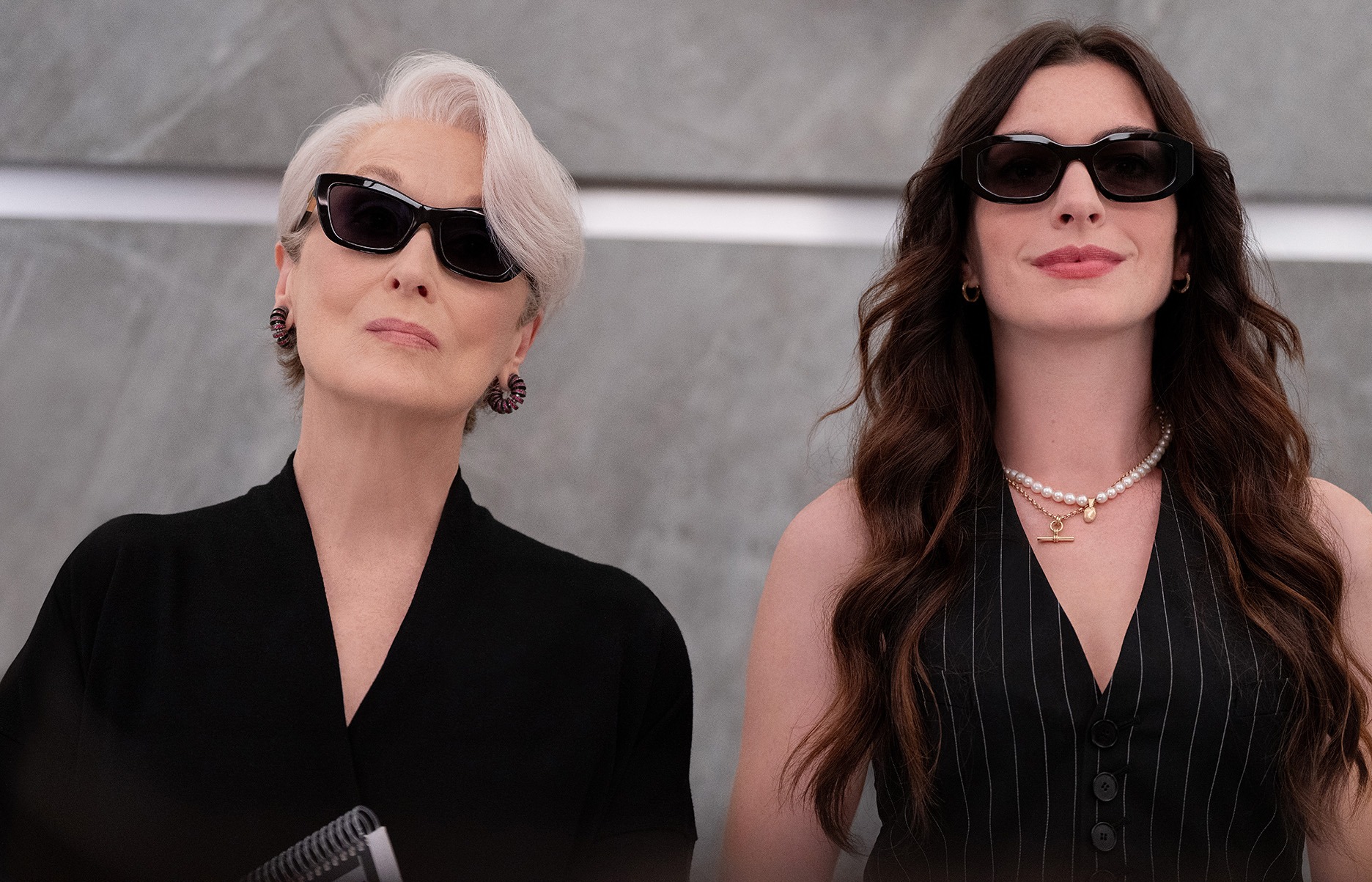
 Miranda Priestly (Meryl Streep) and Andy Sachs (Anne Hathaway) in 20th Century Studios' The Devil Wears Prada 2. (Photo: Macall Polay)
“But what you don’t know is that that sweater is not just blue, it’s not turquoise, it’s not lapis, it’s actually cerulean,” Miranda Priestly tells her newly hired assistant, Andy Sachs, after hearing her remarks that two belts look, to her, no different from each other.
“And it’s sort of comical how you think that you’ve made a choice that exempts you from the fashion industry when, in fact, you’re wearing the sweater that was selected for you by the people in this room,” she goes on to say in her now iconic monologue in The Devil Wears Prada about how luxury fashion trickles down to commercial consumers.
Flash forward 20 years after Andy’s baptism by fiery-red stilettos in The Devil Wears Prada, and we meet her at the height of an investigative journalism career.
Making her way through New York in an opening scene, she passes by a street market and, in a blink-or-you’ll-miss-it moment, a seller in the background holds up two belts to a shopper — those same two belts that were once under the scrutinous stylistic eye of Miranda Priestly two decades earlier.
When we last saw Andy Sachs (Anne Hathaway), she had tossed her cellphone in a fountain in Paris, liberating her from the high-maintenance demands of her boss, Miranda Priestly (Meryl Streep). Yet, with The Devil Wears Prada 2 being set in the always-online present day, it’s needless to say that there can be no more convenient flinging of devices into the nearest body of water.
In fact, it’s via text message that Andy’s distinguished journalism career is upended, setting up this movie sequel for its unexpectedly sincere look at how the media industry has been refashioned by digitisation, social media and commercialism.
And, as the convenience of movie magic would have it, Andy finds herself right back at the place where it all started: Runway Magazine.
“She was one of the Emilys,” Nigel (Stanley Tucci) has to remind an unimpressed Miranda when Andy arrives to take up her new role at the fashion magazine.
Dialogue like this, referencing the original film, is inevitably scattered throughout the first act of The Devil Wears Prada 2. Though at times heavy-handed, they humorously serve as both inside jokes for the diehard fans and nudges to the casual viewers about the drama that unfolded in Andy’s life back in 2006.
/file/attachments/orphans/EmilyBluntasEmilyCharltonin20thCenturyStudiosTheDevilWearsPrada2_MacallPolay_844693.jpg "Emily Blunt as Emily Charlton has lost none of her haughtiness in 20th Century Studios’ The Devil Wears Prada 2. (Photo: Macall Polay)")
/file/attachments/orphans/StanleyTucciasNigelKiplingandAnneHathawayasAndySachsin20thCenturyStudiosTheDevilWearsPrada2_MacallPolay_125594.jpg "Stanley Tucci as Nigel Kipling and Anne Hathaway as Andy Sachs in The Devil Wears Prada 2. (Photo: Macall Polay)")
Besides Emily Charlton (Emily Blunt) – who, as a now authoritative figure at Dior, is just as haughty as when we left her in the first film – the main characters in The Devil Wears Prada 2 might be unrecognisably unlike their younger selves.
Andy is certainly no longer the gawky, fresh-out-of-college assistant from 20 years ago, while Miranda, though still bearing her no-nonsense deadpan stares, allows more frequent glimpses of her softer side to escape.
Where the charm between these present-day characters lies is in their slipping in and out of their old dynamic, recognising that they need each other’s strengths to navigate an industry shifting beneath their high-heeled feet and threatening to move on without them.
“But did they read it?” is a question posed during the Runway editorial team’s debating the online performance of Andy’s feature piece.
On another occasion, in a meeting between Runway and Dior, Emily lays bare the fact that the magazine would perish without accommodating considerable ad placements for Dior.
It’s in these simple, yet perceptive, interactions that The Devil Wears Prada 2 captures the state of the public’s engagement with journalism in a headline-driven social media era.
/file/attachments/orphans/MerylStreepasMirandaPriestlyandStanleyTucciasNigelKiplingin20thCenturyStudiosTheDevilWearsPrada2_MacallPolay_930664.jpg "Meryl Streep as Miranda Priestly and Stanley Tucci as Nigel Kipling in The Devil Wears Prada 2. (Photo: Macall Polay)")
/file/attachments/orphans/MerylStreepasMirandaPriestlyin20thCenturyStudiosTheDevilWearsPrada2_MacallPolay_390315.jpg "Meryl Streep reprises her role as Miranda Priestly in The Devil Wears Prada 2. (Photo: Macall Polay)")
Tonally, the world of The Devil Wears Prada has matured in its sequel, too.
Its thematic relevance is interwoven with a humorous charm that stays true to the fabric of the 2006 movie, but the movie departs, in a sense, from the hallmark quirkiness of its predecessor – taking firmer root in emotional candour that opens up space for its characters to have more than the occasional heart-to-heart.
In its writing, The Devil Wears Prada 2 tends to meander plot-wise, skirting around the edges of establishing high-stakes conflict. Scenes tend to be designed for the sake of characters having a chance to interact with each other, as opposed to being in service of a substantial storyline.
Where the sequel doubles down, however, is in its glam. Extensive sequences of fashion shows set in Milan, stitched together in the same kaleidoscopic style as the original’s Paris Fashion Week scenes, are complemented by a cast of cameo appearances from fashion icons to internet influencers who take up a screen of end credits on their own.
Although it might not be the most memorable in its narrative, The Devil Wears Prada 2 is a refreshing example of what a Hollywood sequel – of a standalone feature, which arguably called for no continuation – can achieve when driven by intentionality and a genuine respect for its predecessor. DM
The Devil Wears Prada 2 is playing in cinemas.
Comments
Scroll down to load comments...