



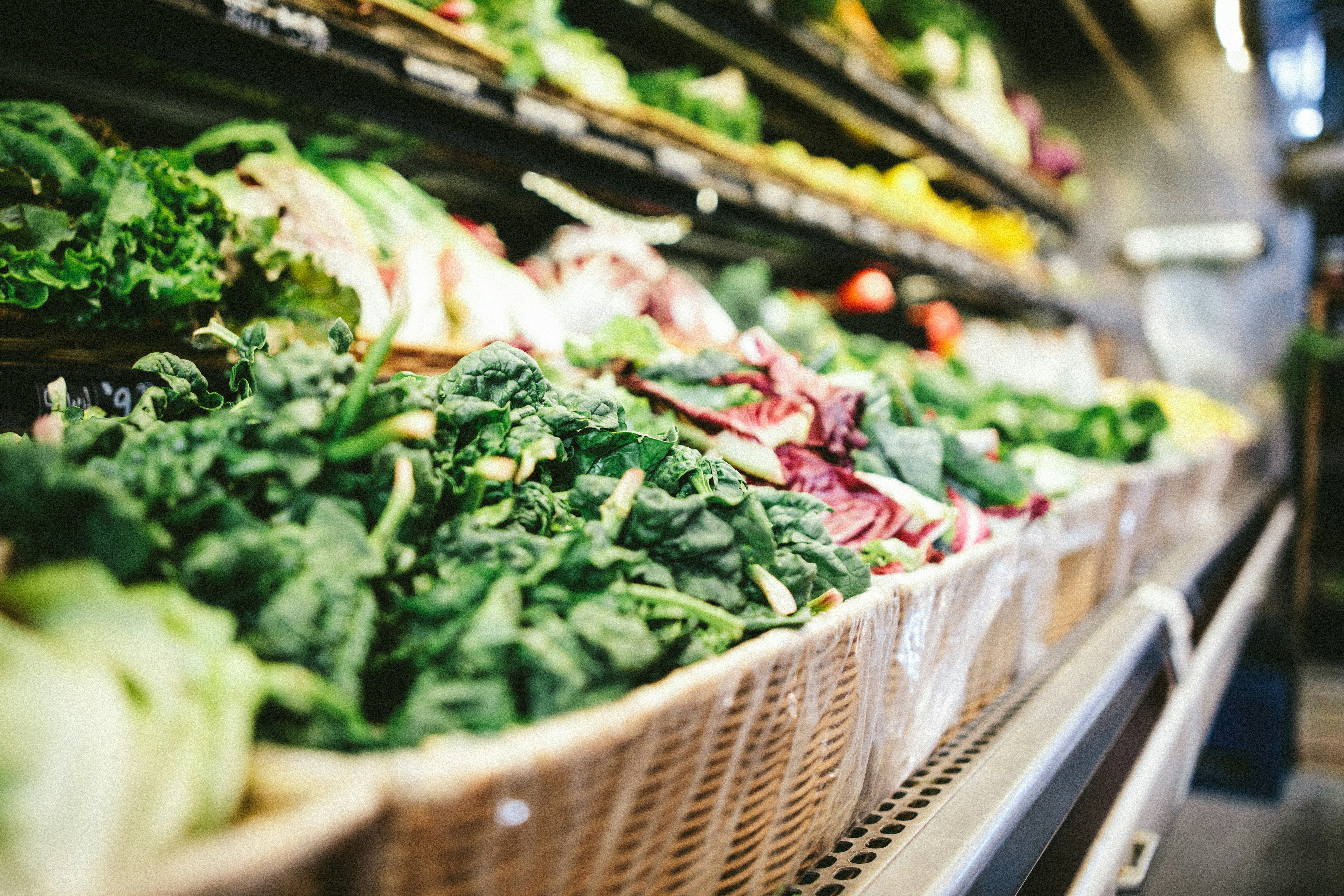
 The increasing price of food has sparked a quiet revolution in the way South Africans eat, spend and survive. (Photo: Unsplash)
 Daily Maverick reported at the beginning of April that a basic household food basket costs nearly R40 more than the R370 Social Relief of Distress grant. The Pietermaritzburg Economic Justice and Dignity’s Household Affordability Index found that in March, low-income families underspent on basic nutritional food by at least 17%. And according to the 2024 General Household Survey, about 14 million South Africans experienced hunger — roughly 22.2% of households in the country.
From backyard gardens and meat-free diets to neighbourhood barter systems, South Africans are finding ways to cope. It is a fundamental shift — a quiet revolution in how people eat, spend and survive.
Changing what ends up in the basket
On Madiba Street in Pretoria, a street vendor has seen buying behaviour shift. Business has not stopped, he said, but it has changed.
“People still come every day, but now they think twice before they buy,” he said. “Before, someone might buy a mix of things like snacks, fruits, drinks, maybe something extra. Now it’s basic food, and even [with] those, they compare my prices with other shops.”
The most visible shift, he said, is toward canned goods. Baked beans, pilchards, sweetcorn — items that last longer and stretch across multiple meals. Even the rhythm of purchasing has changed, he said, with customers returning two or three times a week instead of buying a few things at once.
At home, his own family has cut out all pre-made and takeaway food. “Everything we eat, we cook ourselves with what we have,” he said.
A nurse waiting at a nearby bus stop said that, as the sole provider for three children, the cost-of-living crisis had forced her to make changes in her spending habits.
“It’s not just that things are expensive, it’s that everything is expensive at the same time. Transport, food, electricity, school shoes, all of it,” she said.
Cutting her grocery bill meant slashing meat consumption from daily to twice-weekly. What has also helped them, she said, is an arrangement with an elderly neighbour who grows spinach and tomatoes in a small backyard garden. In exchange for help with her monthly shopping, the neighbour shares what she grows.
“Without that, I don’t know how we would manage fresh food,” she said. “People are helping each other more when things are so difficult. That’s what’s keeping many people going.”
Growing your own
Stephanie van Niekerk and John Gaisford are the co-founders of Get Dirty, a company that manufactures hand tools for small-scale growers and home gardeners. They started the company after Van Niekerk, whose background is in medicine, and Gaisford, whose background is in geology, could not find the right tools for growing food in South Africa; specifically, tools designed to work with soil rather than against it. The tools that are standard among small-scale market gardeners in Europe and the US are largely absent from South African hardware stores.
/file/attachments/orphans/5Johnandsteph_597770.jpeg "Stephanie van Niekerk and John Gaisford, the co-founders of Get Dirty. (Photo: Supplied / Get Dirty)")
Today, Get Dirty is no longer just about tools. It’s built a digital following by mapping out the Western Cape’s best spots for fresh local produce.
For Van Niekerk, the case for growing your own food and buying local is also an argument about what the food you buy in stores contains. Local growers, she says, tend to avoid the chemicals that characterise commercial agriculture, making their produce more nutrient-dense. She also challenges the assumption that fresh and local means expensive.
“Often, fresh vegetables from markets are the same price or cheaper than in the supermarket,” she said. “It’s just more of the perceived inconvenience of shopping ahead versus buying for what you need for your meal.”
Gaisford admits you won’t achieve total self-sufficiency in a small backyard — growing enough carbohydrate-rich foods like sweet potatoes and squash, or protein sources like beans, requires more land than most urban homes have. But he insists that’s missing the point. If dry goods like rice, maize meal and beans can be secured separately, a small, diverse garden can fill significant nutritional gaps. Microgreens; leafy greens like chard, spinach and amaranth; indigenous plants like spekboom; and even wild weeds are all nutrient-dense.
Gaisford points out that just 20 grams of raw dandelion leaves, roughly 15 medium to large leaves, provide approximately 130% of the daily recommended intake of vitamin K and 50% of vitamin A. “The key is diversity; for resilience in the garden, for a range of nutrient profiles, and for keeping your gut microbiome happy,” he said.
Van Niekerk said we should think of the time spent gardening as labour that replaces cash — you are buying food with hours instead of rands. And the return, she argued, extends well beyond what you save at the till.
/file/attachments/orphans/1BroadforkonaFoodandTreesforAfricaProject_398211.jpg "A grower uses a Get Dirty broadfork to till the soil on a Food & Trees for Africa project site. (Photo: Supplied / Get Dirty)")
Building food gardens
Robyn Hills is the head of programmes at Food & Trees for Africa (FTFA), an organisation that has been building food gardens across South Africa since 1990, working with schools, community gardens, market gardens and urban food producers. The conversation around food security, Hills said, has shifted significantly in that time.
Over the last five years, his work has expanded from greening post-apartheid communities to a focus on survival — addressing climate shifts, soaring costs and the precarious supply chains that most people take for granted.
Funding for school food gardens, once a pillar of the National Schools Nutrition Programme, has withered away. The result? Schools now rely on processed commercial staples instead of the fresh harvests they once grew themselves.
FTFA’s EduPlant programme runs 36 workshops every school term, reaching approximately 300 schools nationwide, where children, educators and community members learn about permaculture and food growing in a curriculum-aligned setting.
“If children do things with their hands, they’re able to input that sensory information in a far more integrated way,” said Hills. Every workshop comes with planting materials, seeds and seedlings; so knowledge transfer is always paired with practical resources, allowing children to take the first step in building food resilience.
Where to start
Growing your own food is neither simple nor cheap, said Hills, noting that the costs of water, fencing and seeds quickly add up. Van Niekerk acknowledged that starting can feel overwhelming, but she insists the method matters less than the momentum. In her view, simply beginning is more important than where you take the first step.
/file/attachments/orphans/3Homegardenstage1_671191.jpeg "The Cape Town garden belonging to John Gaisford before its transformation. He ripped out what was there and replaced it with edible and medicinal plants. (Photo: John Gaisford)")
/file/attachments/orphans/4Homegardenstage3_159151.jpeg "The same garden today, now growing more than 40 species that Gaisford eats from daily. (Photo: John Gaisford)")
“Start with a handful of lentils in a jar,” she said. Fill a jar with lentils and water, drain and rinse it every day, and you will have lentil sprouts in just three or four days.
From there, move on to herbs on a balcony, perennial plants like tree spinach that keep producing without being replanted, and even a patch of garden converted from ornamentals to edibles.
For those who want backyard poultry without neighbours complaining, Van Niekerk has a practical suggestion: quails. “They have the same function as chickens, but they don’t make any noise, and you can use their bedding for composting,” she said.
Nobody needs to go it alone, says Gaisford. By connecting with others through WhatsApp groups, food clubs and community networks, and sharing what each person grows, a range of fresh food becomes far more accessible.
For networks of homesteaders and home-growers willing to organise as a group, FTFA provides tools, seeds, seedlings and training workshops. For those starting alone, Hills recommends the most immediate first step: walk around your neighbourhood and find who is already growing produce. School gardens, she noted, often have fenced land and water access — and many welcome community volunteers.
For a growing number of South Africans, stretching the rand is no longer a choice — it’s a survival skill found in a jar of sprouting lentils, a neighbour’s tomato patch, or a tin of pilchards. DM