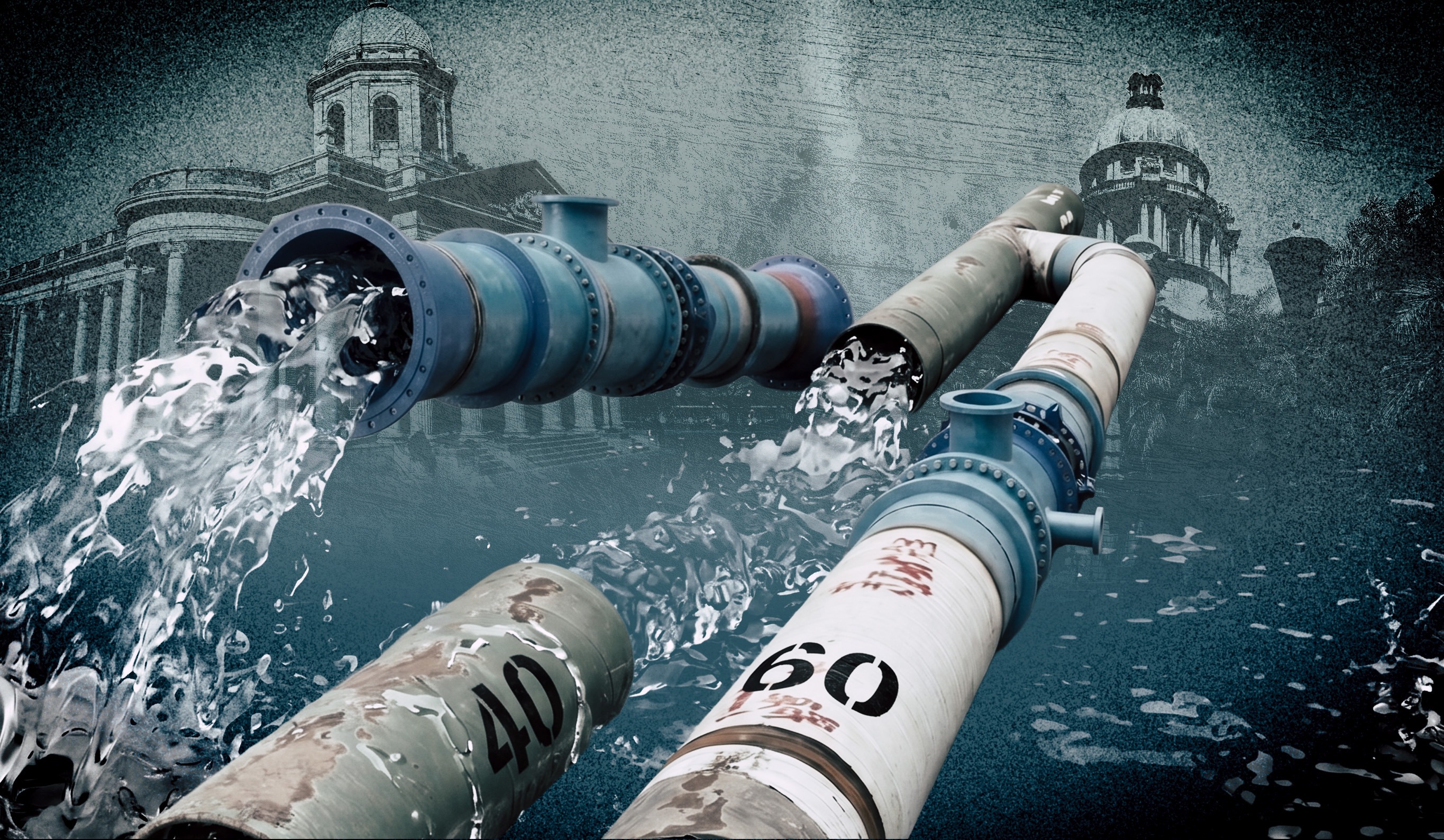
 Illustrative image: Piping to the Southern Aqueduct in Durban (Photo: Ethekwini Municipality; altered with Google Gemini Flash Image 2.5 | The Fourth Raadzaal, Bloemfontein (Photo: Grobler du Preez/iStock) | Durban City Hall (photo: Wikipedia)
 More than 171 million cubic metres of clean tap water — enough to supply the two biggest cities in the Eastern Cape or the entire Northern Cape — go to waste in eThekwini every year due to municipal pipe bursts, leaking valves or overflowing reservoirs.
This came to light after Daily Maverick requested the eThekwini Municipality to provide a copy of the city’s latest water balance sheet — part of a standardised accounting system to assess water loss and non-revenue water (NRW) in municipalities across the world.
However, eThekwini seemed reluctant to provide the information, which we requested more than a month ago (March 26). Initially, the city’s communications section stalled, saying that it was waiting for the relevant department to collate and provide the information.
Later, following further requests, city spokesperson Gugu Sisilana said city officials had “raised concerns regarding the highly technical nature of the information being requested, noting that it may be subject to misinterpretation by non-technical NRW personnel”.
When we persisted with the request, Sisilana suggested that we try to source the information from the national Department of Water and Sanitation (DWS) instead.
So, we did.
The DWS provided a water loss table for eight of South Africa’s largest metros, clearly demonstrating that eThekwini is losing the largest volume of water nationwide from physical leaks.
/file/attachments/orphans/tonyleak2tableofleakingcitiessourceDWS_834378.jpg "A table showing the volumes of water supplied to SA’s major metros, along with the volumes lost from leaks and non-payment. The system input volume refers to the total volumes provided by water boards. Physical losses reflect water lost to leaks from pipes and reservoirs. NRW refers to water that is not billed, not metered, not paid for or from leaks in the system. L/c/d is litres per capita per day. (Source: Department of Water and Sanitation)")
The table shows that almost 54% of water supplied to eThekwini by the Umngeni-uThukela Water utility is classified as non-revenue water (NRW). This is water that is either not paid for, not metered, not billed or has leaked from the system.
The biggest component of this NRW is “physical losses” (leaks and overflows), which amounts to 40.4% of the total system input volume (more than 423 million m³ per year).
The volume of lost water is just short of the combined tap water volumes supplied to the cities of Gqeberha and KuGompo (formerly East London) and exceeds the total volume supplied to the Northern Cape.
/file/attachments/orphans/tonyleak1southernaqueductpipesimageethekwinimunicipallity_262746.jpg "Contractors fit new sections of piping to the Southern Aqueduct in eThekwini as part of a project to increase water supply and reduce high water losses in the city. (Photo: eThekwini Municipality)")
Though Mangaung’s physical leak rate (41.2%) is almost 1% higher than eThekwini on a percentage basis, the Mangaung losses are dwarfed by the sheer volume of water going to waste in eThekwini.
The metro with the third-worst record is Nelson Mandela Bay, where more than 53% of supplies were classified as NRW (with almost 35% attributed to physical losses).
In Johannesburg, almost half the water supplied is now classified as NRW, with just over a quarter of the losses due to physical leaks.
Among the big cities, Cape Town has the lowest rate of NRW (24%), of which 20.4% is from leaks.
According to a 2015 benchmark study by the Department of Water and Sanitation, the countrywide NRW figure of 37% at that time represented income losses of around R7-billion.
/file/attachments/orphans/tonyleak3Ethekwiniwatershortagewarningsourceethekwinimunicipality_911984.png "A recent example of another water shutdown in eThekwini, with residents being urged to save water at a time when over 40% of the city’s supplies are leaking from burst pipes, reservoirs and meters. (Source: eThekwini Municipality)")
The NRW figure was similar to the world average, but high in comparison to developed countries. For example, NRW figures in Albania and Armenia were as high as 70%, whereas NRW in developed countries such as Australia and New Zealand was below 10%. Germany and the Netherlands have recorded NRW rates of 6%, while the Danish capital, Copenhagen, lost just 4%.
The national water and sanitation department has previously suggested that a realistic NRW target of 25% in South Africa could be achieved within 10 years by investing about R2-billion annually in water conservation and water demand measures.
/file/attachments/orphans/ED_534851_496064.jpg "Pemmy Majodina (Minister of Water and Sanitation) during a media briefing on water supply challenges and interventions at Johannesburg Water Head Office on November 11, 2024 in Johannesburg, South Africa. The water utility has advised residents to use water sparingly to avoid a possible water outage in the city. (Photo: Gallo Images / Luba Lesolle)")
But last month, Water and Sanitation Minister Pemmy Majodina published a summary of the latest No Drop progress report, suggesting that average NRW on a national basis had reached over 47%, with leaks accounting for 32% of these losses.
In response to queries from Daily Maverick, the department said a more detailed breakdown of water losses and leaks for all municipalities would be published next month (May). DM