




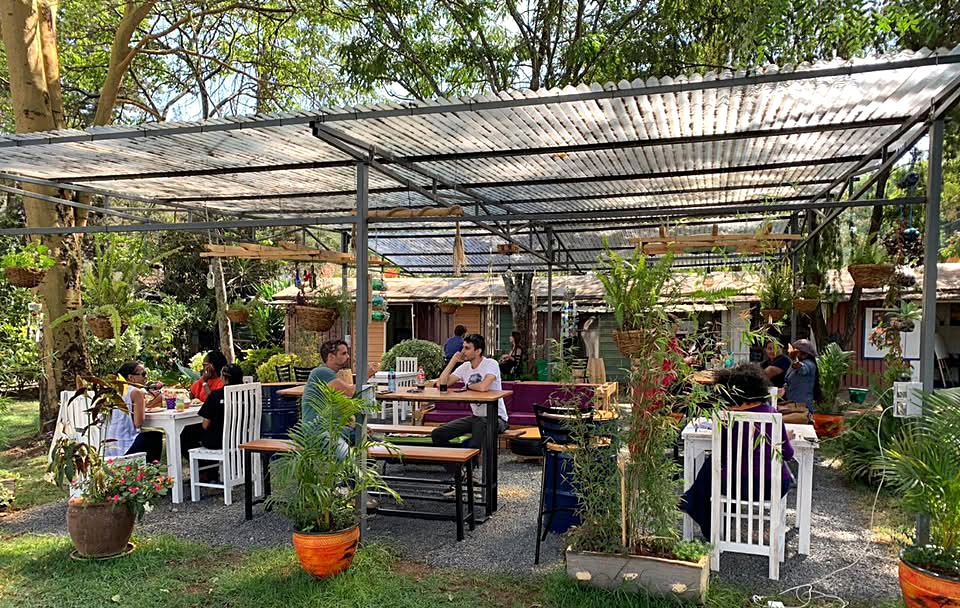
 Nairobi’s Pallet Café, where deaf and hard-of-hearing staff built a rare space of good food, quiet communication and community, closed on 15 April 2026 to make way for a petrol station. (Photo: Supplied)
Turning off from the constant traffic of James Gichuru Road, the noise and commotion of Nairobi almost instantly fall away. Walking down the driveway into Pallet Café, people come to a shaded garden where conversations are carried out through gesture, expression and eye contact.
For years, this was a quiet anomaly in Nairobi’s Lavington district, known for being nearly completely run by deaf or hearing-impaired people.
But on Wednesday, 15 April 2026, the café opened its doors to customers for the last time. According to a notice posted on its gate one month ago, there are plans for the site to be redeveloped into a petrol station.
Pallet Café is now in the process of being dismantled, expected to be fully cleared by the end of April. At its entrance, customers were once greeted by a smile and gestured to choose where they’d like to sit. The first page of the menu introduced the essentials of Kenyan Sign Language needed here – “thank you”, “please”, “more”, “finished”.
When I first visited, I was struck by the high level of friendly customer service, communicating with eye contact, a smile, and lots of thumbs up. It’s this attentiveness I will miss most, and the quiet respite the garden offered.
‘Surprised’
Founder Feisal Hussein built Pallet Café around a simple but persistent idea: that deaf people are often overlooked for work they are fully capable of doing.
Paul Mururi, the branch’s manager, is hearing abled. He first met with Feisal in 2019, and remembers thinking, “What is this guy talking about? I didn’t even know that they [deaf or hearing-impaired people] could be employed.”
Now, six years later, his mind has changed. “My biggest wish is that people and businesses, in every industry, would just give them a shot,” Paul says. “You’d be surprised”.
“There’s a connection you build… just the way you look at each other, you are able to read emotions — you are able to relate more easily,” he explains.
Without speaking much sign language himself, Paul found deaf staff to be quicker, more reliable and precise at work than people who can hear.
Often rejected from most other jobs, this place gives the deaf community a starting point. Paul recounts: “Pallet Café has built a lot of people. They come here and they are afraid, and when they leave, they are strong people, they are confident. It’s something beautiful.”
Different kind of work
Joseph, one of the café’s deaf waiters, used to work in plumbing before joining Pallet Café about a year ago. Things were different at Pallet – structured, consistent and respectful.
“I enjoy working with people and helping them,” Joseph writes with a smile, “it has been a great experience for me”.
/file/attachments/orphans/Joseph_686083.jpeg "Joseph, who previously worked in plumbing, found structure and joy working as a waiter at Pallet Café. Like many of his colleagues, he is now uncertain about his future in the broader job market. (Photo: Julia Audinet)")
Now with the closure looming, Joseph – like many of his colleagues – says he is unsure of what comes next. Finding another job will not be easy.
Paul thinks of others in the deaf community, too. “If I give you the number of CVs we receive, sometimes it makes me...” Paul breaks off. “Within a month, I receive more than 10, 20 CVs. There are so many qualified people, and nobody wants to give them jobs.”
Viable business model
Pallet Café is not closing due to unprofitability. Thanks to its positive reception, two more branches have opened since 2019.
It became a proof of concept — socially and commercially — that inclusive hiring was not an act of charity, but a viable business model.
It has captured the attention of international and local news outlets, from the BBC, Deutsche Welle (DW), Africa News to the Daily Nation, as well as business articles and travel blogs.
According to the BBC, there are about 600,000 deaf people in Kenya, and even though discrimination on the grounds of disability is outlawed in the constitution, they continue to face huge obstacles around access to healthcare, education and employment.
Wider social impact
The influence of Pallet Café extended beyond its immediate staff. Cikũ, one of the artists and shopkeepers based in the café’s grounds, first came here because of her mother.
It was her mother’s job there that funded Cikũ’s university education. After graduating, she returned to work at Zanji Art Gallery, tucked behind the wood-fired pizza oven.
/file/attachments/orphans/Ciku_691191.jpg "Artist and shopkeeper Cikũ, whose university education was funded by her mother’s job at Pallet Café, at her gallery during the café’s final days of operation. (Photo: Julia Audinet)")
Cikũ says she has passed through shock and denial, and is now “taking this as a moment to pause, be grateful, and hope that this is part of the continuation of Pallet, not the end.”
From her workshop, she has observed how the news has affected others. People had built routines around the space. Customers who come and work here every day say there just aren’t other places like it.
“The phone is ringing all day,” Paul says, “with people asking where are you going next, why are you closing, when will another Pallet Café come back.”
“I know a lot of people will be impacted by the café closing down. It was one big community.”
From staff including waiters, chefs, baristas and guards, to artists and customers – the same idea comes up again and again: that Pallet feels like another home.
A community in transition
Feisal and Paul’s top priority is helping find a place for their employees to go.
Those who want to will relocate to their other branches in Diani, which opened in 2023 and 2026. Like almost all staff, Paul himself will move to Diani. “I can’t imagine working anywhere else – it’s become a family”.
But some cannot leave – tied by family, cost or circumstance. Diani is on the coastline, some 550km from Nairobi.
His wish for now is that Pallet Café comes back to Nairobi. “Not just for the staff who were employed,” he says, “but for so many others that we could have given an opportunity to – even if just for one year”.
/file/attachments/orphans/Clearing_392318.jpeg "Tables and chairs are cleared away for the final time. (Photo: Julia Audinet)")
The last day
I was there on 15 April, the last day Pallet Café was open. Coffees and lunches were going around as normal, but the usual comforting atmosphere was bittersweet. I ordered iced coffee.
I spoke with Polo, a Nairobi friend, about what he will miss about Pallet Café beyond its friendly service and good food.
“It is a place that reminded me to be more conscious of the people around me, not just those hard-of-hearing,” says Polo. “The world makes you forget about people living quietly on the outskirts. You forget that places like this can exist.”
Customers slowly, reluctantly left. Tables and chairs from around the garden were brought together, ready to be taken away.
Pallet Café in Nairobi may be disappearing, but the model it demonstrated — of inclusion, dignity, and possibility — lingers in the people it shaped. DM
This story was produced with the support of Roving Reporters and the Yazi Centre for Science and Society.


Comments
Scroll down to load comments...