




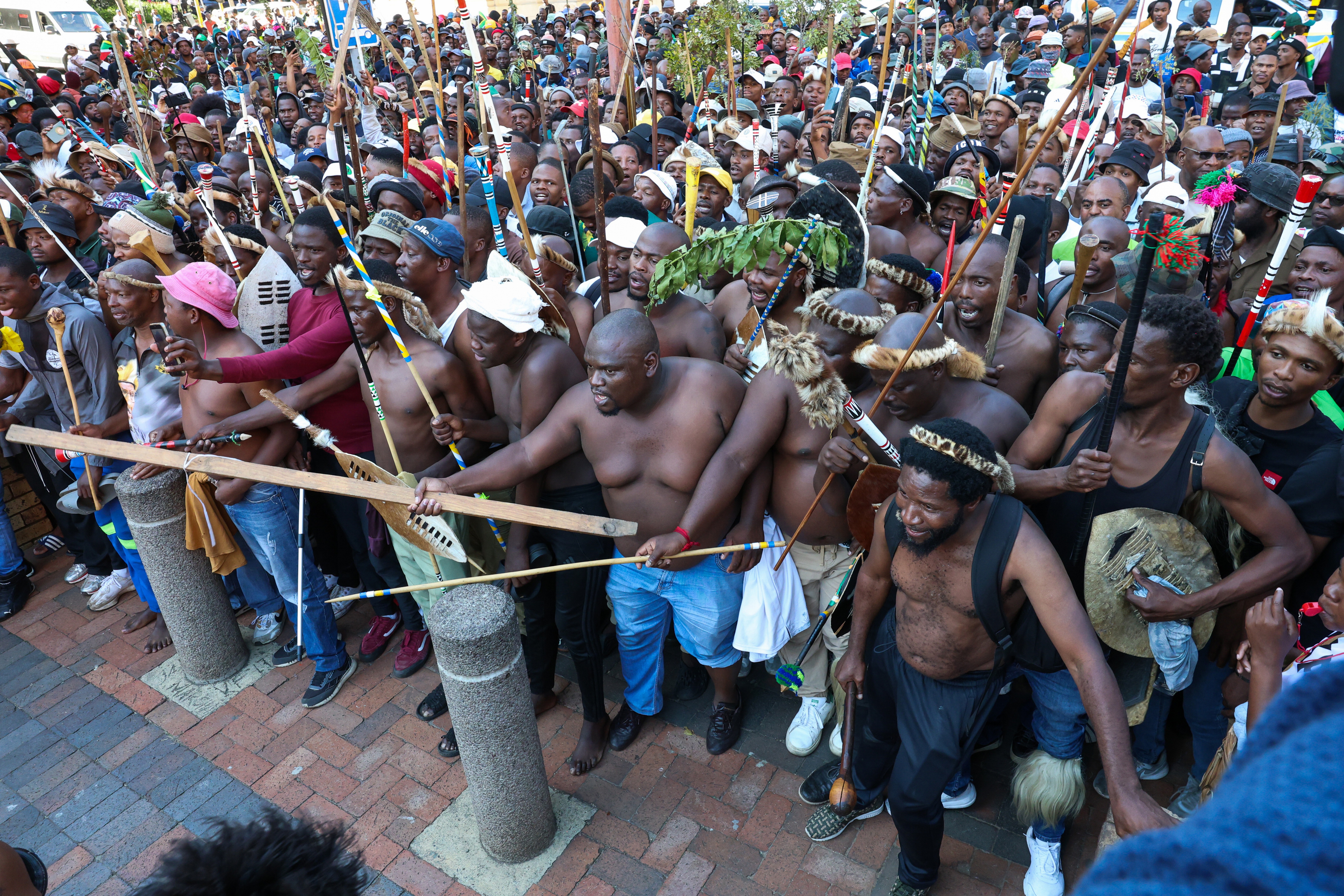
 March and March protesters against illegal immigration at Mary Fitzgerald Square in Johannesburg on 29 April 2026. (Photo: Gallo Images / Luba Lesolle)
 Suddenly, March and March, the anti-migrant organisation, is everywhere – marching across major cities, this week in Tshwane and Johannesburg. Who are they, and what does the name mean?
March and March’s website makes it appear as a legitimate civil society organisation, and it describes itself as a civic organisation. It uses the symbolism and movement-building of South Africa’s civic sector with T-shirts, marches and campaigns featured on its website. It uses the South African flag as a symbol of its merchandise and projects itself as if it is building South Africa. This is used to create the imagery of nationalism.
In this, it mimics the growth of far-right, anti-migrant organisations in the wealthy world who also embroider into civil society. They root among people’s organisations and tap into grievance or social challenges such as unemployment, poverty or unaffordable healthcare and then ramp up anti-foreigner campaigns around grassroots issues.
/file/attachments/orphans/ED_606570_965802.jpg "Marchers during the protest against illegal immigration during a march to Mary Fitzgerald Square on April 29, 2026 in Johannesburg, South Africa. March and March is demanding tighter immigration controls, including stricter visa regulations, a review of asylum policies and action against businesses employing undocumented foreign nationals. (Photo: Gallo Images/Luba Lesolle)")
March and March, a name which suggests rolling mass action, is a founder-led non-government organisation with Jacinda Ngobese-Zuma as the main actor. The website makes this clear. She is front, centre and everywhere in between.
A BackaBuddy crowdsourced funding campaign has collected R13,167 towards a goal of R20,000 in six months, with donors giving an average R200 – small chips, but it shows how it mimics social movement tactics until now seen only in progressive civil society.
March and March has recently been supported by another anti-migrant group, Amabhinca Nation, led by former Ukhozi FM host Ngizwe Mchunu, who was charged for incitement after the 2021 July riots, but was later acquitted.
/file/attachments/orphans/Ferial-Explainer-MarchANDMarch_911285.jpg "Yossabel Chetty, a researcher at the Centre for Information Integrity for Africa, Stellenbosch University. (Photo: Supplied)")
Yossabel Chetty, a researcher at Stellenbosch University’s Centre for Information Integrity in Africa at its Department of Journalism, first picked up on March and March in her analysis in 2025. Ngobese-Zuma worked in radio in Durban, first at Gagasi FM and later at Vuma FM, and her X profile did not post anything hateful.
“From 2025, it ramped up. What first felt organic then became more structured posting,” says Chetty.
Social posters were put up, and calls to action began appearing. “It made us ask whether there are multiple people running the account. It felt amplified, not authentic,” she says.
/file/attachments/orphans/20260428_102106_617906.jpg "A crowd of people led by anti-foreigner organisation March and March in Pretoria on Tuesday. (Photo: Bheki C. Simelane)")
March and March’s first big protest was in Durban, when the eight-year-old twins Aphelele and Aphile Dlamini fell down an unsecured lift shaft at the Homii Lifestyle apartments in 2025. The protests took on an anti-foreigner sentiment because the building may have been owned by non-South Africans.
In KuGompo on 1 April, March and March was a leading participant in violent protests against the performative coronation of a so-called Igbo King. ActionSA joined the protests.
March and March went from a social media phenomenon to a real-life one quickly, but the morphing also showed that its support in the digital ecosystem is much larger than in real life, where relatively small numbers of people turn out. This week’s numbers in big capital cities like Tshwane and Johannesburg were between 300 and 500 people, according to reports.
“What we’re seeing is crisis manipulation, which distracts from the democratic work to be done,” says Chetty, adding that politicians rush to anti-migrant protests, giving them credibility. DM