




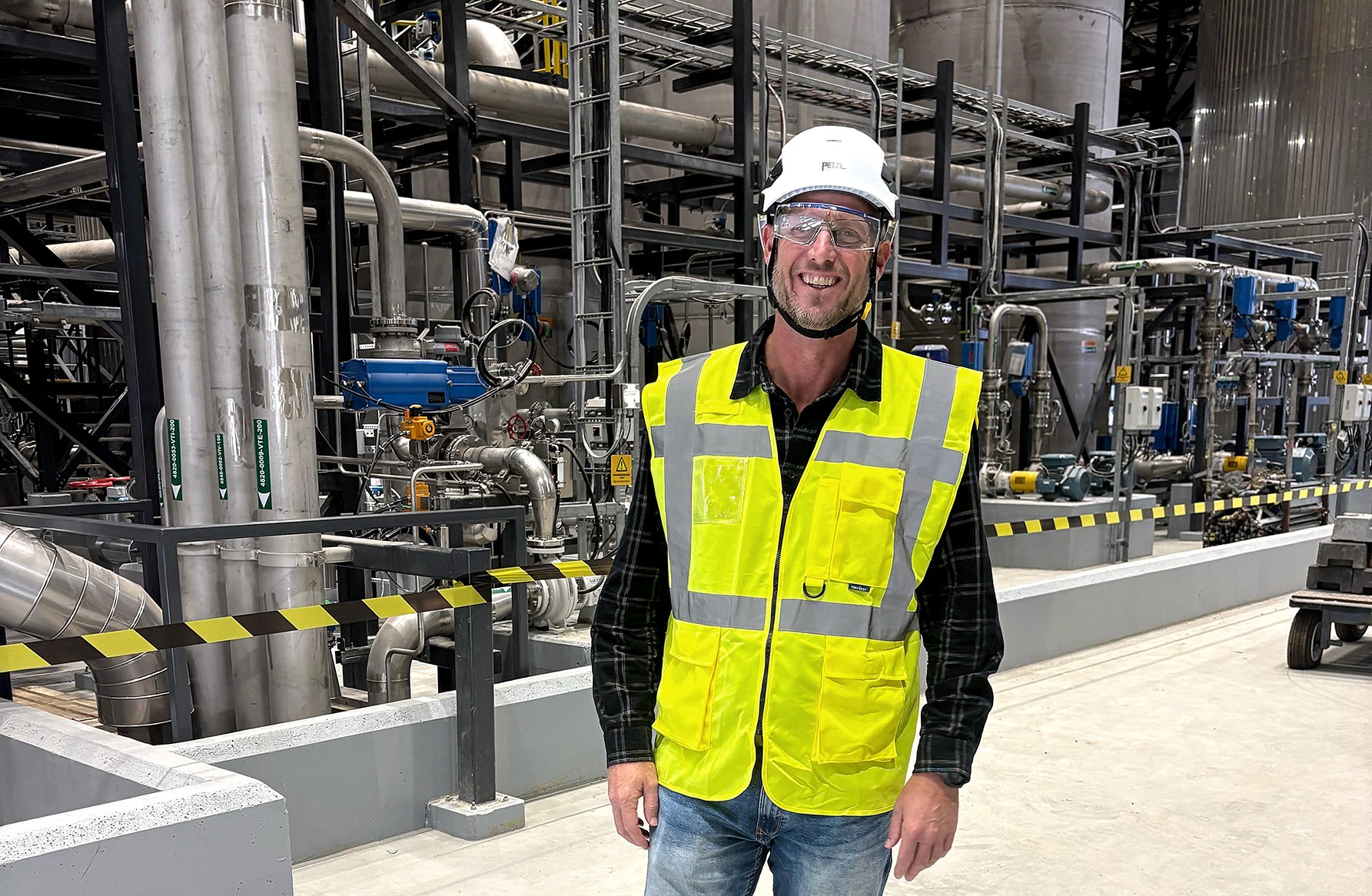
 Sibanye-Stillwater CEO Richard Stewart at the company's new lithium refinery in Finland on 21 April 2026. (Photo: Ed Stoddard)
 If you buy free-range eggs or chicken at Woolies, you pay a premium because of ethics and animal welfare concerns.
But no such premium is offered to mining companies that produce the green metals required for the clean energy transition, regardless of the carbon footprint in their production process. And pointedly, there are also scant concrete incentives in the wider value chain for buying cleaner options.
And that may ultimately have environmental consequences down the road while reducing the incentives for companies to produce such metals cleanly in the first place.
“If you took, for example, lithium hydroxide, whether it’s produced in Finland using renewable energy with very little transport footprint or if it’s produced in China, the OEMs (original equipment manufacturers) have no incentive to buy the cleaner option,” Sibanye CEO Richard Stewart told Daily Maverick in an interview.
“They will buy the cheapest or the most available. There is no direct incentive to buy greener stuff and you also don’t get any premium for that. At the moment, until there is regulation that drives it the OEMs will continue to just go to the cheapest and most available.”
Stewart was speaking during a recent trip to the company’s Keliber mine in Finland, which is the only lithium mine in Europe and is mostly powered by renewable energy. Lithium is a critical component of the batteries and storage needed for clean energy in electric vehicles and solar generation.
Stewart went on to say that there were discussions in the industry to try to provide credit and incentives for the downstream benefits of products. This moves beyond the scope 1, 2 and 3 emissions formulas that measure the CO₂ emissions directly or indirectly generated by the production process.
Net negative impact
“The argument is if you are producing lithium, you can maybe produce it with a slightly higher carbon footprint than coal but the net negative impact across the entire value chain is going to be less. If you are going to do this properly you need to look at the whole chain,” he said.
As an example he pointedly referred to platinum group metals (PGMs) of which Sibanye is a major producer in South Africa. The primary use of PGMs is in autocatalysts used for environmental purposes to cap the emission of harmful and toxic exhaust gases, but not CO₂.
“What it could look like is that if you produce PGMs that go into autocats that reduce emissions by X, you can come up with a metric. If you sell this PGM into an autocat value chain you can get a credit of X because you are stopping emissions. This is something you can standardise,” Stewart said. “So these are things we are saying should be looked it.”
Such a formula could also be applied to other green metals at a time when fossil fuels such as oil, gas and coal – the trio whose use is clearly linked to rapid climate change – remain heavily subsidised.
A couple of years ago the International Monetary Fund said that subsidies worldwide for fossil fuels had surged to a record $7-trillion in 2022.

In the EU, the carbon border adjustment mechanism (CBAM) imposes tariffs on imports of various carbon-intensive products with a focus on scope 1 or 2 emissions. This imposes costs on downstream industries, which is the main incentive they have to seek products with a lower carbon footprint.
But incentives or credits based on the downstream environmental benefits from a product remain scant. There are some examples, such as Australia’s launch last year of AUS$500-million in grant funding to “drive the growth of a strong domestic green iron industry”.
Such initiatives pale in comparison to the subsidies lavished on fossil fuels, and one of the things that is missing is clearer and bigger incentives for green metal production or premiums paid for such products. Amid all the climate policies and regulations coming to the fore, this is an area that is interesting food for thought. DM