
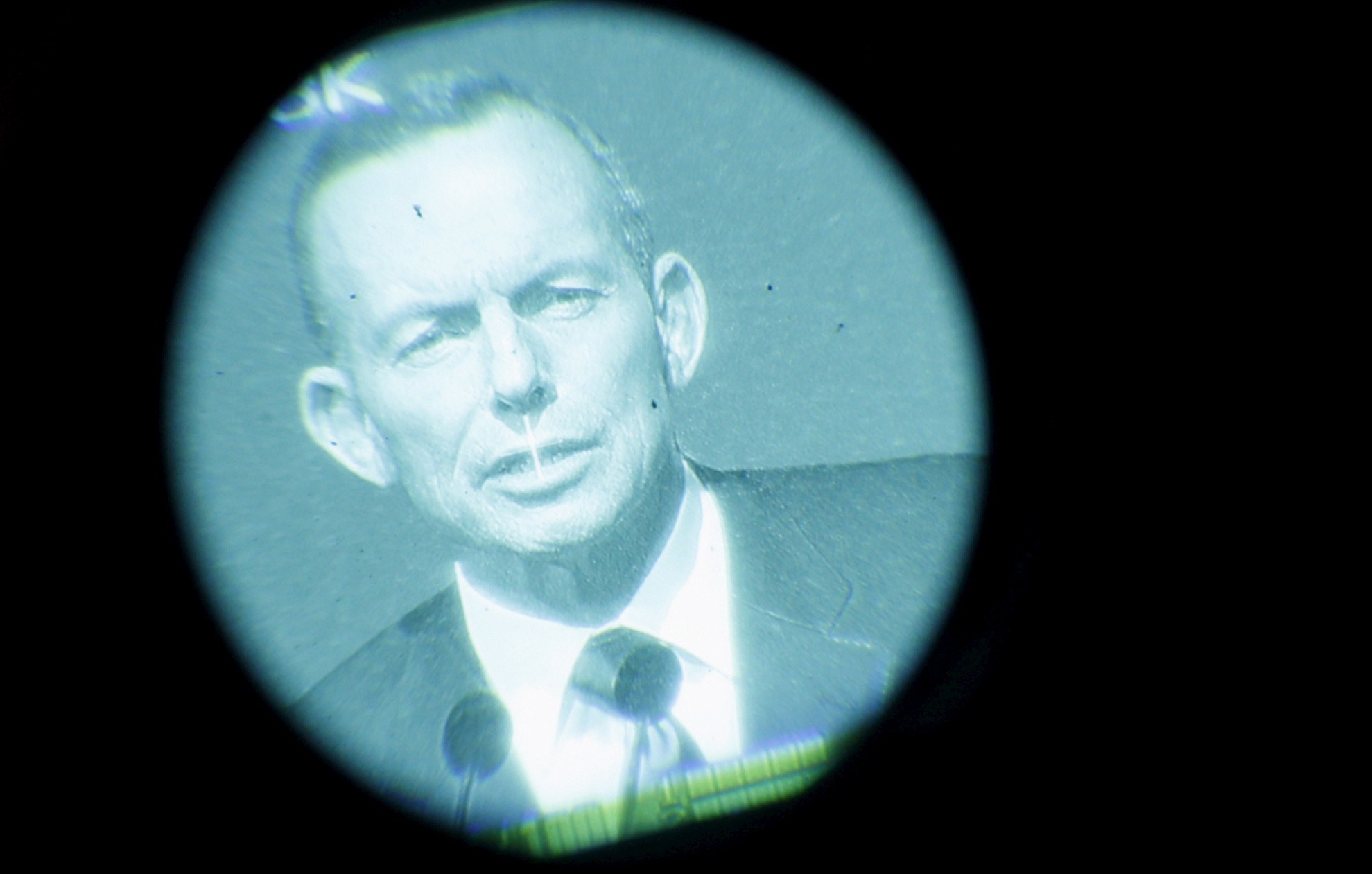
 Tony Abbott delivers a lecture on common security challenges during a June 2015 visit to Singapore as Australian prime minister. Picture shot through a video camera's viewfinder. (Photo: Reuters / Edgar Su)
 When a Wall Street Journal opinion article this month called on US President Donald Trump to seize a vast chunk of Antarctica, a seemingly bizarre scheme shot to global prominence.
Specialising in investigative reporting on Antarctic geopolitics, Daily Maverick was the first publication to challenge the legal basis of this land grab scheme in the 9 April launch edition of our “More than Meets the Ice” fact-check series.
The Journal did not break the call to acquire Antarctica’s Marie Byrd Land. This Pacific-facing territory, Earth’s largest unclaimed landmass, spans three-quarters the size of Greenland.
What sparked that escalation is key to understanding how a falsehood morphed into defensible mainstream discourse overnight.
We found the land grab scheme on a 25 March US think-tank blog by the prominent Irish founder of an international space-telco firm with reported US Navy and other state contracts. In that blog, Rivada Networks CEO and chair Declan Ganley pushed a legal myth: one could legitimately seize Antarctica’s unclaimed Marie Byrd Land because the 1959 Antarctic Treaty “did not require anyone to relinquish the right to make new claims”. Ganley urged Trump to do so by 4 July.
If you know Antarctica is carved into seven geopolitical pizza slices covered in legal toppings, that phantasm is easy to skewer. Just think of Argentina, Australia, Chile, France, New Zealand, Norway and the UK as Antarctica’s historical carvers. To cool the heat in the kitchen, the US convinced these carvers to sign the treaty and retain their right to claim a slice. No one else was allowed to do the same or launch “measures of a military nature”. Yes, Marie Byrd Land is unclaimed, but the rules apply as long as you are a member.
Australia’s slice eclipses Greenland’s size by a factor of three. In other words, Canberra is likely to take exception to any potential intruders who may turn up with carving knives.
So, on 8 April, we emailed questions to Ganley, his firm and none other than former Australian Prime Minister Tony Abbott, who sits on Rivada’s board.
“We have no comment, Tiara,” Brian Carney, the firm’s senior vice-president for corporate communications, told this reporter within two hours. “Thanks for reaching out.”
By the time the Journal unleashed a refreshed follow-up to the 25 March blog on its 8 April opinion pages, no fewer than 15 hours remained of Daily Maverick’s 24-hour comment deadline.
/file/attachments/orphans/declan_ganley15_521508.jpg "Declan Ganley. (Photo: Acton University / Wikipedia)")
The anatomy of Ganley’s gambit
The blog’s arguments probed by Daily Maverick were now pared back. Here’s how Ganley’s gambit had shifted for the Journal’s international audience:
- Ganley casts doubt on the treaty’s future, not its current laws: Daily Maverick asked Ganley to explain how his vision to claim Marie Byrd Land squares with the treaty. In the Journal, he pivots to saying the treaty does not “permanently” ban future claims. By inserting one word, “permanently”, this introduces the notion that no institution is unsinkable.
- He softens the line between claimed and unclaimed land: We asked Ganley if he knew the treaty did not distinguish between claimed and unclaimed Antarctic territory. His Journal article does not say the treaty recognises unclaimed land. It just says Marie Byrd Land is unclaimed.
- He leaves the biggest gap where it was (and gently taunts the haters): We asked how the US would “assert sovereignty without first withdrawing from or amending the treaty”. The blog does not answer that. The Journal article does not answer that. There is nothing to change in a world where Trump seems ready to eat the rules-based order for breakfast, seasoned with stars and stripes.
- He drops the American Independence Day deadline: How could the US take Marie Byrd Land by 4 July under treaty rules that require time to change or exit? The date vanishes in the Journal.
- He removes the part of his own argument that conflicted with the treaty: How would low orbit satellite networks for military data flows meet rules for peaceful use? In the Journal, all such references are dropped.
- He excludes the word “jointly”: We asked for evidence that China and Russia “jointly announced plans” for new research stations. In the Journal, we learn that China and Russia “announced plans”.
The opinion article is no less outrageous than Trump’s attempts to claim Greenland, which the world today treats as a realistic possibility. And, as opinion, it is not demonstrably wrong because it relies heavily on an interpretation that leaves the door slightly ajar.
It is Ganley’s coup.
/file/attachments/orphans/OperationHighJumpUSAP_179341.png "The US Navy salutes the nation’s flag during “Operation High Jump”, the 1946-47 Antarctic expedition led by Rear Admiral Richard Byrd. (Photo: US Navy / USAP Photo Library / Public domain)<br>")
Ganley’s gaffe
Twice the Journal opinion article quotes the Madrid Protocol’s all-critical 2048 review option – that is to argue that the US must plan for a future in which the Protocol’s mining ban could be lifted. This would, pending several legal hoops, open Antarctica to extraction.
Twice citing the 2048 review is a double admission that the Protocol does not expire then: why, for argument’s sake, assess the future of an international convention centre when it will be detonated in the same year?
The Protocol and its ban are indefinite.
But in a podcast that went live the day after the article’s publication, a free-styling Ganley tells Carney the entire Protocol expires in 2048: “That expires in less than 30 years, I think, there or thereabouts. And that time is going to pass very, very quickly…”
As implausible as it seems, Ganley appeared to unremember a lynchpin of polar law just as his own opinion article, citing that law, was newly circulating on one of the world’s most influential news platforms.
This was Ganley’s gaffe.
The blog is rhetorical, discursive, marred by fringe error. The Journal response? Structurally constrained and legally cautious.
Which raises the question: How did Ganley’s rough-edged gambit find a second life on the Journal? There is likely no mystery here. The Antarctic piece may have waited in the Journal’s production line for weeks, days or hours.
Ganley had already published at least two other pieces in its opinion section since December. Op-ed editor James Taranto is a contrarian conservative commentator with a self-declared hostility towards Trump’s critics and “political fact-checkers” from “legacy media”.
And any news publication with a sense of shrewdness employs production elves.
In fact, when a longer draft has to meet a normal opinion limit of roughly 500 words apiece, the unsung production elves must take care of it. It is the unspoken rule of newsrooms just about everywhere.
Official company position with a former Australian PM onboard
As revealed by Daily Maverick on 9 April, Tony Abbott, the prime minister who led Australia between 2013 and 2015, sits on Rivada Networks’ board of directors.
Today we can also reveal that Ganley’s gambit is endorsed by a firm whose business model includes the very technologies he argues will drive future geopolitical competition, including networks that “require polar coverage”.
The space-telco firm relies heavily on marketing itself through its subsidiary, Rivada Space, which says it is building “a truly private space network” for the “telecom, enterprise, maritime, energy and government” sectors. Using an “ultra-secure outernet”, it reportedly has 600 low Earth orbit (LEO) satellites that aim to keep client data in space “from origin to destination”. It aims to achieve “connectivity everywhere … even at the poles and at sea”.
/file/attachments/orphans/RivadaPrivateNetworkSS_907898.jpg "This screenshot from a Rivada Networks promotional video positions its services as a \"truly private space network\". (Image: RivadaNetworks.com screenshot)")
/file/attachments/orphans/RivadaBuiltforGovSS_974987.jpg "A Rivada promotional video notes that the firm's services are designed for government use. (Image: RivadaNetworks.com screenshot)")
Rivada Networks has reported receiving a US Navy contract while another subsidiary, Rivada Port Graham Solutions, says it “specialises in the engineering, design and implementation of communications systems for the US Department of Homeland Security and other public safety agencies”. (Ganley and Rivada Networks have taken CNN to Ireland’s High Court over its report suggesting that the first Trump administration pushed the Pentagon to award the firm a no-bid, mid-spectrum contract.)
Aligning a core Rivada focus – LEO satellites – with a case for claiming Marie Byrd Land, the blog argues that the 21-century’s “great infrastructure competition” will be waged over LEO networks that will carry, among others, “the world’s most sensitive data” and “military communications”. And “those networks”, Ganley stresses, “require polar coverage”.
Rivada Networks deployed several of its online channels to push the opinion article as well as the podcast. Titled “The case for an American claim in Antarctica”, the podcast features firm communications executive Brian Carney in conversation with Ganley himself. It is streamed on Rivada Space’s official website, its YouTube channel and its X.com account. The article was also promoted on Rivada Networks and Rivada Space's X.com accounts, as well as the social media inset on Rivada Networks’ website homepage.
In this @WSJopinion op-ed, our CEO @declanganley explores the significant untapped resource potential of Marie Byrd Land in the Antarctic, the world’s largest unclaimed territory.
— Rivada Space Networks (@rivadaspace) April 9, 2026
Declan strongly believes that the U.S. should seize an opportunity to expand their sovereignty… pic.twitter.com/CkamNNRmSg
Antarctic experts: Abbott should ‘disassociate’ himself
Daily Maverick asked Antarctic governance experts whether Abbott, who continues to make headlines for his right-wing positions, should distance himself from Ganley’s firm-endorsed public campaign.
“It very much depends whether Abbott already tactically wants to be seen as a Trumpian hawk,” notes Peter Convey, a distinguished visiting professor of polar biology at the University of Johannesburg.
A recipient of the UK Polar Medal, Convey is also a senior ecologist at the British Antarctic Survey and chief editor of Antarctic Science at Cambridge University Press. Expressing his personal views, he observed: “If Abbott has any concern over his future wider reputation or cushy appointments in the Australian system or elsewhere, given Australian public opinion and indeed much globally, it might pay him to distance himself rapidly from anything remotely associated with Trump and cronies.”
Professor Tim Stephens, associate dean of the University of Sydney’s Law School, cited “long-standing bipartisan support” for the treaty within the Australian government. But Stephens, a state-appointed arbitrator for the Protocol, advised that the campaign may “undermine the Antarctic Treaty, and Australia’s overriding national interest in the maintenance of the treaty regime”.
He added: “It would be prudent for Mr Abbott to disassociate himself from the firm’s public campaign.”
We first emailed questions to Abbott’s office on 8 April and again on 28 and 29 April, but received no answers by the deadline.
/file/attachments/orphans/RC2A4EAL38VA_509826.jpg "Former Australian Prime Minister Tony Abbott attends the Lest We Forget sunset tribute on the eve of Anzac Day at the Sydney Opera House in Sydney, Australia, 24 April, 2025. (Photo: Reuters / Hollie Adams)")
‘The entire proposal lacks intellectual rigour’
The US, like Russia, is a “semi-claimant” state. That means neither state has claimed any part of Antarctica, but reserves the right to claim all or parts of it.
“That doesn’t give the US a particular standing to make a claim, unless the treaty ends or the US withdraws,” explains Evan Bloom, a US policy head at Antarctic Treaty meetings between 2006 and 2020. Withdrawal “would be manifestly not in the US interest”, because the “treaty and related instruments protect US ability to operate in Antarctica, as they do for all the other parties”.
The original blog also calls for a “coordinated Western territorial framework that organises allied claims”.
Bloom was deadpan. “Even if the US were to make a claim, others wouldn’t accept it.”
University of Canterbury’s Professor Alan Hemmings, who coined the term “semi-claimant”, says “the entire proposal lacks intellectual rigour”. Ganley waxes about closing a gap, the Canberra-based governance expert notes, but then comes the dry hit: “The US won’t have icebreakers for another decade … Is it remotely likely that the Chinese and Russians say ‘fair cop’ and beat a retreat?”
/file/attachments/orphans/AntarcticaBudretskyOasis_349698.jpg "A satellite image of an 11km2 glacier at Russia's Russkaya field base, Marie Byrd Land, Antarctica. (Image: Arctic and Antarctic Research Institute press statement)")
In late March, a Russian state order named an 11km2 glacier at its 46-year-old Russkaya field base in Marie Byrd Land for Arnold Budretsky, a storied “polar explorer” who retired at age 91 in 2019. Russia’s Arctic and Antarctic Research Institute has vowed to include the so-called Budretsky Oasis – a wind-swept laboratory for ecological and geological studies – on “all global maps”.
/file/attachments/orphans/AntarcticaRusskaya_985305.jpg "Russia's Russkaya field base, Marie Byrd Land, Antarctica. (Photo: Arctic and Antarctic Research Institute press statement)")
For his part, Convey cautions that “we have to be a little careful of being seen to condemn China for doing the very thing they are meant to be doing”. China is now Antarctica’s leading researcher in quantity and quality, “which is after all what the stated aim of the treaty is”.
No answers were received from Ganley or Rivada Networks to questions emailed on 28 and 29 April, respectively. DM