




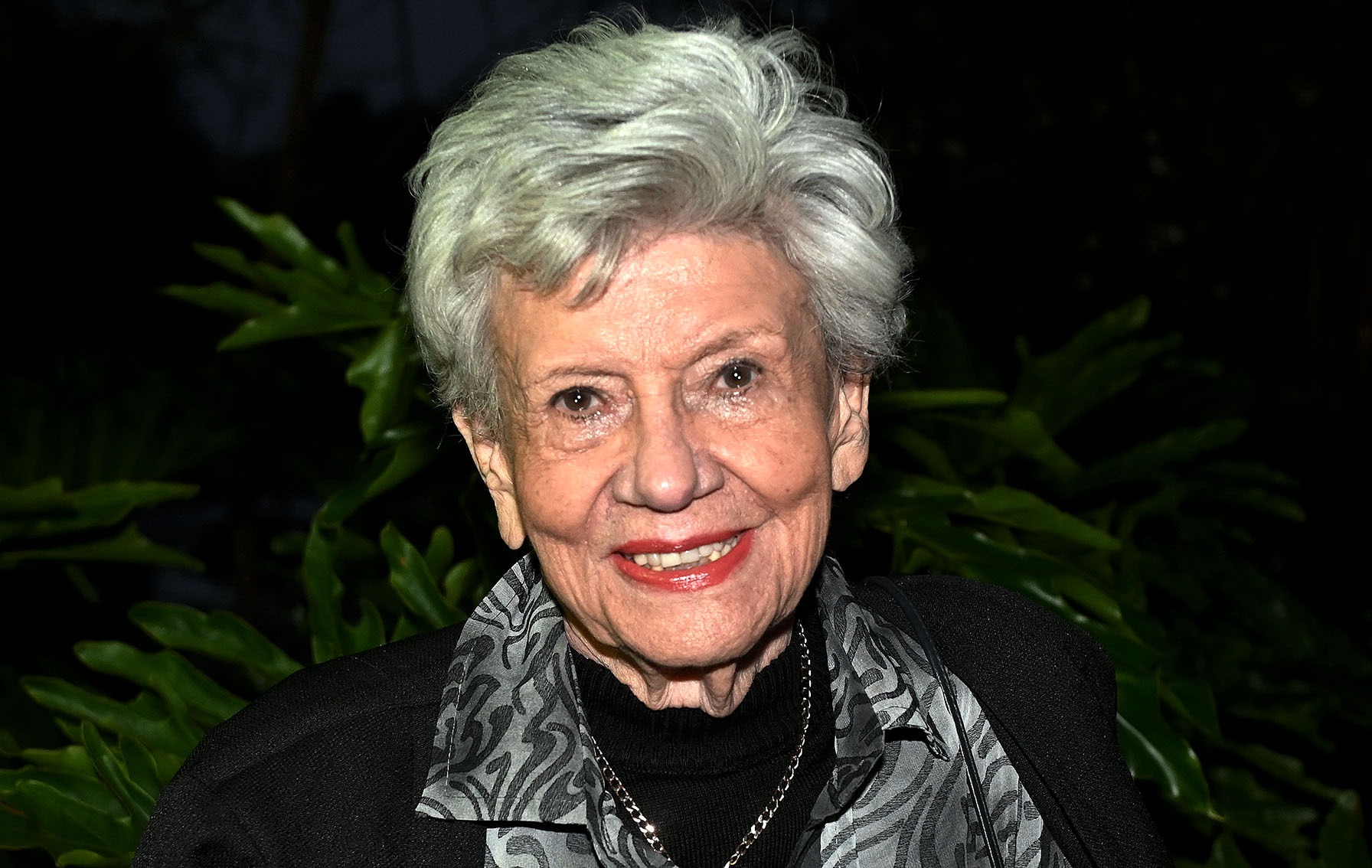
 Mimi Coertse (90) attends the Aitsa music awards on November 29, 2022, in Pretoria. She received an award for lifelong commitment and dedication to the music industry. (Photo: Deaan Vivier / Gallo Images / Beeld)
 Maria Sophia Coertse, one of the 20th century’s most distinguished coloratura sopranos and a cultural figure as deeply woven into the South African imagination as the veld itself, has died aged 93.
Known affectionately across her homeland as “Onse Mimi [Our Mimi]”, she passed away peacefully from natural causes in her sleep at her Pretoria home shortly before 9pm on Monday, 27 April.
Coertse became as much a fixture of the South African landscape as braaivleis, rugby and biltong — a presence as quintessentially local as bobotie, pap and the summer sun. She belonged to that diminishing class of performers whose names travelled ahead of them, carried by radio waves and vinyl long before most of her compatriots could have located Vienna on a map. Yet South Africans knew well enough that a young woman from Durban had gone to the Austrian capital and conquered it with a bird-like voice that seemed to bounce off the moon and back.
/file/attachments/orphans/0000163770_707100.jpg "South African soprano Mimi Coertse, photographed on 11 November 1957. (Photo: Gallo Images / Die Burger Archives)<br>")
Born on 12 June 1932 into an Afrikaans family where music was a natural extension of daily life, she grew up surrounded by sound. Her mother sang, her brothers played instruments, and there was little sense that such activity belonged to a separate, elevated sphere. She would later recall, with a mixture of amusement and impatience, that every singer’s mother claims her child started singing very early. “Mine was no different,” she said. Neighbours regularly paused at the garden fence when the small girl sang, already recognising something distinctive in the timbre.
The family moved from Durban to Germiston, and she attended Helpmekaar Girls’ High School in Johannesburg. She excelled in class and on stage as an actress, but it was not immediately obvious that music would become her vocation. At 17 she began singing lessons with Aimée Parkerson, who taught her that interpretation mattered more than prizes. Coertse absorbed the lesson thoroughly, and by removing the anxiety of competition, she began to win.
Her formal debut was in the early 1950s at the Johannesburg City Hall as a soprano soloist in Handel’s Messiah. Later, she left South Africa for Europe, first to London, then The Hague and finally, in 1954, Vienna. In later accounts, she is often described as a boeremeisie, a cheeky and precocious farm girl abroad, though the label somewhat understated the quiet force of her ambition.
Vienna in the 1950s was not a forgiving city for outsiders. Its musical culture was steeped in tradition, and Coertse had little formal grounding in what was considered proper Mozart style. Yet, within a year, she had secured a contract with the Vienna State Opera. Her early European appearances in Italy and the Low Countries were followed swiftly by the engagement that would define her career: the role of the Queen of the Night in The Magic Flute at the Vienna State Opera.
/file/attachments/orphans/0000163774_190896.jpg "Mimi Coertse (right) and Malanie Kimball perform on 16 January 1982. (Photo: Paul Alberts / Gallo Images / Die Burger Archives)<br>")
‘Musical elegance’
It was a role that required both technical brilliance and nerve. Coertse possessed both. Professor Jeremy Silver, director of Opera UCT, recalls that “her voice was crystalline in its upper register, with an amazing facility for fast coloratura”. What set her apart, he adds, was not theatrical excess but control. “She brought a musical elegance, rather than dramatic flair, to particular German roles like the Queen of the Night, Zerbinetta and Konstanze.” At a time when singers such as Maria Callas were exploring a more visceral, psychologically charged mode of performance, Coertse maintained a style marked by poise, precision and refinement.
Her rise within the Vienna State Opera was rapid. She became the youngest singer appointed to its permanent ensemble and remained there for nearly two decades. In the mid-1960s she was awarded the title of Kammersängerin by the Austrian government, an honour that placed her among the most revered singers of her generation.
/file/attachments/orphans/0000163771_894000.jpg "Mimi Coertse in Salzburg, Austria, circa 1956. (Photo: Gallo Images / Die Burger Archives)<br>")
Her repertoire was wide, though certain roles became inseparable from her name. She sang the Queen of the Night aria more than 500 times, in four languages, a feat that suggests both extraordinary stamina and relentless attention to detail. She was widely admired as Zerbinetta in Richard Strauss’s Ariadne auf Naxos, as Konstanze in Die Entführung aus dem Serail, and as Gilda in Verdi’s Rigoletto. The pianist and vocal coach Albert Combrink, who worked closely with her in her later years, recalls the breadth of those achievements: “She made some wonderful recordings; of course, the Queen of the Night, but also operettas and Salome and Daphne and a bit of Arabella, and for Solti she did the impossible Fiakermilli. And an absolutely gobsmacking Zerbinetta.”
Beyond the opera house, Coertse also made her mark on screen. She appeared as herself in the Afrikaans musical film Nooi van my Hart, one of the most popular Afrikaans productions of its era, and later took the lead role of Concepción in a television adaptation of Ravel’s L’heure espagnole. She provided the voice of Grietjie in the children’s television series Hansie & Grietjie, appeared as an opera singer in Pieter-Dirk Uys’s satirical film Skating on Thin Uys, and was the subject of a television documentary, Mimi Coertse: Queen of the Night, which captured her most iconic role for posterity.
/file/attachments/orphans/000046269_943100.jpg "From left, opera singer and instructor Nellie du Toit, actress Shaleen Surtie-Richards, opera singer Mimi Coertse, actress Trix Pienaar and Adele Searll, a fighter against drug abuse, seen here on 16 March 1992. (Photo: Gallo Images / Die Burger)")
She worked with conductors of the highest calibre, including Herbert von Karajan, Karl Böhm and Lorin Maazel, and sang alongside the leading voices of the age. Yet her career unfolded within the fraught context of apartheid South Africa. While artists such as Miriam Makeba and Hugh Masekela went into exile and openly opposed the regime, Coertse remained based in Europe, continuing to perform as a South African artist. In Britain, the Equity boycott limited her appearances, a stark and correct reminder that politics could not be entirely avoided from the stage.
Honoured by the ANC
Her position during those years has been interpreted in different ways. Some saw her as a cultural emissary; others regarded her as detached from the political realities of her country. What is beyond dispute is that, on her return to South Africa in the early seventies, she committed herself to expanding opportunities for singers who had previously been excluded. She knew Nelson Mandela well and was honoured by the ANC. Even after her music room in Waterkloof, Pretoria, was destroyed in a racially motivated attack, a direct consequence of her support for singers of other races, she refused to withdraw.
Her decision to leave Vienna at the age of 41, when she was still at the height of her international career, surprised many. She cited a desire for family life and a growing weariness with European winters. In Pretoria, she created a home that was both domestic and artistic, marrying the businessman Werner Ackerman in 1970 (her third and last marriage) and adopting two children, Mia and Werner, after enduring five miscarriages.
/file/attachments/orphans/0000163778_906992.jpg "Dr H Luttig, Mimi Coertse and her second husband, Diego Brighi, on their wedding day in 1965. (Photo: Gallo Images / Die Burger Archives)<br>")
Her attention turned increasingly to mentorship. The Mimi Coertse Bursary provided financial support for young singers to study abroad. The Debut with Mimi concerts offered emerging performers the rare opportunity to sing with a full orchestra. In the late 1990s, she co-founded the Black Tie Ensemble with Neels Hansen, a project that helped bridge the gap between conservatory training and professional performance.
Martin Lane, pianist and vocal coach, emphasises her practical impact. “She was an astute promoter of opera; [specifically], South African opera singers representative of all races,” he says. “The Mimi Coertse Bursary also promoted many local opera singers, some of them making big waves overseas.”
Of her voice, he says simply: “Pure, natural spiritual coloratura … she was able to also sing the Afrikaans lieder, FAK [Federasie van Afrikaanse Kultuurvereniginge] songs with ease.” Her presence, he adds, was unmistakable. “When Mimi entered the stage or room, all eyes were captured; she had pizzazz par excellence.”
Albert Combrink adds a further dimension to her legacy as a teacher. “She supported and inspired so many young singers who have careers all over the world because of her,” he says. He remembers one masterclass on Le Nozze di Figaro above all others: “She had a quick and naughty sense of humour, but absolutely knew her stuff. The suitable-for-polite-company version of her advice was: ‘Do not sing about things you do not understand.’ Advice I have been imparting in coaching sessions ever since, and applying to myself.”
She was not, however, universally gentle. Lane remembers her impatience with misplaced familiarity. “Moet my nie tannie noem nie! Ek is nie met jou oom getroud nie,” she would snap. (“Don’t call me auntie, I’m not married to your uncle!”) The remark, half humorous, half admonition, became part of her legend.
Professor Jeremy Silver offers another glimpse of her character. Recalling a production of Lucia di Lammermoor in the mid-two-thousands, he notes how open she remained to new ideas. “My approach to the score took account of more recent scholarship … and I was touched by how fascinated she was by this, and how totally open she was to our performing the work in a different way than she had.” It was a quality not always associated with artists of her stature.
She was also an avid art collector, with a particular interest in South African women painters such as Irma Stern, Maud Sumner and Cecil Higgs. Her collection reflected a sensibility attuned not only to music but to visual form and composition, a parallel life of the eye alongside the life of the voice.
There were lighter moments. Backstage in Vienna, she played Scrabble with colleagues, leaving the board with the stage manager when called to sing. Between appearances, she made tapestries, filling her home with them. She took up hang gliding, prompting Herbert von Karajan to remind her of contractual prohibitions against dangerous activities. She replied that he skied, to which he answered, with dry authority, that he could.
/file/attachments/orphans/0000163852_195324.jpg "Mimi Coertse on 16 January 2003. (Photo: Brendan Croft / Gallo Images / Foto24) <br>")
Her involvement in public life extended to the board of the South African Broadcasting Corporation, where she argued vigorously for the preservation of the National Symphony Orchestra alongside fellow board member Reeva Forman. Coertse attended concerts faithfully and did not hesitate to challenge decisions she considered detrimental to the country’s musical life. She received an honorary doctorate from the University of Pretoria and another from Unisa, and in 2020 she was inaugurated as a living legend in the South African Legends Museum, one of only 20 South Africans honoured with a bust.
In later years she continued to teach, adjudicate and occasionally perform. Even in her eighties she remained a presence on the musical scene, her voice still capable of surprising those who assumed it had faded. She spoke often of the importance of Lieder, regarding it as an art form requiring as much discipline and interpretive intelligence as opera. In the 1980s, there was a scandal in the old Nico Malan Theatre Centre when she was booed on stage. The opera singer Wendy Fine was blamed but denied being responsible. The rivalry between opera divas was tight and heated.
A faultlessly clear memory
This obituarist often contacted Coertse, up to her 85th birthday and even beyond, to ask for her recollections of a recently deceased opera singer. She had a faultlessly clear memory of many performers, especially the timbre of their voices, and could recall precisely when and where some managed to hit a top C. I encountered this kind of memory among senior rugby players, who could recall the exact hour, day and year they saw a player score a try, along with the weather conditions and the roar of the crowd.
Coertse’s memory, much like that of those rugby players, was remarkable. She dined with numerous opera stars, among them Maria Callas. She recalled exactly what they ate, where they ate it, and the conversations they had. This was in the 1970s, decades ago. She could also tell me about other famous opera singers, such as the Russian Galina Vishnevskaya (she pronounced the name effortlessly), with whom she had dined, and once again recalled her on- and off-stage voice, the food they ate, and what the other person was wearing. She was a journalist’s dream because of her prodigious memory. Yet one day, when I phoned, someone else answered and told me that Mimi would not be able to help me. The woman with the sharp memory was slowly succumbing, I gathered, to dementia.
/file/attachments/orphans/0000163847_279961.jpg "Mimi Coertse on 13 May 2002. (Photo: Lee Warren / Gallo Images / Beeld)<br>")
Coertse was a woman of contrasts. On stage, she appeared frightfully noble, but in private she could be a little rough, though no one seemed to mind. She had a foul mouth and, when the fancy took her, could swear like a drunken sailor.
The first time I met her was at the old Nico Malan Theatre Centre, where she was rehearsing for an opera. A friend of mine who knew her well wanted to greet her. She came to the door of the rehearsal room, her conversation spiced with delicious swear words. Before we left, she turned to me with theatrical flair. I was wearing an army uniform, doing my compulsory national service at the time. She looked at me and said how terrible it must be; she could see it on my face. In an operatic voice, she said: “En my vriend, sterkte vir jou, en sê jy maar vir daai donnerse Magnus en sy generaals hulle kan almal doppies gaan blaas!” (“And my friend, strength to you, and you can tell that bloody Magnus and his generals they can all go to hell!”)
That was Onse Mimi. Bravo! Take a bow, and may you have many standing ovations on the other side. DM