




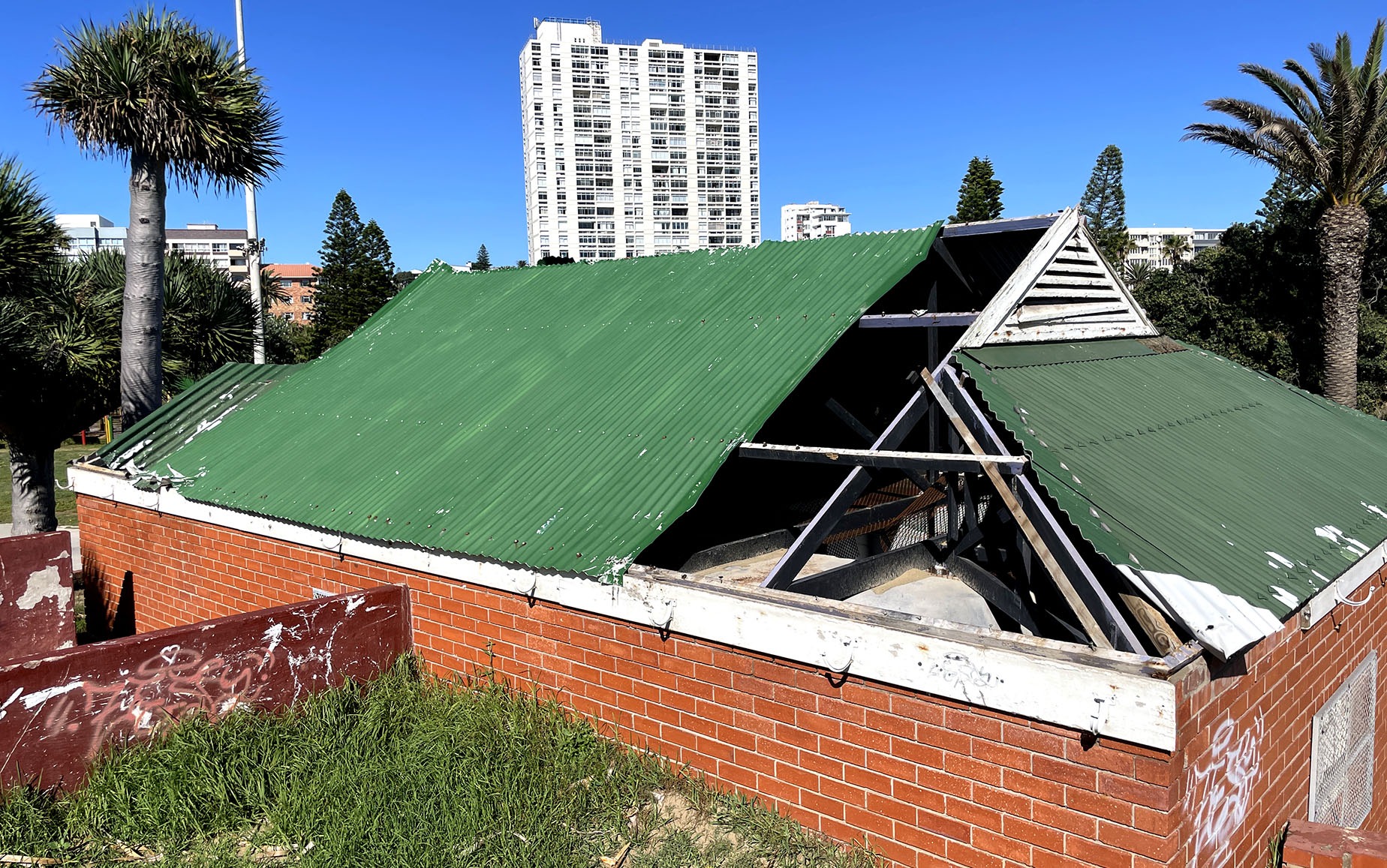
 The roof of a bathroom at Kings Beach has been vandalised. (Photo: Kyran Blaauw)
With thousands of competitors and supporters in Nelson Mandela Bay for the Isuzu Ironman SA Championship, a sewage leak at Kings Beach in the days leading up to the 19 April event raised fresh concerns about water safety — and renewed fears that the city’s crumbling beachfront infrastructure is putting its R12.3-billion tourism economy at risk.
The sewage incident — not the first of its kind at Kings Beach — comes amid growing concerns about rising crime, vandalised facilities, poor maintenance and inadequate municipal responses along one of the metro’s primary tourism nodes.
These concerns were raised at an economic development committee meeting last week, where Federated Hospitality Association of SA (Fedhasa) regional representative Glenn Pappin warned that conditions on the beachfront were driving tourists away while also negatively affecting the already plummeting economy of the metro.
They have also sparked alarm in the tourism sector, which believes that if they persist, national and international events could be moved elsewhere.
Pappin represents the majority of the hotels and restaurants along the Gqeberha beachfront.
/file/attachments/orphans/Pappin_135697.jpeg "Federated Hospitality Association of SA (Fedhasa) regional representative Glenn Pappin. (Photo: Andisa Bonani)")
Pappin told the committee that neglect of the beachfront had hit bed occupancy rates and tourist spending, with direct consequences for job creation.
The beachfront is one of the metro’s most strategic economic and tourism assets, serving both residents and visitors and contributing significantly to employment, destination attractiveness and the city’s brand image.
Tourism is the second-largest contributor to employment in the metro, with the beachfront forming the primary leisure and visitor node.
It contributes R12.3-billion to the local economy, supporting about 25,000 direct jobs and almost 50,000 indirect and induced jobs.
Tourism spend from overnight stays amounts to R4.9-billion, while day visits contribute R1.9-billion, bringing total direct spend to R6.6-billion.
Serious interventions needed
“The beachfront is a hub of tourism sites. The accommodation sector, where everyone comes to Gqeberha and needs a place to stay, is in a rapid decline. The [bed] occupancy rate is also declining in line with the condition of our beachfront, and we need some serious interventions,” Pappin told officials.
“Despite the importance of tourism, the beachfront challenges remain unresolved. Declining facilities and rising crime are reducing visitor numbers. These issues undermine destination image, investor confidence and economic sustainability.”
He said while different sectors struggled to keep afloat due to the declining economy, the tourism industry was the easiest to turn around.
Pappin indicated that growing occupancy rates would result in increased employment levels in Gqeberha.
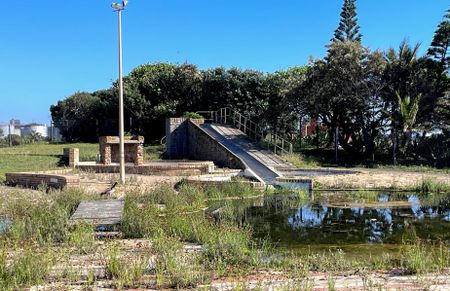
/file/attachments/orphans/Photo8_299568.jpg "A run-down children’s pool area at Kings Beach in Summerstrand. (Photo: Kyran Blaauw)")
“Some of the key issues we have [are] the sewerage and environmental health problems, there are regular electricity outages along the beachfront and persistent failures (sewage leaks) especially on the Kings Beach parking and by Something Good restaurant.

“Sewage pipes have burst, causing effluent to stream to the beach, causing a bad stench in the parking area of Kings Beach.
“These are things we need the directorate to ensure are dealt with, especially when we are hosting the prestigious World Livesaving Championships (set to take place from 25 November to 13 December). Issues at Kings Beach also affected preparations for Easter celebrations,” Pappin said.
“Just before the … SA National Lifesaving Championships and the Ironman, we had some system failures (sewage leak), and unfortunately, that all spreading through social media, and damage control had to be done to ease the participants, ensuring them that the seawater was safe to enter.”
Pappin said homeless people had taken over the beachfront as they were given money and food from visitors, who were later robbed or harassed for handouts, making for a bad experience and affecting the reputation of the city.
“We saw this happen during Ironman, and it’s not a nice experience for visitors, but with limited law enforcement and inadequate facilities, it’s not easy to fend off people, some of whom were destroying infrastructure while world events [were] hosted.”
Metro report confirms problems
Pappin’s sentiments were corroborated in a report tabled at the committee by the acting executive director for economic development, Wandisile Makwabe.
/file/attachments/orphans/EDTA_619811.jpeg "Nelson Mandela Bay metro’s acting executive director for economic development, tourism and agriculture Wandisile Makwabe (left) and the directorate’s politics head Bassie Kammana. (Photo: Andisa Bonani)")
The report says conditions at the beachfront are shaping increasingly negative visitor perceptions, affecting the destination’s image and reputation, as well as length of stay, repeat visits and the city’s competitiveness as a coastal and event-hosting destination.
It notes that stakeholder submissions, including visitor feedback and survey inputs, point to ongoing problems relating to personal safety, inadequate law enforcement presence, vandalised or dysfunctional infrastructure, poor cleanliness and visible social challenges along the beachfront.
Submissions from beachfront business clusters, tourism organisations and safety forums also highlight rising incidents of theft and harassment affecting visitors, as well as weak coordination between municipal safety services and external partners.
/file/attachments/orphans/Photo19_206156.jpg "A children’s pool area at the Kings Beach precinct is run down, abandoned and poorly maintained. (Photo: Kyran Blaauw)")
Additionally, recurring sewage overflows and associated beach closures, public concerns regarding water quality and health risks and littering linked to inadequate waste management during peak periods had further undermined the overall visitor experience.
“Challenges also noted related to infrastructure degradation and broader economic impact, and these were also consistently raised. Pertaining to the infrastructure, repeated vandalism of ablution facilities, lighting, walkways and public amenities, coupled with inconsistent maintenance and slow response times for repairs [resulted] in the loss of basic services relied upon by residents and tourists alike,” the report said.
Risk to Blue Flag status
“Collectively, these issues are contributing to deteriorating beachfront conditions that undermine marketing efforts and investor confidence, pose potential risks to Blue Flag status and have direct negative implications for tourism revenue, employment opportunities and the sustainability of small businesses operating in the beachfront precinct.”
The economic development department says it has recently partnered with stakeholders and is implementing a beachfront safety initiative supported by private sector investment.
The department said an integrated Beachfront Action Plan was being developed to consolidate municipal and private sector interventions into a single, time-bound programme, clarify roles and responsibilities and improve coordination before upcoming national and international events.
The plan would also introduce a monitoring and accountability framework, with a focus on safety, cleanliness, sanitation and infrastructure maintenance.
Despite safety and infrastructure management being municipal competencies, the private sector has made substantial contributions to supporting the beachfront through the funding and installation of surveillance cameras and solar lighting, the provision and support of additional safety personnel via approved external funding mechanisms, and targeted waste management interventions coupled with ongoing monitoring support.
These initiatives demonstrate a strong willingness from the private sector to partner with the City; however, their effectiveness and long-term sustainability are dependent on clearer coordination, alignment and strong municipal leadership, the report says.
/file/attachments/orphans/IMG_3991_940049.jpg "One of the beach ablution facilities is in ruins. (Photo: Kyran Blaauw)")
ANC councillor Sicelo Mleve said the situation on the beachfront was worse than Pappin had described.
“The beachfront is the face of the city when it comes to activities. With international events coming, it’s embarrassing that our beachfront is in that state. It’s our responsibility to provide leadership. Our children will judge us harshly for this.
“When the private sector is making means to assist us, let’s welcome and work with them for the betterment of our city. I welcome the presentation, and thanks to the leaders of the private sector, especially the hotels and hospitality operators. The beach has a bad smell, the toilets are not working, that’s nothing to be proud of.”
DA councillor Bernhard Wolf said the municipality had to invest money into the city to reap the benefits of such decisions.
“We need to ensure our colleagues in council actively support the plan to turn around the beachfront. It’s the car guards, waitresses, cleaners, taxi drivers dropping people off that need us to invest and get things going and create jobs in the city because they all benefit from the tourism.” DM
Comments
Scroll down to load comments...