



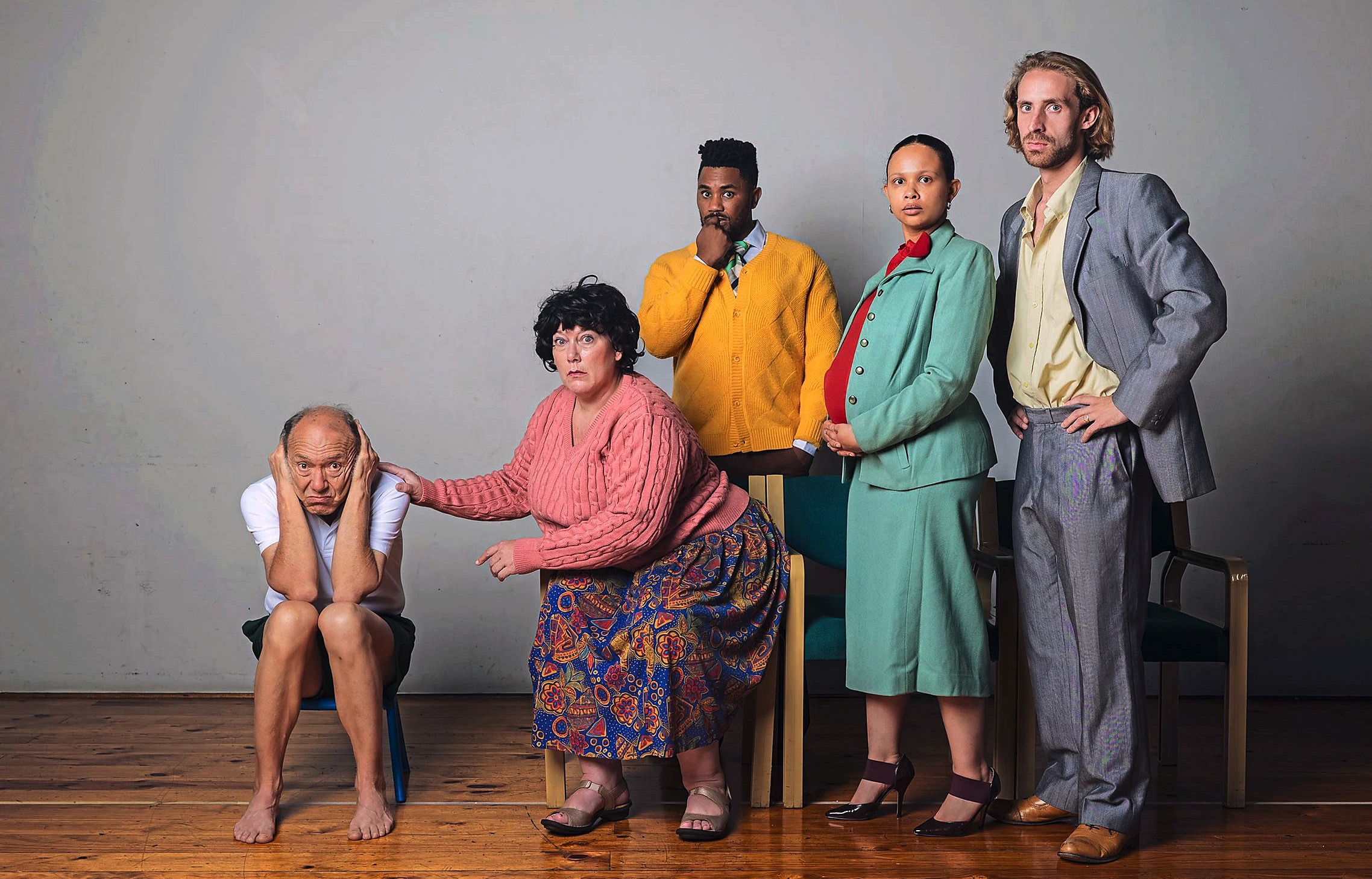
 The cast of Carla Smith’s new comedy, CRYBABY, which explores the absurd transformation of a four-year-old into an adult after glimpsing disturbing media, satirising contemporary life. (Photo: Hans van Veen)
 In an era when each day’s farcical headlines seem to allude to yet another outsized tantrum involving a publicly elected octogenarian throwing his toys out the White House cot, it seems perfectly reasonable to write a play about a toddler trapped in the body of a grown-up.
Which is precisely what actor and now writer-director Carla Smith did, though her inspiration lies more in the fabric of contemporary life than in the specifics of childish political incompetence.
The result is an absurd new comedy called CRYBABY, an Afrikaans farce about a boy who, one day at pre-school, accidentally glimpses his teacher’s doom-scroll feed on her handheld device.
The repercussions are instantaneous and immense. For Samuel, the young boy, seeing whatever is on that screen transforms him – his body at least – into a late-in-life adult; while his mind and personality remain those of a child, physically he could be his own grandfather.
The teacher’s feed, we learn, is everything and nothing specific, all the usual nonsense people seem addicted to: recipes and cat videos, harrowing news and sarcastic memes, advertising, conspiracy theories and IQ-diminishing slop.
In this farce, though, the mix seems to have the algorithmic function of inexplicably rewiring Samuel’s genetic code. Whether because he’s super-sensitive to the harsh realities he witnesses or by some divine force, he is instantly conveyed into the body of his older self.
/file/attachments/orphans/ReneCloeteFrankOppermanandWianTaljaardinCRYBABY_HansvanderVeen_470924.jpg "René Cloete, Frank Opperman and Wian Taljaard in CRYBABY. (Photo: Hans van Veen)")
Technically, it’s a frightening biological malfunction akin to the kind of transition you’d expect from a body-horror film by David Cronenberg. In Smith’s vision, however, it’s played for comedy. As much as the play could be described as a nightmarish trip into an ugly adult world, for the audience most of the ensuing events are triggers for hilarity.
And thus the toddler at the heart of the play is introduced to us in the body of Frank Opperman, not only a seasoned and beautifully skilled fully formed grown-up actor, but perhaps the only South African performer who could feasibly be relied upon to pull off a completely convincing and incredibly empathetic portrayal of a child in such an implausible situation.
To Opperman’s great credit, there are plenty moments when you quite forget he’s a man on the stage and give yourself over to the conceit that he’s in fact a boy in a grown-up’s body.
While Opperman plays the body language of a child with great efficiency and care, there’s also the muddle of delicate expressions that he uses to convey the range of emotions – from confusion to delight – that the tiny boy who dwells within might be expected to experience. His performance is masterful, and he never plays it for laughs, nor does he reduce Samuel to a cliché, trope or stereotype. He is simply a young boy in an extreme situation for which no explanation can be found.
Though his parents, once they accept that old-man Samuel is in fact their son and not some weirdo, try various treatments and therapies, consultations with doctors and charlatans and even a nun who attempts an exorcism, he’s ultimately faced with the predicament of having missed out on most of his life.
Decades of potential living have been squandered in that momentary engagement with a screen and the deep, dark, empty pit it metaphorically represents.
/file/attachments/orphans/GantaneKuschandFrankOppermaninCRYBABY_HansvanderVeen_415935.jpg "Gantane Kusch and Frank Opperman in CRYBABY. (Photo: Hans van Veen)")
/file/attachments/orphans/GantaneKuschandFrankOppermaninCRYBABY_HansvanderVeen2_616683.jpg "Gantane Kusch and Frank Opperman in CRYBABY. Carla Smith has assembled a small but formidable cast, and has her actors chop and change their roles in order to flesh out the topsy-turvy world which Samuel must navigate. (Photo: Hans van Veen)")
Some aspects of Samuel’s situation we’ve perhaps seen before in movies, often comedies that toy with the notion of switched bodies: There is, for example, the classic Steven Martin and Lily Tomlin soul-in-the-wrong-body comedy, All of Me. And there’s the more recent Freaky in which Vince Vaughan’s serial killer swops meat suits with a teenaged girl.
Smith’s play is not simply a chance to entertain via the body-swop comedy trope, however. Hers is a far more cynical use of the narrative device, the idea being not simply to have us laugh at various permutations of how a child responds to the realities of being prematurely thrust into the adult world, but instead to have that child serve as a mirror up to a world that has collapsed into unreasonableness.
While many wrong-body comedies tend to be about personal development, Smith’s play has a decidedly existential focus: there’s something about a child having most of his life stolen from him that feels very much like a metaphor for many of the most critical large-scale crises currently facing humanity.
It’s a roller coaster of a play, one that takes us on a fast-paced madcap adventure. As we spend 70 minutes with Opperman giving a performance that’s 100% invested in the project of being an innocent child in the body of a much, much older man, it’s clear that the farce is not so much aiming to be revolutionary as working to give the audience a look at ourselves through the eyes of a child.
Samuel, who is an unwitting observer who simply wants to be loved, comforted and tucked into bed by his parents, is forced to endure the harsh, loud, self-serving, self-important tendencies of adults without possessing the tools to express how revolting much of it in fact is. Since much of what he observes is beyond his own understanding, he pretty much accepts whatever comes his way, a bit like the sensation of conscious dreaming, when you’re aware but are unable to wake up.
Along the way, his encounters include an array of adults, some of them callow and narrow-minded, with self-serving interests that range from thoroughly debased to outright hilarious.
To populate this vision, Smith has assembled a small but formidable cast, has her actors chop and change their roles in order to flesh out the topsy-turvy world which Samuel must navigate. Wian Taljaard, who plays Samuel’s always-too-busy-working father, transforms for one scene into his unrecognisable opposite, becoming a raver in a pink wig and tiny cut-off-at-the crotch jeans. And Gantane Kusch elsewhere goes from serious-but-hapless nursery school headmaster to committed-but-clueless doctor in the blink of an eye.
/file/attachments/orphans/FrankOppermanandNicoleHolminCRYBABY_HansvanderVeen_270674.jpg "Frank Opperman and Nicole Holm, who supplies many of the funniest moments in the play. (Photo: Hans van Veen)")
Many of the funniest moments are supplied by Nicole Holm, an exquisite actor who is required – with a crazy assortment of wigs and a large wardrobe – to transform into a dizzying variety of often unhinged characters. You know you’re in for a ride when, as Samuel’s kindergarten teacher, having witnessed first hand his bizarre transformation, Holm steps into the principal’s office and, with a subtly half-stoned expression, announces that she’s just popped a few Urbanols.
While the reference to anti-anxiety medication feels wildly funny, the drugged-up dream state that’s then posited by Holm’s marvellously dilly teacher hints at the play’s solid swerve into the subconscious.
There’s an untethering from reality that in a way provides footing for the audience, a place from which to perhaps get a grip on the outlandish ride we’re on. Those Urbanols in a sense illuminate the play’s surreal ambitions.
This dreamlike sensibility is heightened by the fluid scene transitions and various sudden character changes which endeavour to have each moment flow almost imperceptibly into the next, just as they do in dreams – and nightmares.
Elsewhere, the transitions are borderline trippy, such as when Samuel, having chugged a handful of clubland drugs like they’re sweeties, suddenly understands the appeal of the electronic beats and is compelled to join the rave. Later, though, having recovered from his dance-floor euphoria, he quietly makes the astute, heartbreaking observation that grown-ups enjoy dancing in the dark. Which is both sad and profound.
While making us laugh at society’s unravelling is certainly part of the happy magic of Smith’s farce, there’s an unavoidable element of subversion underscoring that laughter. Her comedy is in many ways also a tragedy, genuine despair lurking just below the jokes, hyperbolic characters and ridiculous situations.
Growing up, the play seems to say, has never been easy; perhaps – in this age of tantrum-throwing world-leaders and our increasing infantilisation at the hands of AI-generated brain-rot content – a rewind, back to the innocence of childhood, is the salvation we need. DM
After premiering at KKNK in Oudtshoorn last month, the play is being performed at the Artscape Theatre on 30 April and 1 May as part of Cape Town’s annual Suidoosterfees, which runs from 29 April until 3 May.