




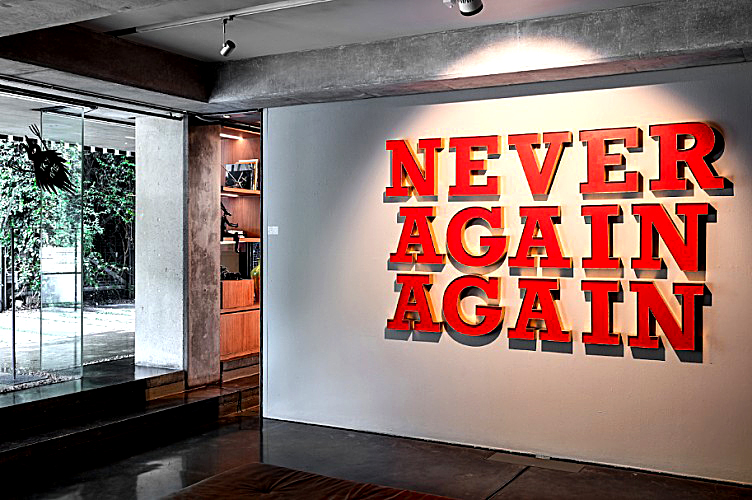
 The installation of Never Again Again by Brett Murray at Everard Read. (Photo: Everard Read)
I remember from when I was young, one Springbok Radio announcer saying, rather gleefully: “And that was Talk Talk, with their song ‘Talk Talk’, off the album Talk Talk.”
Something about the wilful absurdity of the sentence, combined with the repetition of the word and its sound, etched the moment into my memory. And it wasn’t just me: that became the way groups of friends referring to the seminal post-punk band’s early hit.
It was broadly appealing to think about a band joyfully creating confusion between its own identity and that of its output. And not to get too PostMod 101 about it, but singing a song about talking pretty much set the tone for the way Mark Hollis and company would operate from then on, gently mocking conventions and sidestepping expectations by doing subtly surprising things.
It was with this sort of gentle subversion that the show up at the Everard Read Gallery’s CIRCA space, titled WORDS, WORDS, WORDS, was curated.
It’s obviously not news that words form the cornerstone of many contemporary visual artists’ practices.
Since Dada in 1917 and the wonderful double entendre of Marcel Duchamp’s R. Mutt (a reference to J.L. Mott ironworks where Duchamp purchased the urinal, but also a play on the German “armut” meaning “poverty”), words have floated around the artsphere, nudging, directing and even cajoling us towards levels of understanding that pictures alone could no longer achieve.
For a time, the word was used in place of, and even as antagonist against, the image.
The conceptual artists of the 1960s picked at the image’s authority until, at the hands of Lawrence Weiner, Joseph Kosuth and Sol LeWitt, it unravelled completely. Eager to challenge the aesthetic art object’s usurpation of meaning, these artists deployed the word as thought, as proposition, as instruction, making it into the base unit of Conceptualism.
In this context, language also expressed an ascetic impulse: to deny oneself and the audience the image, and instead rely on evocation, became a radical new orthodoxy.
Conceptual art heralded a new dematerialisation, if you will, one of which the Byzantine painters would have been jealous.
So, it was something of a relief, I guess, when 80s and 90s titan Barbara Kruger began to play her inimitable (but often-mimicked) games with knockout text-and-image combos.
Kruger understood the magazine age (and prefigured the social media age by about four decades) – for the contemporary eye, image and text interloop, which play with each other, sometimes reinforcing and sometimes negating each other. Their symbiosis is complicated, and endlessly malleable for artists.
And this is wonderfully apparent on WORDS, WORDS, WORDS; as the curators state on the show’s wall text, “words are bent, repeated, fragmented, and reassembled” by the wide range of South African artists included in this exhibition.
/file/attachments/orphans/WillemBoshoffPlanetofEchinus2008Zebranoandbrailletextinescutcheonpins50cm_EverardRead_147369.jpeg "Willem Boshoff Planet of Echinus (2008), Zebrano and braille text in escutcheon pins, 50cm. (Photo: Everard Read)")
Willem Boshoff’s work Planet of Echinus, seemingly a reprisal of the ideas that informed his “Blind Alphabet” series, uses braille inset into beautifully textured wooden segments.
This strain of Boshoff’s work deals with the notion of privileging the sight-impaired within the visual art context, as sighted people would need to have the words translated and explained to them by someone fluent in braille. Boshoff’s approach reflects on the ways in which language includes and excludes, as he questions the normative power of text by problematising its decoding.
Luca Evans’ Joseph Kosuth did it first, a wood panel which shouts “FOUR WORD TEXT WORK” in marquetry, gestures to the seminal American artist’s “Four Colours Four Words”. The idea of riffing on Kosuth’s neon signage work by making art in a technology (wood inlay) that is thousands of years old, subtly questions 20th century art’s cult of newness.
In particular, I loved that the text in Evans’ image sloped downwards as it got to the fourth line: Western art’s self-serving narrative slipping, perhaps?
/file/attachments/orphans/LucaEvansJosephKosuthdiditfirst2024Kiaatmapleandsapeleonpine32x42cm_EverardRead_771467.jpeg "Luca Evans’ Joseph Kosuth did it first (2024), Kiaat, maple and sapele on pine, 32 x 42cm. (Image: Everard Read)")
/file/attachments/orphans/WayneBarkerHome2020Oilandneonondigitallyprintedcanvas120x120cm_EverardRead_786079.jpg "Wayne Barker Home (2020), Oil and neon on digitally printed canvas, 120 x 120cm. (Image: Everard Read)")
Wayne Barker, a stalwart of the Everard Read stable of artists and one of the OG enfants terribles of 90s South African art, is represented by two strong pieces, Home and La Vie.
Barker is possessed of both a sharp wit and a deft hand, and his polyglot works often utilise multiple visual languages. In Home, a sample of Pierneef’s “apartheid cubism” landscape painting jostles for position with an old movie star publicity shot, a small bird and the titular word “home”, with each letter in a different colour of neon (again alluding to Kosuth).
Barker’s willingness to literally rupture the painting surface with the visual language of capitalism (the neon sign is certainly synonymous with 1940s and 50s advertising) has the effect of wryly skewering some of white SA’s unspoken nostalgia for apartheid, while self-consciously reminding us that the painting is a product and the gallery is essentially a shop.
This is a thread picked up on by Lady Skollie, herself fast becoming one of the most important new voices in contemporary South African art.
Her work GOOD BUY, GOOD BUY, good buy is a large-scale crayon-and-ink drawing of the title phrase rendered on the undulating front of a plastic packet.
/file/attachments/orphans/LadySkollieGOODBUYGOODBUYgoodbuy2025CrayonandinkonFabriano1635x1495cm_EverardRead_672459.jpg "Lady Skollie, GOOD BUY, GOOD BUY, good buy (2025), Crayon and ink on Fabriano, 163.5 x 149.5cm. (Image: Everard Read)")
As Skollie stated in a recent Instagram reel, “with the current corporate boom of the art world, [this work] speaks of the money side of art, how commercial glory often limits the artistic practice by trapping the artist in a loop of creating what will sell – not always what we what to create. It catches the artist in a loop of trying to make what others would buy […] GOOD BUY, GOOD BUY, good buy also shows the transience of this concept; that an artist can disappear out of thin air and be discarded like a shopping bag. The shopping bag is a vessel to carry our purchases, but it’s often forgotten as soon as what is important is taken out of it, the same way an artist is discarded by the public once they’ve moved onto the next ‘biggest and best’ thing.”
This self-awareness of the artist also extends to the commercial gallery world, as financial pressures and the global downturn in sales possibly give gallerists and curators pause for thought.
An invigorating and important blast from the recent past is the inclusion of Brett Murray’s NEVER AGAIN AGAIN (2017), which dates from the middle of Jacob Zuma’s chaotic presidency (2009 to 2018). In 2019, current SA President Cyril Ramaphosa called this period our “nine lost years”.
/file/attachments/orphans/BrettMurrayNEVERAGAINAGAIN2017Metalpaintgoldleaf111x82cm_EverardRead_211255.jpeg "Brett Murray NEVER AGAIN AGAIN (2017), Metal, paint, gold leaf, 111 x 82cm. (Image: Everard Read)")
Murray’s work clearly recalls President Nelson Mandela’s optimistic declaration from 1994: “Never, never and never again shall it be that this beautiful land will again experience the oppression of one by another.”
As he is wont to do, Murray finds the slippages in language, or at least the moments when language doesn’t walk its own talk: the corruption during Zuma’s tenure undermined many of the democratic gains made by Mandela and Thabo Mbeki after him. Murray seems to be saying, rather sardonically, that we are indeed back again to where Mandela’s speech would have had us never return.
My only criticism here is not with the work but its curation: it should have been placed in CIRCA’s larger upstairs space, where it could function as the conceptual heartbeat of this show.
At the centre of the contemporary art project is often this exact interrogation of language as moral, political and social signifier; and in our post-truth reality, the nuanced accounting for the loss in meaning and understanding encapsulated by Murray’s work is surely one of the chief preoccupations of our age. This is all a bit diluted by the work being in the smaller, downstairs gallery.
Overall, it is interesting to see the Everard Read creating conceptually robust group shows with its complement of artists, and avoiding the “end of summer sale” approach, which sometimes befalls galleries without strong curatorial staff. I look forward to more in a similar vein. DM
WORDS, WORDS, WORDS is on exhibition at Everard Read until 2 May.
Comments
Scroll down to load comments...