



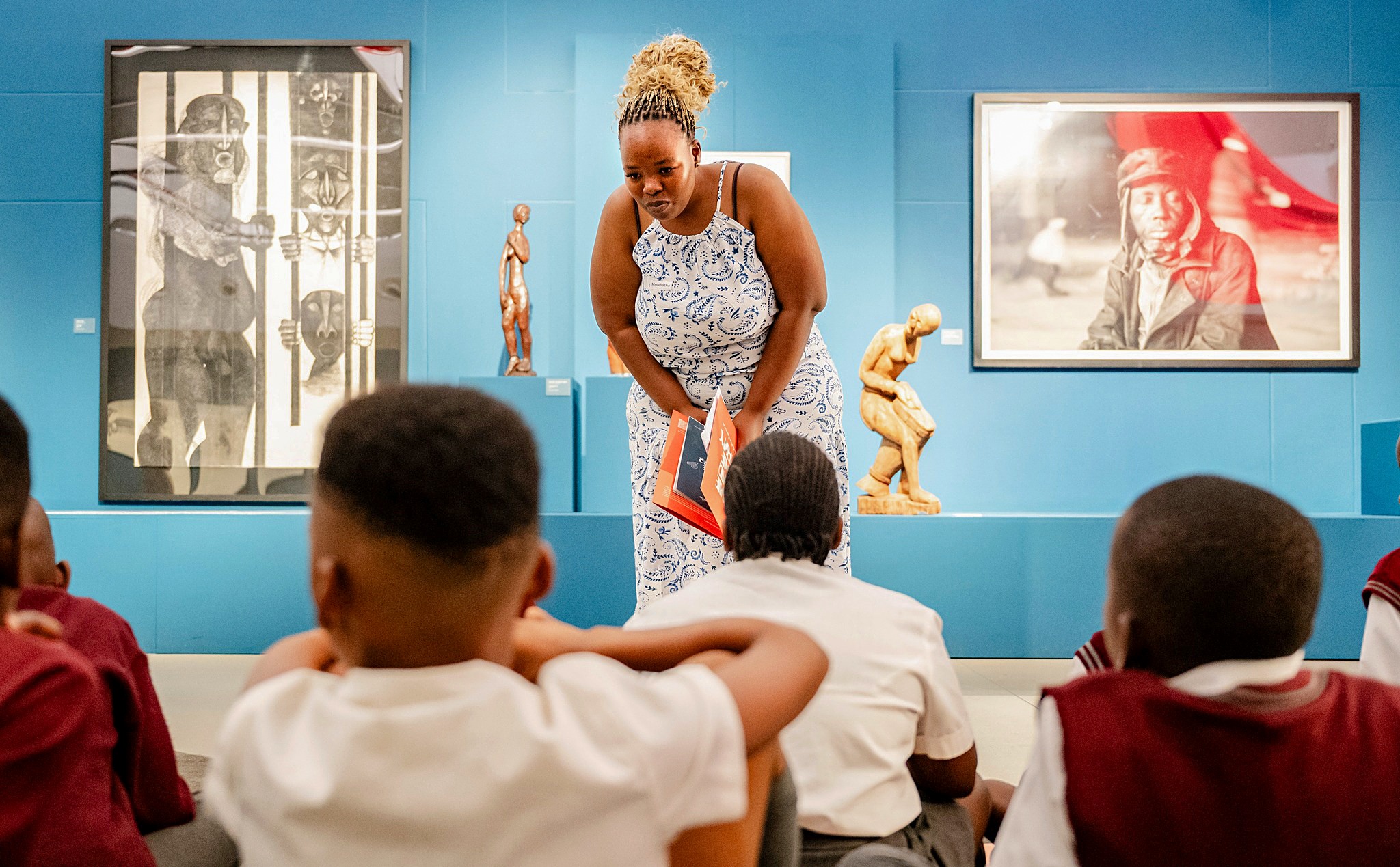
 A teacher uses the One and the Many resource guide to facilitate an interactive lesson inside the Javett-UP gallery, bringing the CAPS curriculum to life for learners directly in front of the artworks. (Photo: Javett Art Centre)
 Rather than a quiet vault for untouchable art, a creative space should be a classroom that breathes. This is the driving philosophy behind a new initiative launched by the Javett Art Centre at the University of Pretoria (Javett-UP) in collaboration with the university’s education faculty. Designed to meaningfully transform how art is taught from Grade 4 all the way to matric, the newly unveiled One and the Many resource guide is fully aligned with the South African Curriculum and Assessment Policy Statements (CAPS).
Instead of just reading about art theory, the guide brings those CAPS requirements to life inside a real-world exhibition. The project embraces a Living School methodology, which turns the gallery space into an interactive educational environment.
Dr Deléne Human, senior lecturer and visual art education coordinator at the University of Pretoria, explained that the resource guide is the culmination of a year-long collaboration that began in early 2025. The Javett-UP curatorial team worked alongside lecturers Human and Ulricke Nelson, and third-year Art Education (BEd) and Postgraduate Certificate in Education (PGCE) students, to develop innovative resources linked to the exhibition themes: The Altar, Fractured Forms and The Garden.
Human noted that the project was a hands-on endeavour for the university students. The future educators were tasked with translating complex exhibition themes into age-appropriate activities and lesson plans.
“We can then bring school learners into the gallery space and museum context, and they can use those pamphlets for the activities,” Human said.
/file/attachments/orphans/647336123_1241546641509126_8807839029831015586_n_158952.jpg "The physical resource guides not only serve as a gallery companion for learners but also fold out into posters for their classrooms. (Photo: Javett Art Centre)")
By bringing learners into this environment, the initiative offers an immersive experience that breaks the monotony of traditional schooling, allowing students to engage with art in its intended setting.
“The brochures even fold out to become posters. The idea is that teachers can take these back and use them as additional support material in the actual classroom spaces,” Human said.
The Altar: Sacred spaces and icons
The exhibition One and the Many explores how we connect as individuals to the world around us. Throughout the art centre, thematic groupings in the galleries propose new relationships among artists, artworks and historical art periods.
The first chapter, which serves as the heartbeat of the Living School, guides learners through the theme of spirituality and devotion.
/file/attachments/orphans/648101985_1241546691509121_5607041282988766744_n_374449.jpg "Learners get comfortable as they engage with the One and the Many resource guide in the immersive, quiet space of The Altar chapter. (Photo: Javett Art Centre)")
Puleng Plessie, the curator of education and public programmes at the Javett Art Centre, explained that The Altar immediately challenges learners to ask a central question: what makes something iconic or worthy of devotion?
Plessie added that The Altar can also challenge the traditional idea of what belongs on an altar by asking students to reconsider who and what we hold sacred. The exhibition includes photographer Santu Mofokeng’s portrait of his brother, Ishmael, titled Eyes-Wide-Shut, Motouleng Cave, Clarens (2004).
Fractured Forms: Abstract expression and identity
The next section, Fractured Forms, explores how artists use distortion, abstraction and fragmentation to convey deep emotional and spiritual complexity.
The resource guide outlines that these techniques are intrinsically tied to South Africa’s apartheid history. For many artists of the era, the violence and degradation they experienced were too profound or too dangerous for literal representation. Instead, they turned to non-figurative expressions to symbolically convey their reality.
Plessie said these abstract, fractured techniques provided apartheid-era artists with a profound sense of liberation. This section includes The Interrogators Series (1979) by Paul Stopforth, who used distortion to show how the apartheid system broke people down.
The Garden: Ecology, life cycles and connection
The final chapter of the Living School, The Garden, explores the complex human relationships to the natural world. This section immerses learners in the realities of ecology, life cycles and environmental responsibility.
“What the curator is trying to do is say, actually, there is no hierarchy. We all need each other,” Plessie said.
A piece used to illustrate this interconnectedness is Village Scene (Leeu), created by the Mapula Embroidery Project. Founded in 1991 in Winterveld, northwest of Pretoria, this collective empowers women artists to make a living by stitching the stories of their lives and communities into fabric.
Stepping out of the box
The difference between a standard classroom and an immersive exhibition is night and day, as student teachers Paige Clarke and Mandisa Mashabane highlighted.
“The four walls of a traditional classroom limit creative and critical thinking,” Mashabane said. She said that in an exhibition space, by contrast, learners are free to think creatively and can engage with the real artwork, an experience that simply cannot be replicated at a school desk.
Clarke agreed, pointing out that standard lessons can often feel rigid and limit a learner’s potential.
“In the exhibition space, there’s more opportunity for learners to interact with the artworks they are learning about, which allows for more meaningful lessons,” she said.
/file/attachments/orphans/647207172_1241546684842455_8375245786663963883_n_197077.jpg "Learners take in the exhibition while a teacher facilitates an active discussion, illustrating the Living School methodology. (Photo: Javett Art Centre)")
A major goal of the project was to ensure the exhibition’s complex themes connected directly to the lived realities of South African learners, no matter their background.
To achieve this, Clarke focused on universal concepts. “I focused on everyday experiences that all learners could relate to, such as their homes, their favourite animals and themselves. This helped the learners relate to the themes and see themselves in the artworks,” she said.
Mashabane said she prioritised inclusivity and representation by highlighting South African artists from varying cultural and social backgrounds.
“This representation helped learners relate to the content. I also created opportunities for discussions and reflection, where learners could share and compare perspectives,” she said.
Why visual studies is crucial in a digital age
Human said visual art education in South Africa remains a complex mix of opportunities and systemic hurdles.
While the current CAPS curriculum has strong conceptual goals, emphasising themes such as identity, gender and critical citizenship, Human noted that it is beginning to show its age.
Written more than 15 years ago, the framework remains largely rooted in a Western canon of art history. Furthermore, while its focus on visual culture is valuable, the curriculum often relies on broad, generic skills. For under-supported teachers, translating these vague guidelines into concrete classroom practice is incredibly difficult, resulting in a massive variation in the depth and quality of teaching across different schools. The subject of visual arts also battles marginalisation within the broader school system. While schools heavily prioritise STEM, art is often incorrectly dismissed as an “easy” subject, which negatively skews staffing and resource allocation.
Human said that in our rapidly changing, technology-driven world, art education is more crucial than ever.
“It is often believed that the subject is about learning to draw, paint, sculpt, but more than that, it is about developing vital life skills, such as critical thinking and problem solving,” she said.
To address these gaps, Human proposed a rethink of South Africa’s visual arts curriculum. She emphasised three crucial steps: investing in school infrastructure for hands-on art-making; elevating the subject’s status to recognise its role in building critical thinkers; and strengthening teacher training.
“I have immense hope for the subject. I believe that its importance will become prevalent as time goes on,” she said.
Schools interested in booking guided tours aligned to the CAPS curriculum, including customised educational resources, can contact bookings@javettup.com for further information. DM