




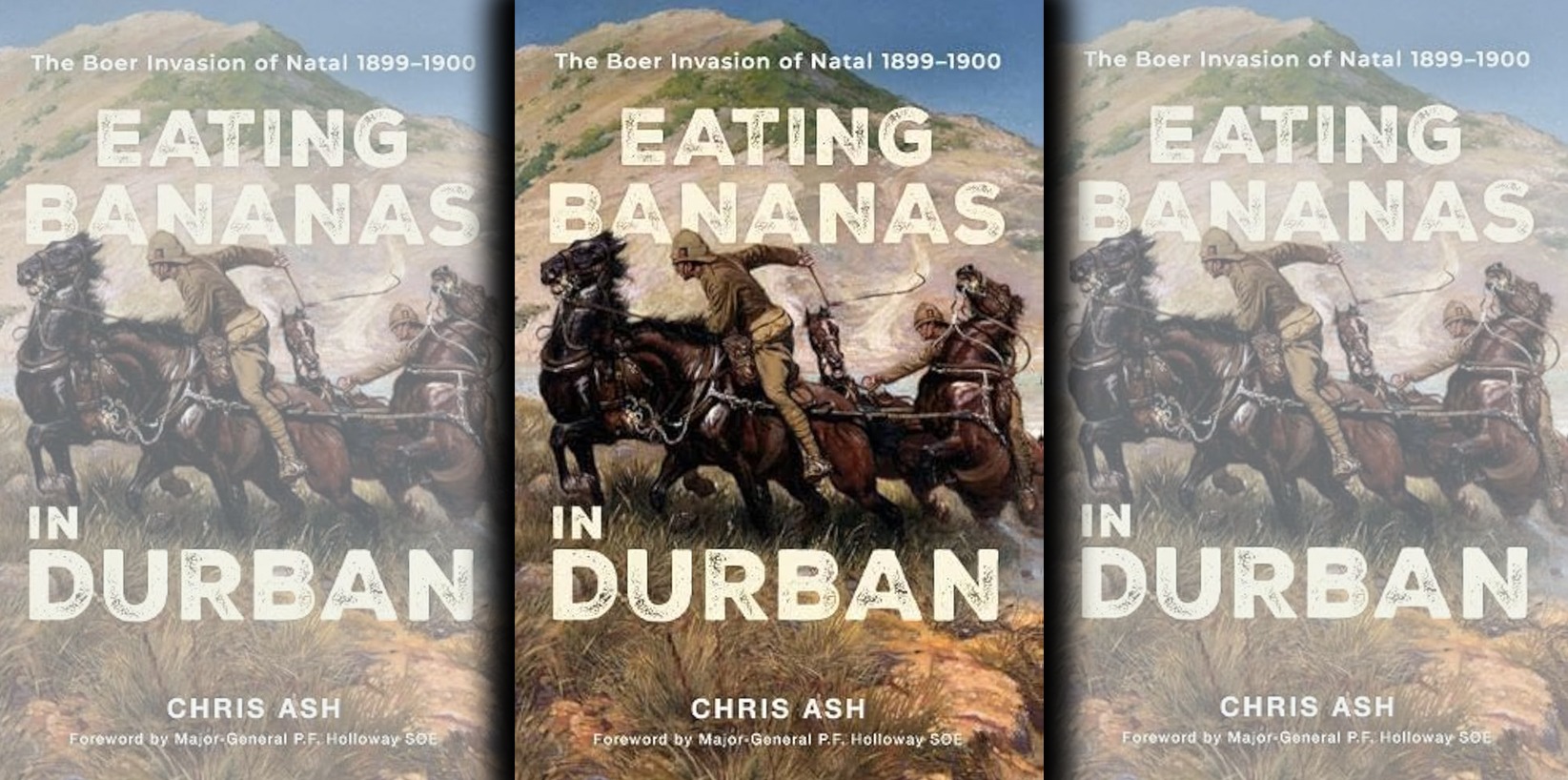
 (Photo: 30 Degrees South Publishers)
 The 1899-1902 South African War is no different. It is commonly accepted to have been, like World War 1, a bad war, fought for nefarious motives of British imperial expansion and that military action by Boer forces was entirely defensive.
This narrative has been sustained over the years from many sources. It was expedient for Britain to indulge a sympathetic version of events for the Boers after the war’s end when reconciliation to accommodate the new union was necessary. Much of the rest of the work has been carried by sympathetic historians and Afrikaner nationalists for whom the war was a source of grievance and nation-building.
But there are dissenting voices contesting this terrain.
The book Eating Bananas in Durban – the Boer Invasion of Natal 1899-1900, by historian Chris Ash, is one, bold, such contribution, challenging traditional narratives about the origin of the war and the course of events.
Its focus is on the invasion of Natal at the outset of the conflict in 1899, claiming that this was not entirely defensive, but fitted a broader, long-standing ambition to dominate more of southern Africa and bring new territory under Boer control. Holding Natal and the port of Durban would have fulfilled the objective of having an outlet to the sea aside from any defensive purpose.
Ash is clear that the Transvaal’s leaders would have been very content to hold Natal indefinitely and that this was a foreseen objective. The title is drawn from a comment by General Louis Botha, lamenting that it was only General Piet Joubert’s hesitation at Ladysmith that prevented him from coming to Durban “to eat bananas”.
As it was, northern Natal was annexed to the Transvaal and administered by its officials throughout the occupation. This does not look to have been temporary. Towns were renamed – Dundee became Meyersdorp and Newcastle was renamed Viljoensdorp, among others – and Boer settlers began staking out new farms. Had it succeeded, the history of the war and southern Africa would have unfolded very differently.
This densely researched text includes an exhaustive account of Natal’s origins and competitive, highly conflictual Boer and British interactions ever since the first British arrived in the 1820s. That includes the short-lived Natalia and Klip River republics before British suzerainty was finally resolved not long after the proclamation of a colony in 1843.
One of the myths rebutted is that Natal was stolen from the Boers, pointing to Boer encroachments into English territory that were consistently checked.
It provides further insights into the territorial ambitions of President Paul Kruger and the South African Republic as an expansionist state, something for which there is evidence in the chunks of new territory consistently added to it in the lead-up to the war.
For this claim, Ash refers to attributed comment from Kruger and others in the Transvaal government. Jan Smuts made the forthright statement that “whether we conquer or whether we die... that shall be from the Zambezi to Simon’s Bay, Africa for the Afrikcander”.
The French mercenary George Villebois-Mareuil, who had close access to Kruger and the most senior Boer generals, was clear that the war’s aims were “simply a matter of grabbing back the whole of South Africa from the British”. The similarly sympathetic Austrian war correspondent Adalbert Graf Sternberg wrote that Kruger himself definitely wanted Natal and Durban at the very least, and that others in his circle were prepared to go much further.
In a clash of nationalisms, Kruger and his followers are shown as determined to supplant British influence in southern Africa, an outcome Britain could hardly have been expected to accept. In Ash’s telling, it is the Transvaal’s intransigent abrogation of treaty obligations, territorial expansion and rejection of democratic rights for non-Dutch residents that are the causes of the war.
Here, Ash provides documentary evidence to back this position and is on reasonably strong ground in arguing that these sources have been customarily disregarded in accounts from more established historians. The British Army’s own official History of the War in South Africa, 1899-1902, in the first volume by Major-General Sir Frederick Maurice, came down clearly on the side of Britain as the wronged party that was dragged into war.
It was somewhat overshadowed by more sensational accounts at the time but is regarded to be meticulously researched and detailed.
The newly appointed Chief of the General Staff, General Neville Lyttelton, however, stated that in regard to the official history, nothing “should be done to impede… reconciliation”, that “any controversial points should be omitted” and that a “colourless narrative of events” be adopted. Historical accuracy, in other words, would be sacrificed to political expediency.
Unabashedly a protagonist of Britain and the reputations of soldiers and officers he believes have been unfairly compromised, Ash’s account is a polemic attempting to set the record straight.
As a well-researched piece of scholarship the text is effective and defendable on these grounds. At other times, and less effectively, the author betrays irritation and makes use of rhetorical flourish against opponents – something that has obviously come from lonely years of rebutting orthodoxy.
This book is a worthy counterargument, useful for interpreting this conflict. Those who do not accept these viewpoints will still find an engaging perspective on the war that will illuminate and entertain, providing fresh insights into events that still animate opinion more than a century later.
Readers will also find a lively narrative with a soldier’s own view of battles and the pivotal events that marked the progress of the war.
Revisionist history serves the purpose of discerning historical fact from evidentiary sources through research and inquiry to reveal new perspectives and truths. It is the essence of historical scholarship. This book delivers on all these counts. If a more mature and balanced approach to understanding this war results, then it will have served its purpose. DM
Eating Bananas in Durban – the Boer Invasion of Natal 1899-1900 by Chris Ash was published by 30 Degrees South Publishers in November 2025.