




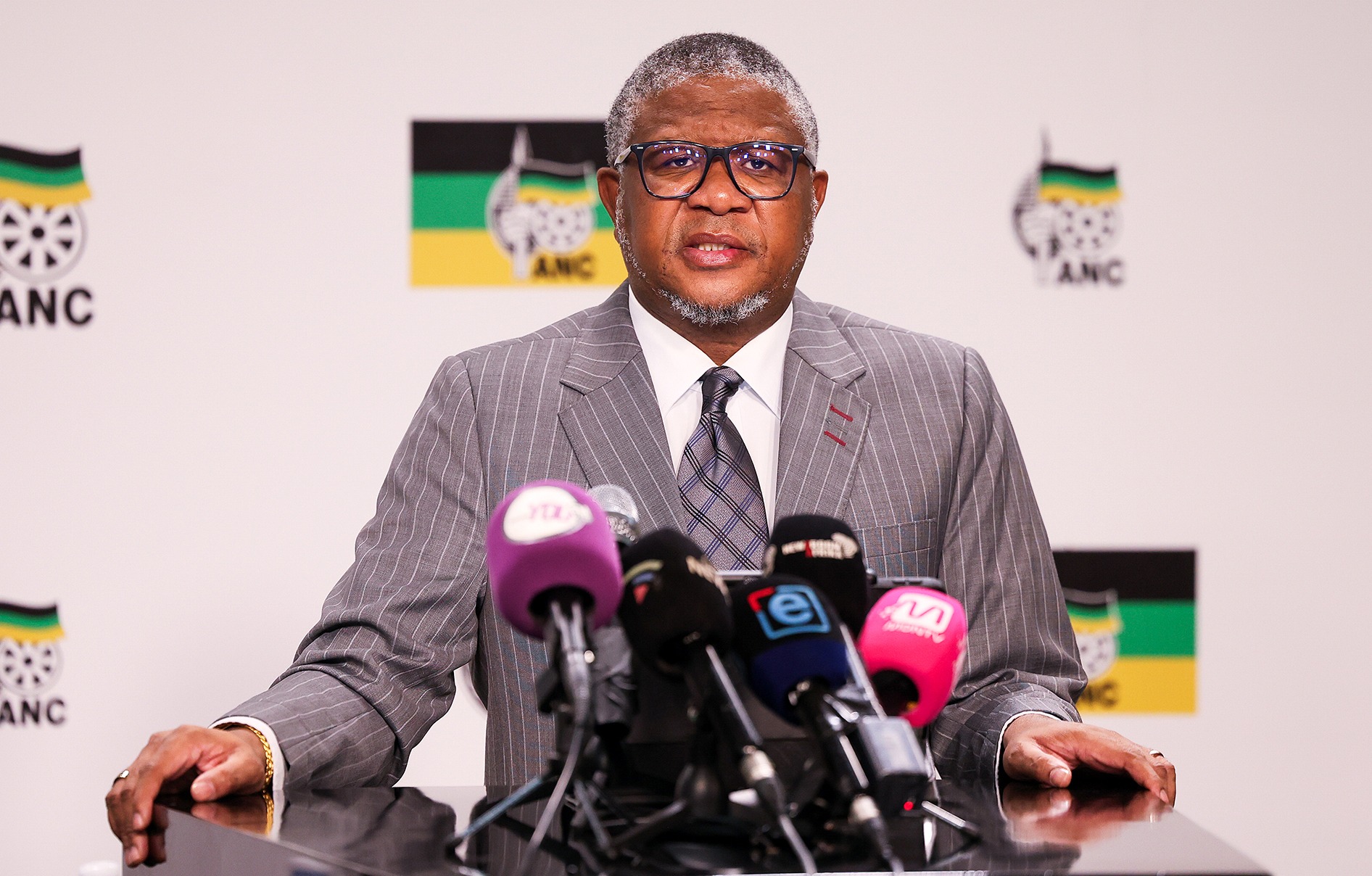
 ANC Secretary-General Fikile Mbalula speaks at a media briefing at Luthuli House on 23 April. (Photo: Lubabalo Lesolle / Gallo Images)
 The ANC has disputed allegations made by the South African Communist Party (SACP) that its 10-day ultimatum for members with dual membership amounts to a political witch hunt against communists in the party, stating that SACP members remain welcome within the party.
In a press conference at Luthuli House in Johannesburg on Thursday, 23 April, ANC Secretary-General Fikile Mbalula argued that the party’s decision to require members to submit in writing which party they will be campaigning under was a “practical matter”.
He added that the decision was made in accordance with the ANC constitution, which recognises dual membership and does not permit members to stand for election, campaign, or endorse a candidate in opposition to a candidate endorsed by the ANC.
“To ensure clarity, consistency and discipline across the movement, the NEC [National Executive Committee] has directed that all ANC members, including those serving in leadership structures and public office, must declare whether they will campaign for the ANC or any other political foundation. Failure to do so will be interpreted as a commitment to campaign for the ANC in accordance with the oath of membership,” said Mbalula.
He added that any member who did not declare in writing that they wished to run for the SACP before doing so would be subjected to disciplinary action, including removal from office if they are in local government, executive leadership, or a “position of influence”.
Mbalula emphasised that the decision was not made to undermine communists in the party but to provide clarity ahead of the election to avoid confusing voters. In particular, he pointed to decreasing voter turnouts and a desire to win an outright majority in the upcoming elections as one of the key motives for the decision.
The ANC first deputy secretary-general, Nomvula Mokonyane, said: “We must also think about members of the ANC who may be confused seeing the red caravan [SACP] at 6am and seeing the black, green, and gold truck [ANC] at four in the afternoon. You can’t be in both. Because remember, you are fishing in the same pool.”
/file/attachments/orphans/ED_605413_859341.jpg "The ANC first deputy secretary-general, Nomvula Mokonyane, during the ANC media briefing at Luthuli House on 23 April. (Photo: Lubabalo Lesolle / Gallo Images)")
The ANC saw significant declines in the 2021 local government elections, achieving 45.59% of the votes nationally, down from 53.91% in 2016. Of the eight metros, it only retained two, Buffalo City and Mangaung, with an outright majority. In the 2024 national election, the party dropped from 57.5% in 2019 to 40.18%.
‘Political deviations’
The SACP, ANC, and Congress of South African Trade Unions (Cosatu) make up the Tripartite Alliance, formed in 1990. But that alliance is seemingly at risk of fracturing, with the warning signs beginning in 2024 when the SACP took a decision to contest local government elections independently of the ANC.
In a press conference held at Cosatu House just hours before the ANC’s, the SACP general secretary, Solly Mapaila, argued that the decision to contest elections separately stemmed from ideological differences between the two organisations.
/file/attachments/orphans/ED_605341_529296.jpg "The SACP general secretary, Solly Mapaila, briefs the media at Cosatu House on 23 April. (Photo: Lubabalo Lesolle / Gallo Images)")
“Our decision to contest the forthcoming elections directly was not taken lightly, emotionally, or adventurously. It arose from a sober assessment of the crisis facing local government, among others, the weakening hold of the liberation movement over working-class communities, and the need to rebuild a direct, independent and accountable political presence of the working class in the terrain of governance and public representation,” he said.
Mapaila raised other points of contention, including “political deviations” on key issues regarding common ownership of land and wealth, declining voter turnout, and a drift towards neoliberal policies and corruption. The party has since instructed members not to “submit to intimidation and ultimatums” or make decisions or tender resignations without consulting it.
‘You can’t serve two bosses’
The bone of contention is that the SACP views the ANC directive as an “intimidation tirade” orchestrated by Mbalula to isolate, monitor and censure communists within the party.
Mapaila argued that this was supported by a lack of consultation between the ANC and the SACP before the announcement, adding that the ANC had not attended meetings organised between the two. The SACP argues that it kept the ANC informed of its decision to contest the elections, calling the ANC’s ultimatum a “one-sided demand with no reciprocation”.
This claim was disputed by Mbalula and Mokonyane, who called it “factually incorrect” and said they had met several times with the SACP over the issue and to discuss electoral outcomes.
The pair emphasised that they do not want the relationship between the two parties to become hostile. Both parties have prominent figures with dual membership, including Mineral and Petroleum Resources Minister Gwede Mantashe and Higher Education Minister Buti Manamela.
“Communists are part and parcel of the African National Congress,” said Mbalula. “But in the election campaign, which we are now getting into uncharted waters, you can't serve two bosses. You can’t stand for the Communist Party and stand for the ANC. You must make a choice.” DM