




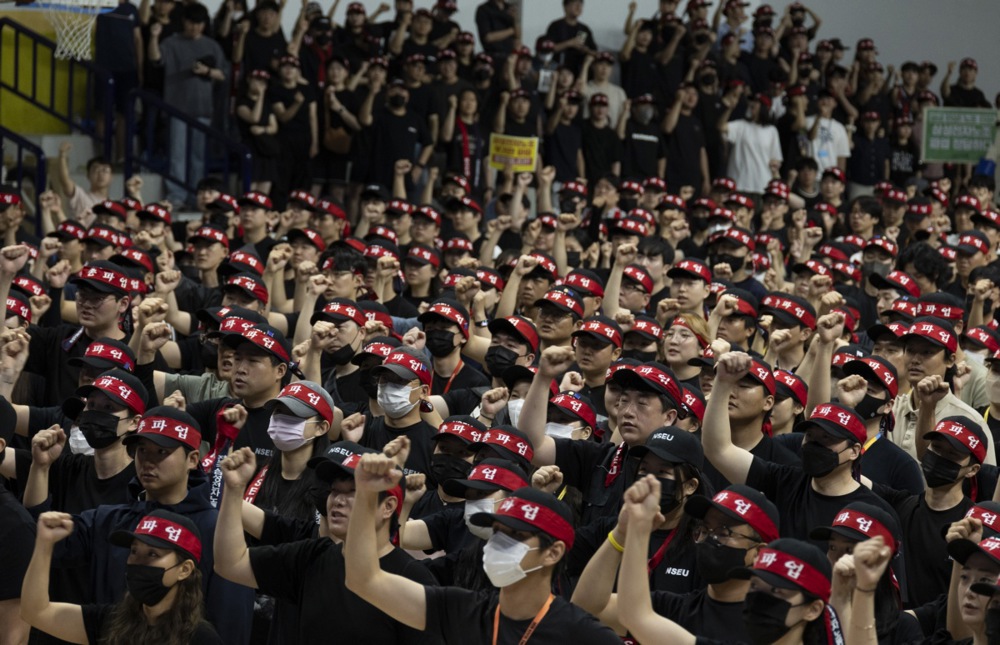
 Members of the National Samsung Electronics Union (NSEU) shout slogans during a rally outside the Giheung campus of Samsung in Giheung, Gyeonggi-do province, South Korea, 22 July 2024. The Samsung Electronics National Union (NSEU) has been on an 'indefinite general strike' from 10 July, to protest demands for improved working conditions and wage increases. EPA-EFE/JEON HEON-KYUN
By Hyunjoo Jin
The rally, to be held at Samsung's giant chip factory complex in Pyeongtaek, underscores growing labour risks facing the world's biggest chipmaker, which had long been largely immune from worker unrest that has affected other local companies, such as Hyundai Motor.
Samsung was previously known for its union-busting activities but saw workers walk out for the first time in 2024. Union membership has since tripled to more than 90,000, representing over 70% of its South Korean workforce of 125,000.
Workers have been emboldened by record profits at chip companies, as booming demand for AI infrastructure has stretched supply and driven prices higher.
Crosstown rival SK Hynix 000660.KS in September accepted its union's demand for compensation reforms and hefty bonuses, fueling Samsung employees' frustration over a pay gap and sparking a surge in union membership.
"The phenomenal growth in union memberships reflects a unified and urgent call among employees for change at Samsung Electronics," Choi Seung-ho, who leads Samsung's biggest union, said last week.
Choi said many workers had left for SK Hynix, while other rivals like Micron MU.O and even Tesla TSLA.O were wooing Samsung engineers. Samsung does not disclose employee turnover.
In March, Co-CEO Jun Young-hyun acknowledged that Samsung lagged its rivals in wage competitiveness due to sluggish chip earnings, but said the gap would narrow with a chip market recovery.
It remains unclear how many will join the rally. Samsung has warned of legal action should unions disrupt safety facilities that require more than 2,000 workers to operate.
A union member working at Samsung's IT support group said he had been bombarded with requests from colleagues seeking vests to wear at the rally.
If no deal is struck, unions plan to strike for 18 days from May 21.
Seo Ji-yong, a business administration professor at Sangmyung University, said a strike could delay shipments to customers, push up chip prices further and benefit rivals. Some experts, however, said factory automation and Samsung's use of subcontractors would mitigate the impact.
One of the most contentious issues is a union demand to scrap a cap on performance pay, currently set at 50% of annual base salary, which management has rejected.
The union is also seeking 15% of annual operating profit to be allocated as performance pay and a 7% hike in basic salaries.
Management has offered 10% of operating profit for performance pay and additional funding to ensure memory division employees receive higher payouts than competitors this year.
SK Hynix last year approved an overhaul, including the removal of the bonus cap, widening the pay gap with Samsung workers, unions said.
SK Hynix on Thursday posteda more than five-fold jump in first-quarter operating profit to a record high.
(Reporting by Hyunjoo Jin Editing by Ed Davies)
Comments
Scroll down to load comments...