




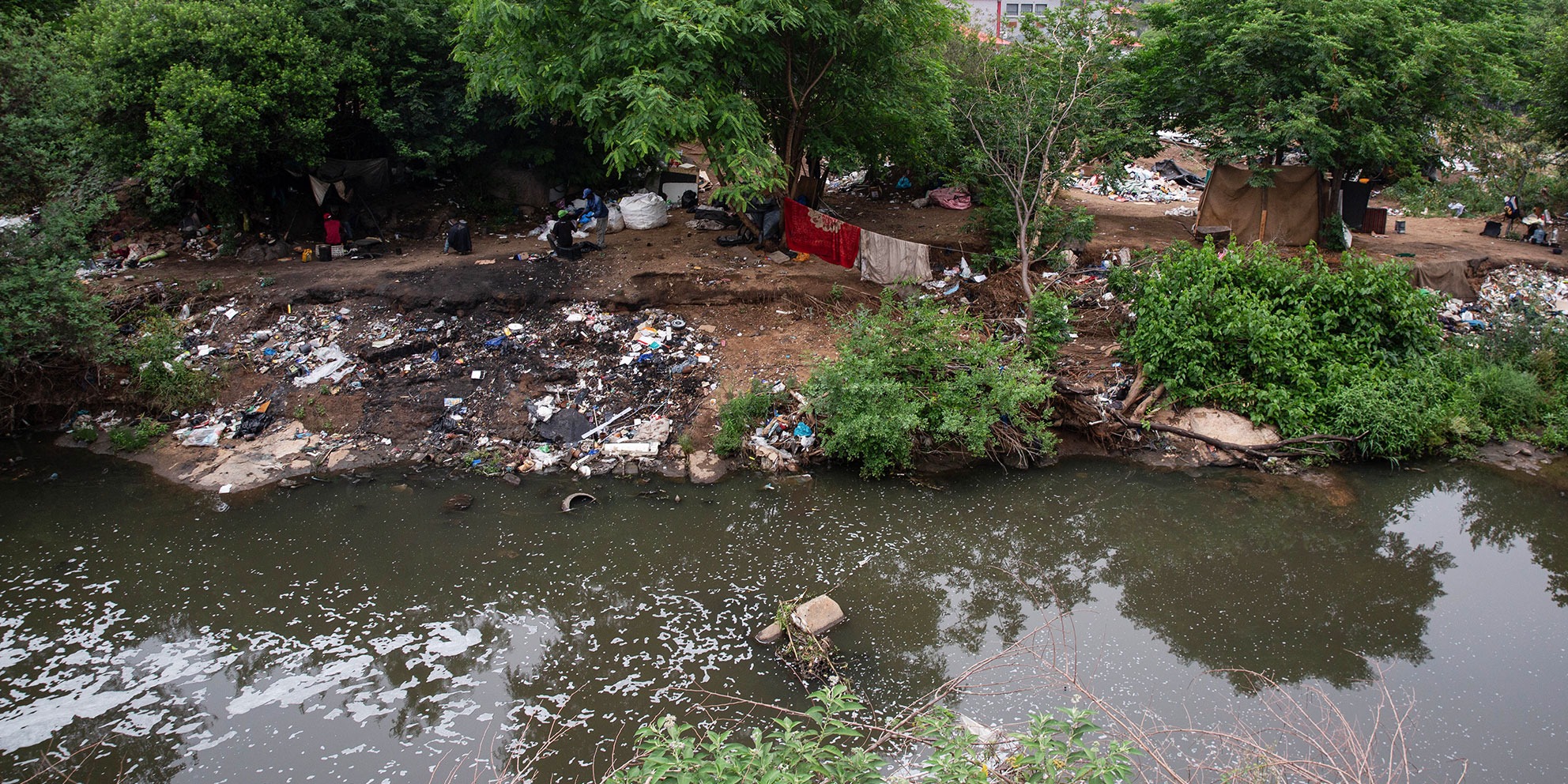
 Pollution in the Klein Jukskei River near Strijdom Park in Johannesburg on 29 October 2025. (Photo: James Oatway / Our City News)
 Johannesburg is at the centre of a worsening national crisis as polluted water and raw sewage continue to flood into South Africa’s primary waterways. The latest Green Drop Report from the Department of Water and Sanitation highlights a systemic collapse: the number of wastewater systems in a critical state has climbed to 396, up from 334 in the 2022 findings.
Councillor Ralf Bittkau (DA), who lives on the banks of the Klein Jukskei River in Randburg, frequently takes the City of Johannesburg to task for raw sewage spewing out of broken pipes or stormwater drains — a situation that ensures pollutants flow directly into the river.
It’s personal for him. Eight years ago, he contracted an E. coli infection after a boating trip on Hartbeespoort Dam, one of the most polluted water bodies in the country.
“The pollution into our rivers is out of control. I keep asking questions, and I am not getting answers. The latest readings show 200,000 to two million E. coli particles per 100ml test,” said Bittkau.
/file/attachments/orphans/Klein_Jukskei02a_181181.jpg "A blocked stormwater drain near the Klein Jukskei River in Johannesburg on 29 October 2025. (Photo: James Oatway / Our City News)")
Hugely elevated E. coli readings
According to international standards, 200 E. coli particles/100 ml is a high-level contamination finding for drinking water and a marginal-to-poor finding for recreational water. A reading above 200 means it is toxic for people and animals.
Bittkau’s numbers are borne out by numerous studies from 2018 to the present, which have found E. coli levels ranging from 1.5 to 13 million particles per 100ml in the city’s rivers.
In 2021, Johannesburg Water’s tests showed an E. coli count of more than 2 million particles/100 ml of water in the Jukskei. At the Cheetah bridge in Alexandra, E. coli levels of 2.4 million per 100ml were measured. In the Kaalspruit, one of the sources of the Hennops River, 52 million E. coli particles per 100ml were measured. These results have been measured by Johannesburg Water, WaterCAN and environmental action groups.
The 2025 Green Drop Report, released by Water and Sanitation Minister Pemmy Majodina, reported that only 66 wastewater systems throughout South Africa performed at excellent or good standards. It was 118 previously. The report highlighted deteriorating municipal wastewater performance, citing issues including poor maintenance, budgeting failures and incompetent staff.
Only 16 (1.6%) wastewater systems achieved a Green Drop score of more than 90%, qualifying for the prestigious Green Drop Certification. By comparison, in 2021, a total of 23 (2.3%) wastewater systems were awarded certification.
Municipal wastewater systems showed a marginal improvement in overall risk profile, decreasing from 70.1% (high risk) in 2021 to 66.6% (medium risk) in 2024. Of the 848 municipal systems assessed, 99 were classified as low risk, 293 as medium risk, 302 as high risk, and 154 as critical risk.
Three wastewater treatment plants did not meet regulatory standards.
The City of Johannesburg has six wastewater treatment works (WWTWs), which treat 1,043 million litres a day of sewage. Wastewater in the city is collected and reticulated through 11,956km of wastewater networks and 38 sewer pump stations. Three of these were disqualified by the Green Drop Report.
The Section 79 Johannesburg city council oversight committee recently expressed concern about the low compliance rate of the WWTWs, which, it said, threatened environmental integrity and public health.
The committee’s report noted total spill days of 318 over three months, attributing spillages at WWTWs to equipment failure, ageing infrastructure, vandalism, power outages and capacity limits during periods of high inflow.
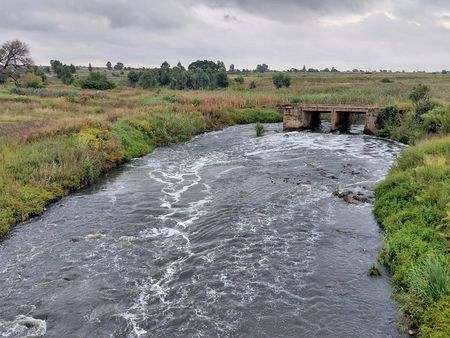
Johannesburg Water (JW) spokesperson Nombuso Shabalala said the entity’s primary plan of action centred on stabilising operations at the three WWTWs disqualified under the Green Drop Audit because of excessive spillages.
“These incidents stemmed from multiple factors, including design capacity constraints at Ennerdale WWTW, theft and vandalism at Olifantsvlei WWTW, and protracted procurement delays impeding essential repairs and maintenance at Northern Works WWTW,” she said.
“To address these profound operational challenges, recovery plans emphasise the exploration of decentralised infrastructure solutions alongside the urgent restoration of critical electromechanical equipment.
“JW is adopting an implementation agent model to expedite efficiency and execution, and we remain firmly committed to addressing these issues with urgency, with several key interventions already under way,” she said.
/file/attachments/orphans/Klein_Jukskei_04a_550795.jpg "Pollution in the Klein Jukskei River near Strijdom Park in Johannesburg on 29 October 2025. (Photo: James Oatway / Our City News)")
The Section 79 committee expressed concern that water quality testing showed unacceptable bacteriological levels across all three catchment areas in the city. Data from the 131-point monitoring network confirm that elevated E. coli levels are not isolated incidents but a systemic failure, affecting the majority of testing sites within the Jukskei, Klip, and Rietspruit catchments — a clear indicator of widespread sewage contamination.
The city’s Environment and Infrastructure Services Department is responsible for monitoring pollution levels in the rivers. Questions about the latest readings were sent to them, but no response had been received by the time of publication.
Systemic failures and underinvestment
Water management expert Professor Anja du Plessis gave a blunt assessment of the water quality in South Africa’s waterways.
“Our water sources can be described as dumping grounds for waste, effluent and other toxins. As supported by the Green Drop Report findings, municipalities are releasing untreated and/or partially treated wastewater from the wastewater treatment plants, right into the various rivers and streams, causing some rivers/ streams to become open sewers due to raw sewage continuously being deposited into these water sources.
“The municipalities are shooting themselves in the foot economically. The continued and increased pollution of our water sources means that the treating of water to drinkable standards becomes more expensive, contributing to increased tariffs.
“For example, continued dysfunctional wastewater treatment works polluting the Vaal Dam means that Rand Water has to budget for more chemicals to treat the water to the standard it needs to be, illustrating that continued pollution affects the whole water value chain in terms of overall cost,” said Du Plessis.
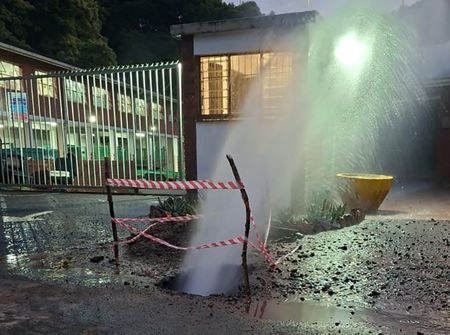
She said the pollution of riverways was a direct result of not investing in the maintenance and/or upgrading of wastewater systems, as well as other factors such as non-adherence to standard operating procedures.
Her message is clear: Raw water from rivers and streams should not be used under any circumstances for drinking and other domestic purposes.
“Water from these sources is simply not safe; it will make people sick.”
According to WaterCAN, the Green Drop Report confirms what communities have been saying for years. “The crisis is not new — what is new is the continued failure to act. Reports are being released, but where is the accountability?” said Dr Ferrial Adam, WaterCAN’s executive director.
“We are moving backwards, and that should alarm every South African. Fewer high-performing systems and more in critical condition is not a trend — it is a collapse. We cannot celebrate mediocrity while our rivers are being turned into sewage channels. A slight improvement in scores means nothing if wastewater is still spilling into communities and making people sick,” she said.
This story was produced by Our City News, a non-profit newsroom serving the people of Johannesburg.
/file/attachments/2985/WhatsAppImage2025-11-21at1946001_346702_1cea9e715c05dc0a538fc79753ac3401.jpeg)